We appreciate you taking the time to help America’s Health Rankings better understand our audiences. Your feedback will allow us to optimize our website and provide you with additional resources in the future. Thank you.
Please select one option which best describes your profession or field of expertise
Journalist or media professional
Health Policy Professional
Public health professional (state, local, or community level)
America’s Health Rankings Model Shows the Most Rural States Consistently Rank as Less Healthy
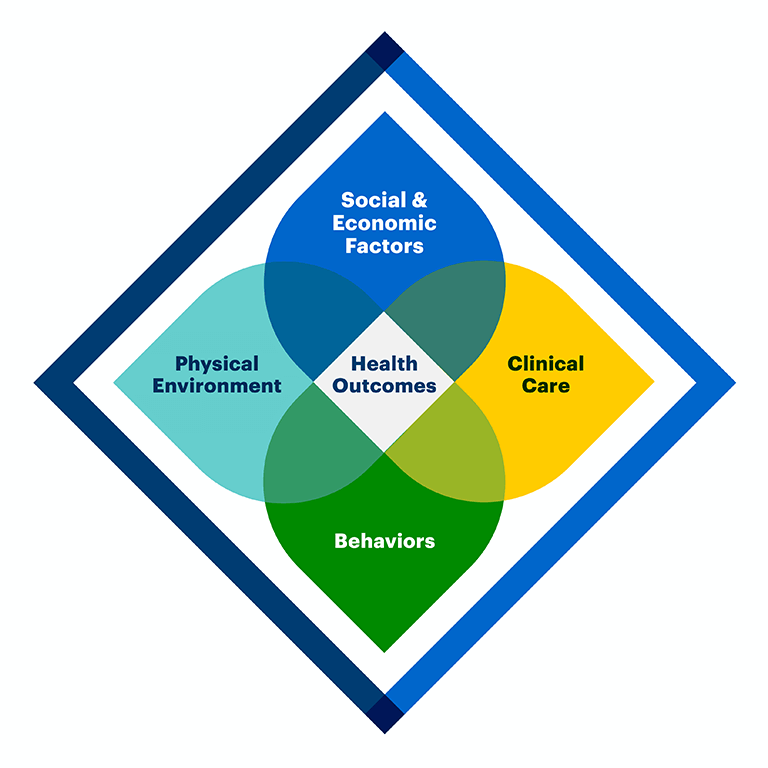
The America’s Health Rankings® model serves as a framework for identifying and quantifying health drivers and outcomes that impact population health. It aims to offer decision-makers and advocates a way to understand their state’s health — and to compare it with the health of other states and the nation overall. Leaders can look to the platform each year to assess their progress toward goals and drive conversations about emerging needs.
This model ranks states’ health based on scores in five categories: Behaviors, Clinical Care, Health Outcomes, Physical Environment and Social & Economic Factors. Each category is broken down into three to four topics, and each topic contains three to five measures.
For each category, a state is assigned a score — positive scores are associated with better health, and negative scores are associated with poorer health — based on its performance relative to the national average on each individual measure.*
Learn more about the individual measures and how they are incorporated into the model on the Explore Health Measures page.
The platform’s holistic understanding of health underscores how it is influenced by where a population lives and other factors. In particular, rural areas often face unique challenges, and the health of rural populations is affected by a complex mix of factors. Financial insecurity,
remote location, lower socioeconomic status and higher rates of unhealthy behaviors contribute to the measurable health disparities
between rural and urban populations.
This analysis compares the health of the nation’s 10 most and 10 least rural states using categories from the America’s Health Rankings model. Rurality is defined by the percentage of a state's population estimated to live in a rural area.**
10 Most Rural States in 2024 (percentage of state population estimated to live in a rural area)
10 Least Rural States in 2024 (percentage of state population estimated to live in a rural area)
The Overall ranking combines all five model categories into one measure of a state’s health compared with other states. Overall, in 2024, the most rural states had a less healthy average score (-0.10) than the least rural states (0.20).
The most rural states varied considerably in their Overall ranks:
Most Rural States (less healthy than the average)
Overall Score
Rank
Most Rural States (healthier than the average)
Overall Score
Rank
Mississippi
-0.936
49
Montana
0.053
25
Arkansas
-0.770
48
South Dakota
0.171
22
West Virginia
-0.683
46
Maine
0.495
12
Alabama
-0.599
45
Vermont
0.810
2
Kentucky
-0.360
41
New Hampshire
0.857
1
Health Outcomes
The Health Outcomes category directly measures the burden of disease and impacts on life expectancy and mental and physical health and well-being, and its measures include high blood pressure and frequent physical distress. These unique and varied challenges can complicate health outcomes; for example, compared with those living in urban areas, rural populations have a 23% higher mortality rate.
Out of all model categories, the largest difference in scores between the most and least rural states was in Health Outcomes.
The 10 most rural states, on average, had worse Health Outcomes (-0.23) scores compared with the 10 least rural states (0.29).
Three of the top 10 most rural states — Vermont (0.540), New Hampshire (0.535) and South Dakota (0.062) — scored better for Health Outcomes.
The Behaviors category represents practices that impact health and are influenced by individual, community, system and policy factors. It includes measures like smoking — a behavior that varies significantly by education, race, ethnicity and geography, and is more common in adults living in more rural areas compared with those living in less rural areas† — as well as exercise and insufficient sleep.
In 2024, the most rural states (-0.22) had an average score for Behaviors that was worse than that of the least rural states (0.27).
Behaviors category scores were highest for Vermont (1.177) and New Hampshire (1.040). Two of the other most rural states had positive Behaviors scores: Montana (0.457) and Maine (0.456).
The most rural states, on average, scored lower on Social and Economic Factors than the least rural states in 2024 — with notable variation among the most rural states:
The 10 most rural states (-0.12) scored lower, on average, than the 10 least rural states (0.20) in this category.
New Hampshire (0.998), Vermont (0.717), Maine (0.582), South Dakota (0.326) and Montana (0.104) all had positive scores.
Arkansas (-0.971), Mississippi (-0.971), West Virginia (-0.795), Kentucky (-0.602) and Alabama (-0.542) scored as less healthy than the national average.
Clinical Care
The Clinical Care category represents access to quality health care and preventive services and takes into account measures like childhood immunizations and preventable hospitalizations. Rurality can have an impact on clinical care, as geographic isolation and shortages in the health care workforce that make access to care
a very serious challenge for rural populations.
In 2024, there was little connection between a state’s proportion of rural population and its Clinical Care score:
The 10 most and least rural states had similar scores, on average, in the Clinical Care category (-0.02 and 0.05, respectively).
Vermont (1.193), New Hampshire (1.107), Maine (0.968) and South Dakota (0.207) scored healthier than the national average.
The 10 most rural states scored higher than the least rural states in the Physical Environment category, with a score healthier than the national average – a notable exception among other America’s Health Rankings model categories where more rural states were less healthy.
In 2024, the Physical Environment score for the 10 most rural states was 0.43, on average, while the average score for the least rural states was 0.03.
All 10 of the most rural states had positive scores for Physical Environment — Maine (0.833), South Dakota (0.807), Kentucky (0.500), New Hampshire (0.497), Vermont (0.457), Alabama (0.423), Arkansas (0.272), Montana (0.195), West Virginia (0.182) and Mississippi (0.138).
Learn More About Rural States with America’s Health Rankings
For Overall rankings and three of the five model categories, the nation’s 10 most rural states scored as less healthy than the least rural states. However, in the Physical Environment category, the most rural states were healthier than the least rural states. Notably, in 2024, two of the most rural states — New Hampshire and Vermont — scored healthier than the national average in all five categories.
The wide range of categories, factors and measures included in the America’s Health Rankings model can help monitor the health and well-being of rural and other populations across the country — and where those populations are experiencing progress, stagnation or worsening challenges over time.
Dive deeper into your state’s data on the America's Health Rankings platform, and explore which measures have positive and negative impacts in your state. To use these tools, hover over Explore Data on the top menu bar, select a state and scroll to view positive impacts, negative impacts and key measures.
State rankings are updated using the America’s Health Rankings model based on the latest data. Sign up here to receive new insights as they are released.
*Category scores are a weighted sum of the measure-level z-scores, which indicate the number of standard deviations a state value is above or below the national average. A z-score with the value of zero indicates a state has the same value as the nation. For more information, see Ranking Methodology.
**There are many ways to define rurality, and not all rural communities are alike. Rural population, or the percentage of the population that lives in rural areas, is measured and defined using the American Community Survey
(ACS) 2023 data.In this piece, data from the ACS are used to define the 10 most rural states and the 10 least rural states. For more information on data sources and methodology, see Our Model and Methodology.
2023 dataset, which classifies respondents by whether they live in nonmetropolitan or metropolitan areas. Nonmetropolitan includes micropolitan and noncore communities. In this section, adults living in nonmetropolitan areas as classified by BRFSS are referred to as “adults living in more rural areas,” while adults living in metropolitan areas are referred to as “adults living in less rural areas."