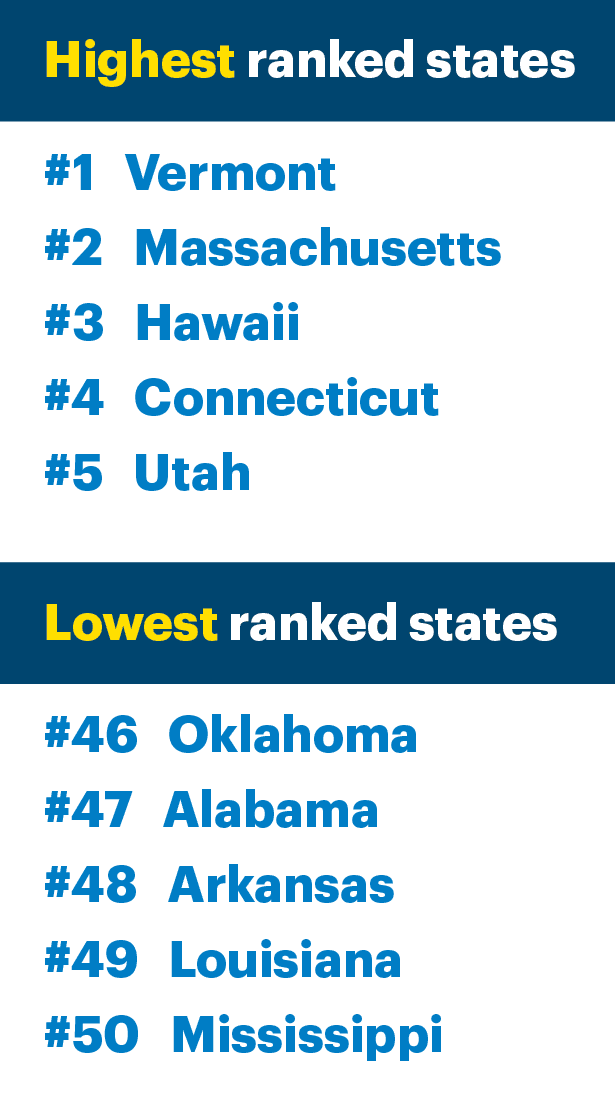
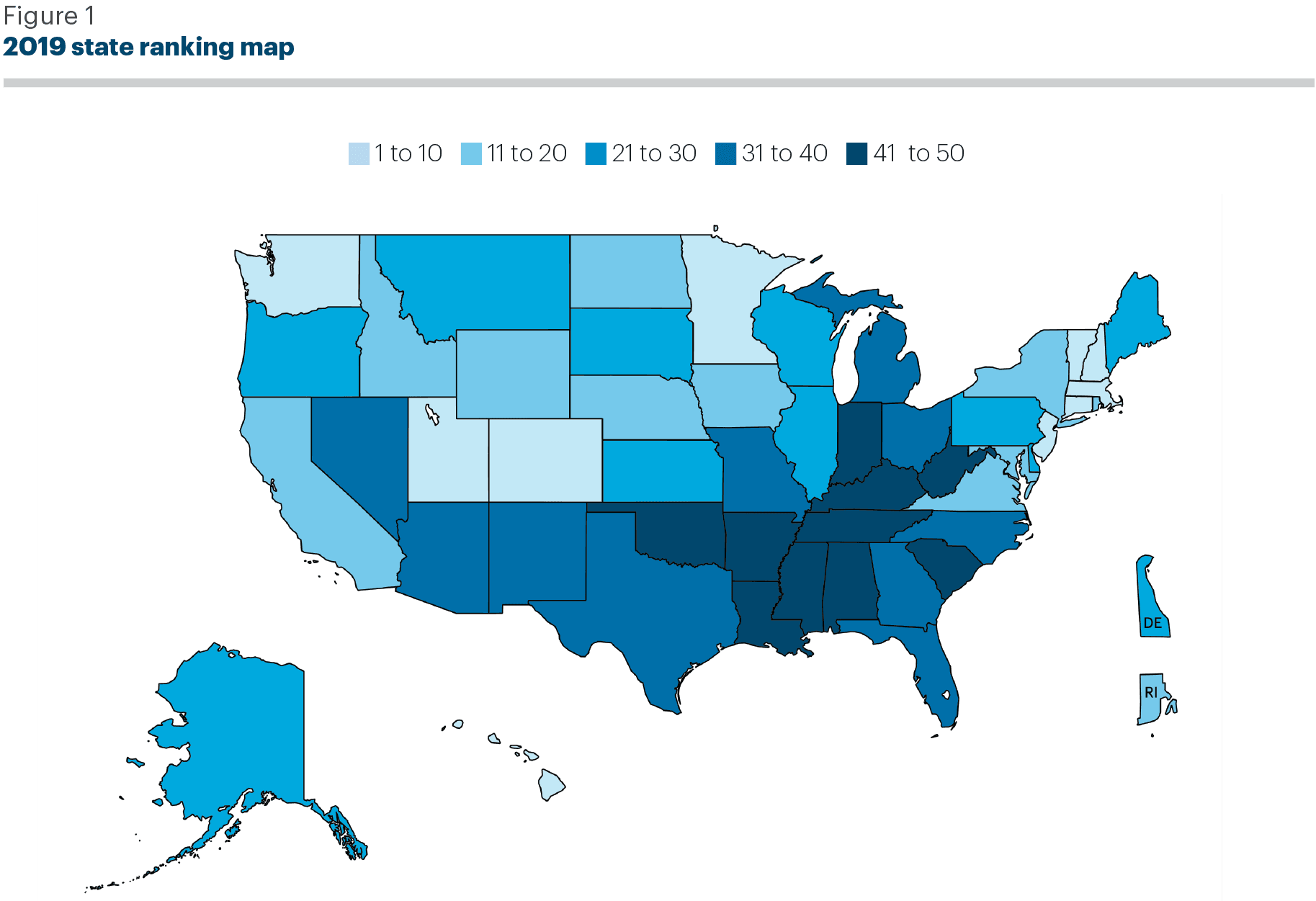
Figure 1 displays the 2019 rankings shaded by quintile. Three of the top five states are in the Northeast, with the addition of Hawaii and Utah. The bottom five states are in the South.
The states are ranked according to a score derived from 35 measures across five categories of health: behaviors, community & environment, policy, clinical care and outcomes . For a more detailed description of how the overall score is calculated, see
Rankings Methodology.
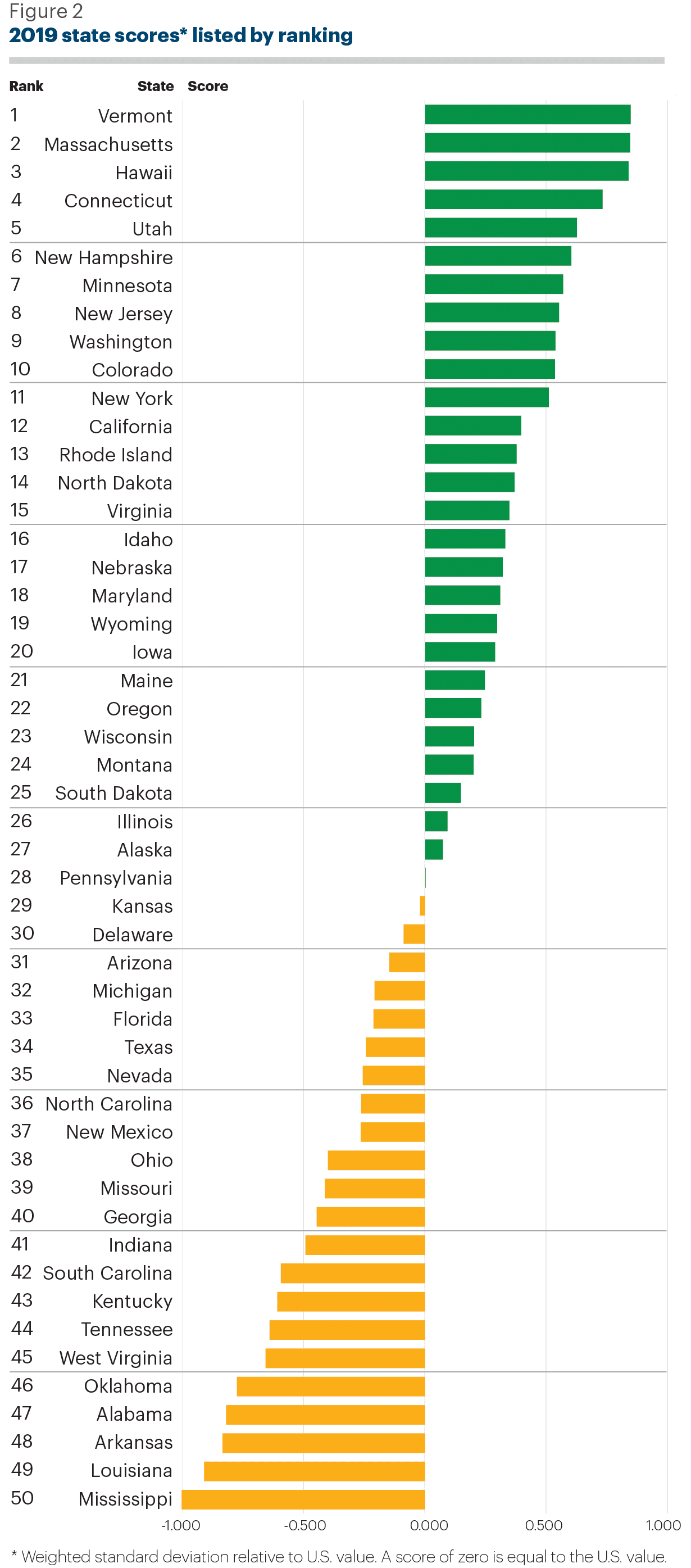
Figure 2 displays the states in order of rank. The green bars represent states scoring higher than the U.S. score (above zero), while gold bars represent states scoring lower than the U.S. score (below zero). The difference between length of bars indicate the difference between state scores. For example, New York (No. 11) and California (No. 12) have a large difference in score, making it difficult for California to move up in the rankings. There is also a large gap in score between Ohio (No. 38) and the next higher state, New Mexico (No. 37).
Vermont Moves To the Top Spot
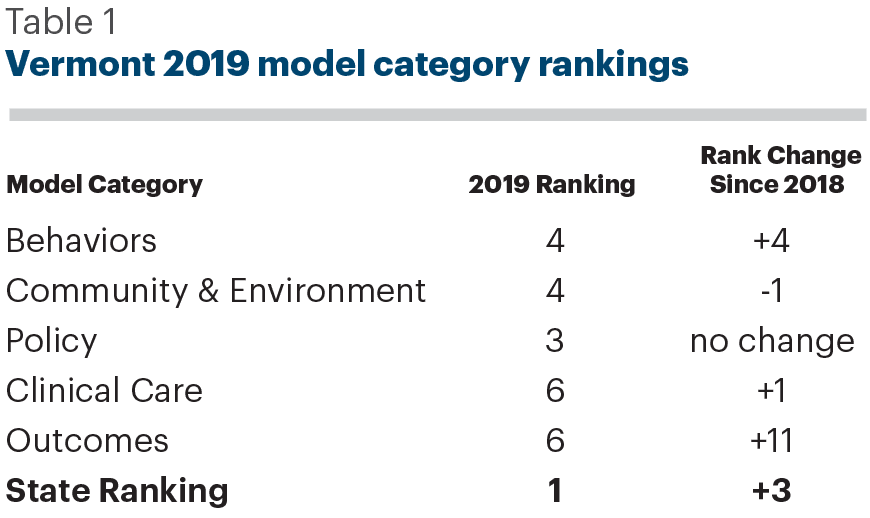
Vermont is the healthiest state in this year’s report, moving up three spots since last year. The state’s top rank is driven by substantial gains in the outcomes category, particularly for disparity in health status (+44 ranks) decreasing from 33.8% to 17.4% and frequent mental distress (+13 ranks) decreasing from 13.0% to 12.1%. Vermont also showed gains in the behaviors category, particularly for smoking (+9 ranks) decreasing from 15.8% to 13.7%. Vermont's large improvement in disparity in health status was driven by a large increase in the percentage of adults with less than a high school education who reported high health status (24.3% to 36.7%). Vermont now ranks in the top five across the behaviors, community & environment and policy categories (Table 1).
Strengths
- Low incidence of chlamydia at 297.9 cases per 100,000, compared with 524.6 cases per 100,000 nationally.
- Low violent crime rate at 172 offenses per 100,000, compared with 381 offenses per 100,000 nationally.
- Low percentage of uninsured population at 4.3%, compared with 8.8% nationally.
Challenges
- High incidence of pertussis at 17.3 cases per 100,000, compared with 5.8 cases per 100,000 nationally.
- High cancer death rate at 197.0 deaths per 100,000, compared with 189.3 deaths per 100,000 nationally.
- High occupational fatality rate at 4.8 deaths per 100,000, compared with 4.4 deaths per 100,000 nationally.
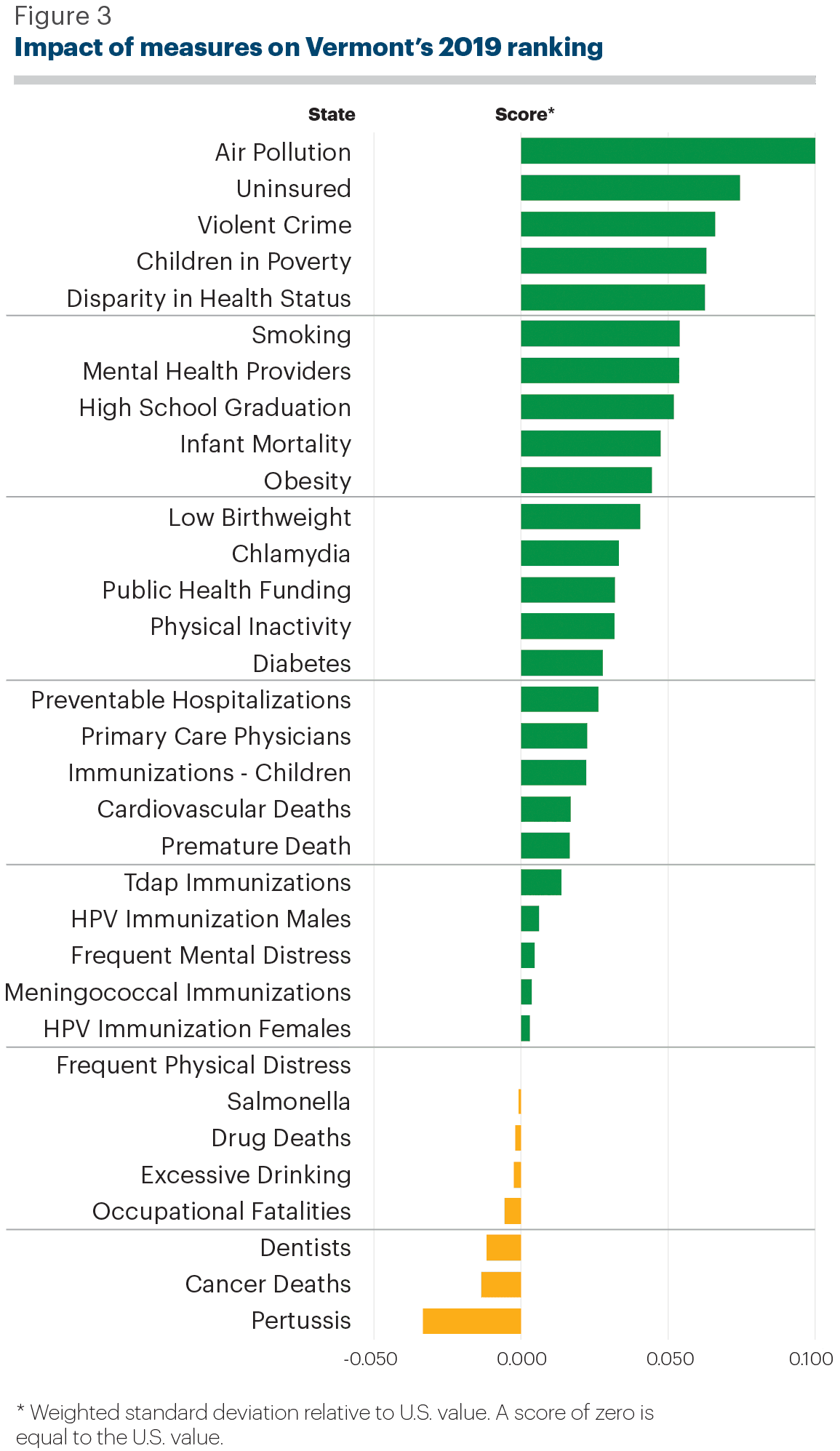
Figure 3 shows how the measures impact Vermont’s rank this year. The length of the bar represents the normalized measure value (standard deviation relative to the U.S. value) multiplied by the measure weight. Vermont outperforms the U.S. score in 25 measures (green bars) including air pollution, uninsured and violent crime. Vermont performs below the U.S. score in seven measures (gold bars) including pertussis, cancer deaths and dentists.
Mississippi Drops To the Bottom Spot
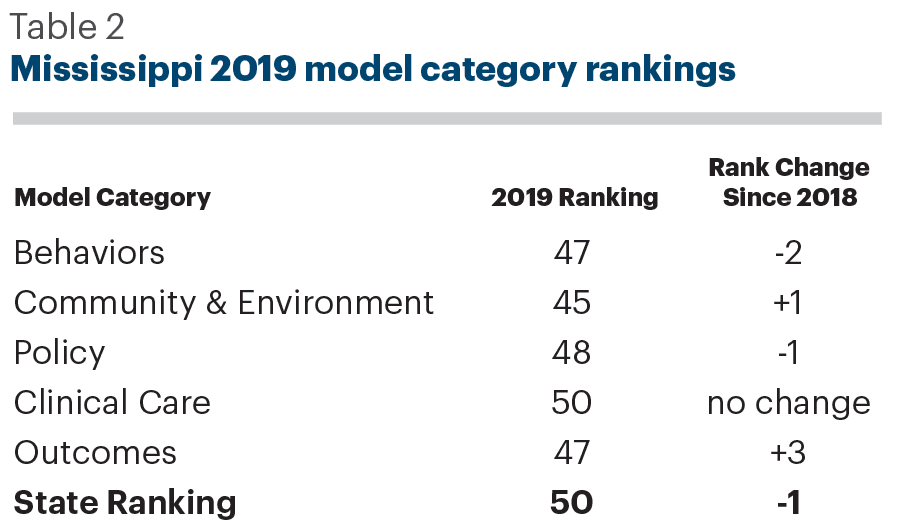
Mississippi is No. 50, falling one spot since last year. The state’s bottom rank is driven by drops in the policy and the behaviors categories. Mississippi’s behaviors ranking decline was a result of Ohio and Alaska, ranked near Mississippi, experiencing larger improvements than Mississippi across various behaviors measures. Mississippi ranks in the bottom six across all model categories (Table 2).
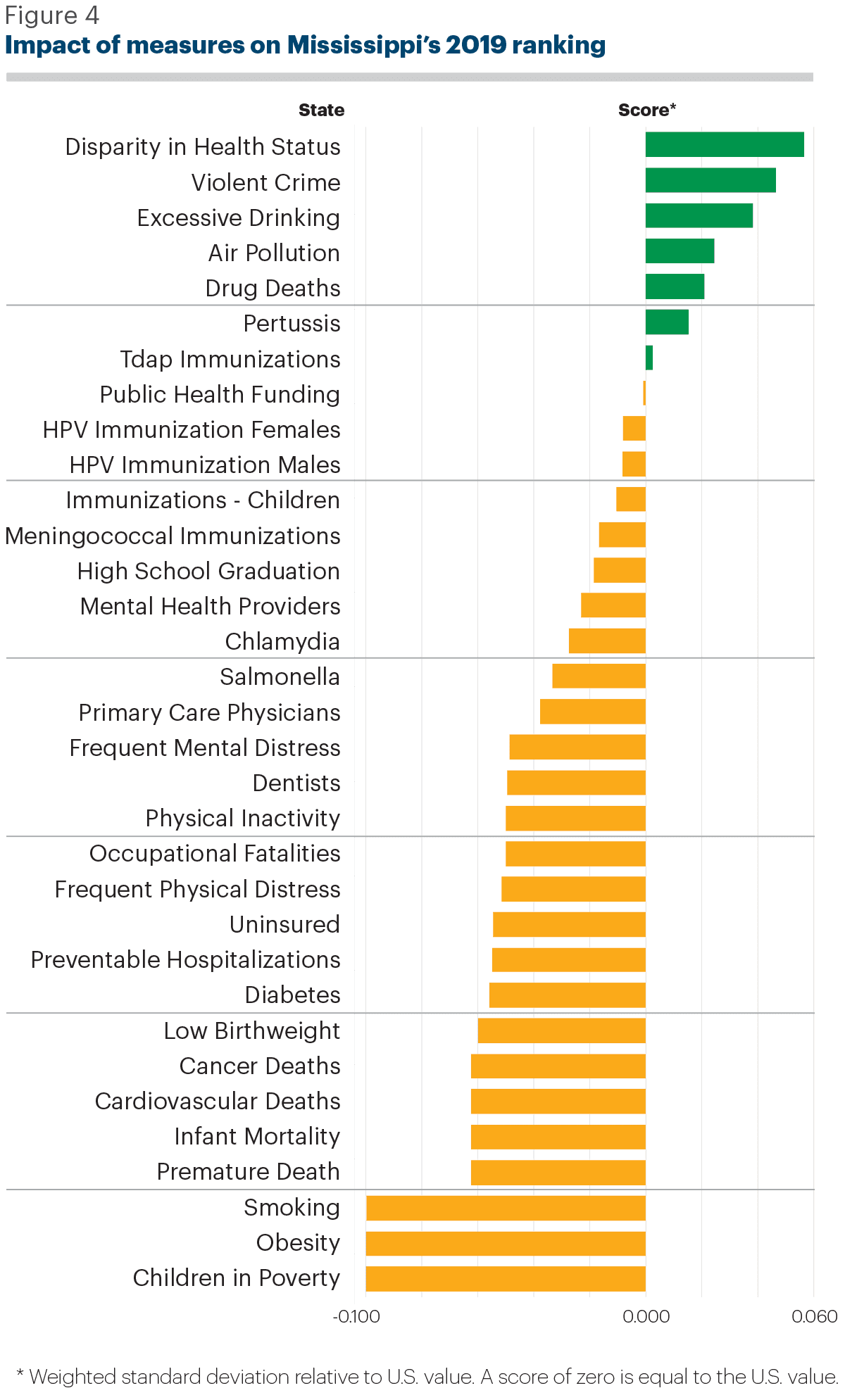
Figure 4 displays how the measures impact Mississippi’s rank this year. Mississippi outperforms the U.S. score in eight measures (green bars), including disparity in health status, violent crime and excessive drinking. Mississippi falls short of the U.S. score in 25 measures (gold bars), including children in poverty, obesity and smoking.
Strengths
- Low prevalence of excessive drinking at 13.8%, compared with 18.2% nationally.
- Low disparity in health status at 18.8%, compared with 27.6% nationally
- Low drug death rate at 12.1 deaths per 100,000, compared with 19.2 deaths per 100,000 nationally.
Challenges
- High infant mortality rate at 8.6 deaths per 1,000 live births, compared with 5.8 deaths per 1,000 live births nationally.
- High prevalence of obesity at 39.5%, compared with 30.9% nationally.
- High cardiovascular death rate at 363.2 deaths per 100,000, compared with 260.4 deaths per 100,000 nationally.
Largest changes in state ranking
Improvements
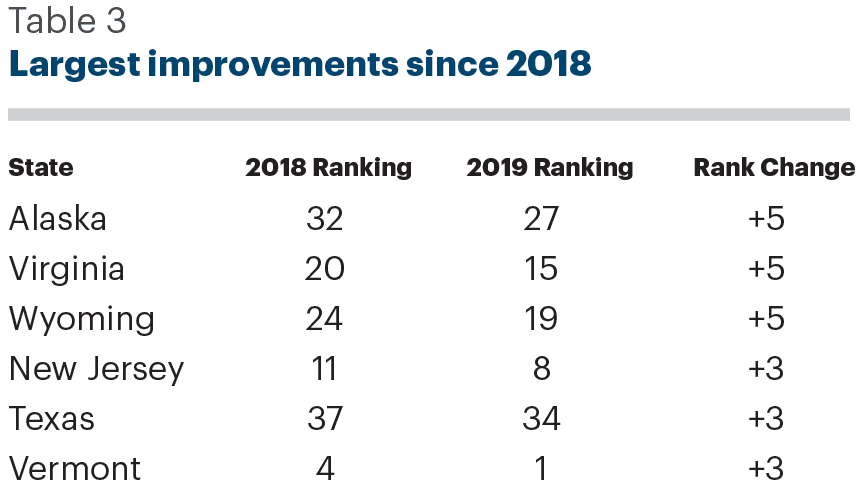
Alaska,
Virginia and
Wyoming made the largest improvements in the ranking since 2018, all rising five spots (Table 3).
Alaska’s improvement was driven by gains in the behaviors category (+9 ranks), particularly for obesity (+27) decreasing from 34.2% to 29.5% and excessive drinking (+19) decreasing from 21.3% to 17.7%. Also a factor was an advance in the community & environment category (+7), particularly for air pollution (+12) decreasing from 7.4 to 6.4 micrograms per cubic meter.
Virginia’s improvement was driven by advances in the outcomes category (+4 ranks) particularly for disparity in health status (+21) decreasing from 33.3% to 26.2%, and the behaviors category (+3), especially for physical inactivity (+13) significantly declining from 25.9% to 22.0%.
Wyoming’s rise was driven by gains in the behaviors category (+12 ranks), particularly for high school graduation increasing from 80.0% to 86.2% and physical inactivity significantly decreasing from 25.7% to 21.7% (both +14). Gains were also made in the policy category (+4), notably for HPV immunization among females (+25).
Declines
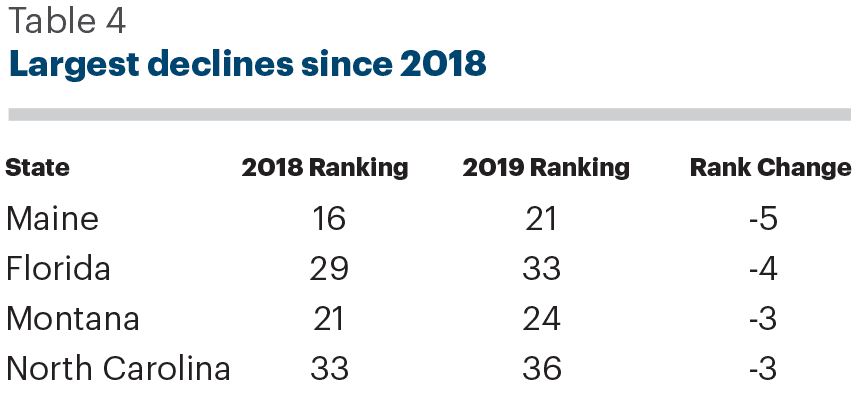
Maine and
Florida experienced the largest declines, dropping five and four ranks, respectively (Table 4).
Maine’s decline was driven by drops in the behaviors category (-9 ranks), particularly for obesity (-5) increasing from 29.1% to 30.4%, drug deaths significantly increasing from 21.6 to 27.0 deaths per 100,000 and smoking increasing from 17.3% to 17.8% (both -4), and the policy category (-5), especially for children in poverty (-10) significantly increasing from 13.1% to 14.5%.
Florida’s dip was driven by declines in the outcomes category (-7 ranks), particularly for disparity in health status (-19) increasing from 24.8% to 27.2% and diabetes (-17) significantly increasing from 10.5% to 12.6%. Florida also dropped in the community & environment category (-4), notably for air pollution (-9) increasing 7.1 to 7.4 micrograms per cubic meter.
Since the first Annual Report in 1990
Improvements
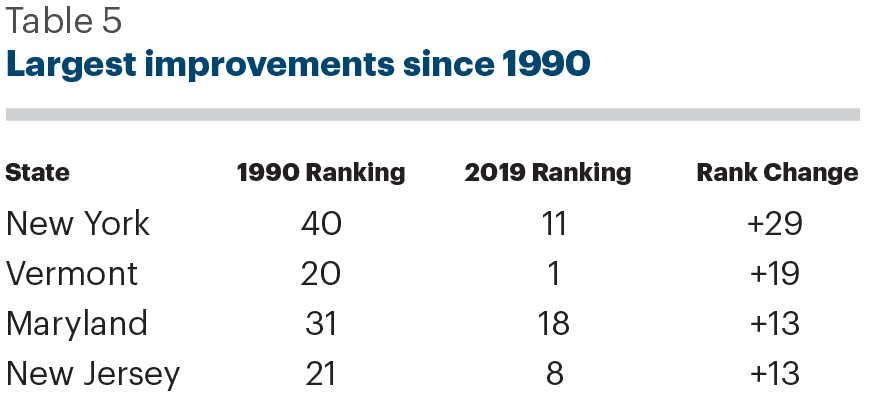
New York made the largest improvement in the rankings since 1990, rising 29 ranks, followed by
Vermont at +19 (Table 5).
New York’s improvement was driven by improvements in premature death (+42 ranks) dropping from 9,754to 5,830 years lost before age 75 per 100,000 population, infant mortality (+28) declining from 10.7 to 4.5 deaths per 1,000 live births, violent crime dropping from 1007 to 351 offenses per 100,000 and cancer deaths declining from 205.6 to 176.4 deaths per 100,000 (both +23).
Vermont’s improvement was the result of decreases in smoking (+21 ranks) from 30.7% to 13.7%, uninsured (+17) from 10.7% to 4.3%, infant mortality (+11) from 9.2 to 4.0 deaths per 1,000 live births and cardiovascular deaths (+7) from 390.4 to 238.7 deaths per 100,000.
Declines
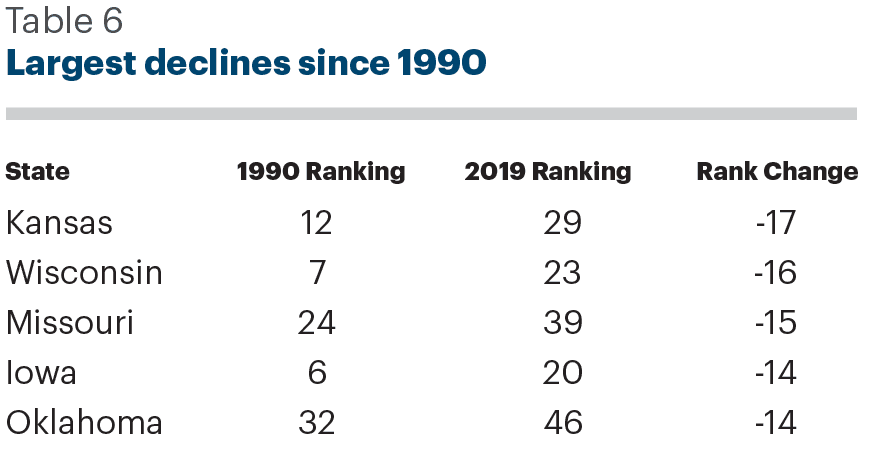
Kansas,
Wisconsin and
Missouri experienced the largest declines, dropping 17, 16 and 15 ranks, respectively (Table 6).
Kansas’ decline was driven by cancer deaths (-20 ranks) increasing from 180.2 to 194.7 deaths per 100,000. Kansas’ rank was also impacted by relatively small improvements compared with other states in uninsured (-19 ranks, decreasing from 9.0% to 8.8%), high school graduation (-16 ranks, increased from 84.1% to 86.5%) and cardiovascular deaths ( -16 ranks, decreased from 361.0 to 261.8 deaths per 100,000).
Wisconsin’s drop was due to an increase in violent crime (-10 ranks, increasing from 250 to 295 offenses per 100,000) and relatively small improvements compared with other states in infant mortality (-25 ranks, decreased from 8.9 to 6.4 deaths per 1,000 live births) and smoking (-20 ranks, declined from 26.3% to 16.4%).
Missouri’s drop was the result of relatively small declines in smoking (-30 ranks, decreasing from 27.7% to 19.4%), occupational fatalities (-21 ranks, declining from 6.0 to 4.7 deaths per 100,000 workers) and cardiovascular deaths ( -12 ranks, decreasing from 399.0 to 295.3 deaths per 100,000) compared with other states. In addition, cancer death rates went up during this time (-15 ranks) from 198.2 to 206.3 deaths per 100,000.
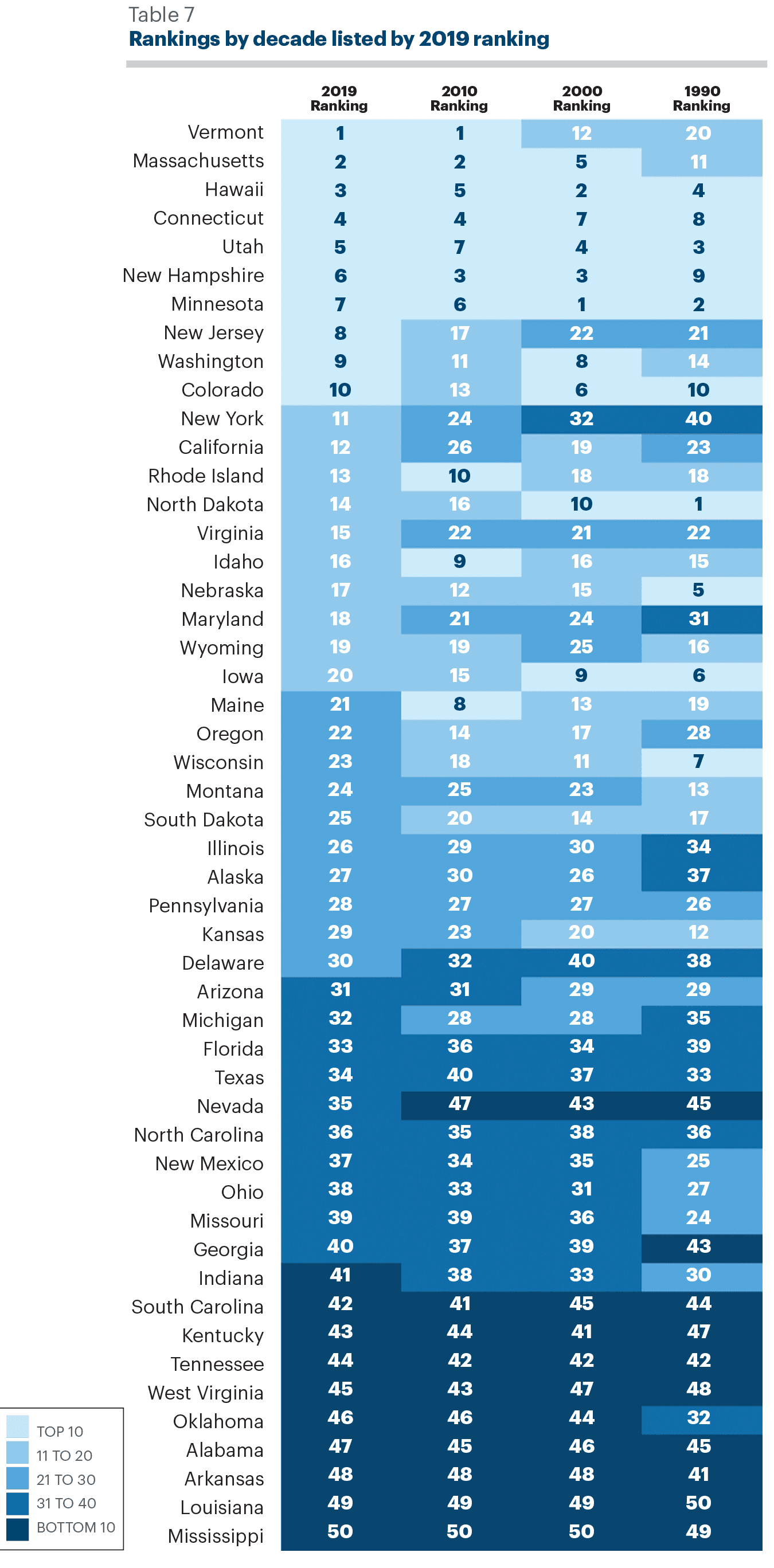
Table 7 shows the state rankings shaded by quintile at 10-year increments from the first
Annual Report in 1990. Of states in the top 10 today, five were in the top 10 in 2010, 2000 and 1990; this includes
Hawaii (No. 3),
Connecticut (No. 4),
Utah (No. 5),
New Hampshire (No. 6), and
Minnesota (No. 7). Of the bottom 10 states today, eight were in the bottom 10 in 2010, 2000 and 1990; this includes
South Carolina (No. 42),
Kentucky (No. 43),
Tennessee (No. 44),
West Virginia (No. 45),
Alabama (No. 47),
Arkansas (No. 48),
Louisiana (No. 49) and
Mississippi (No. 50).
Nevada (No. 35) moved out of the bottom 10 in 2011 and has remained out of the bottom 10 since.
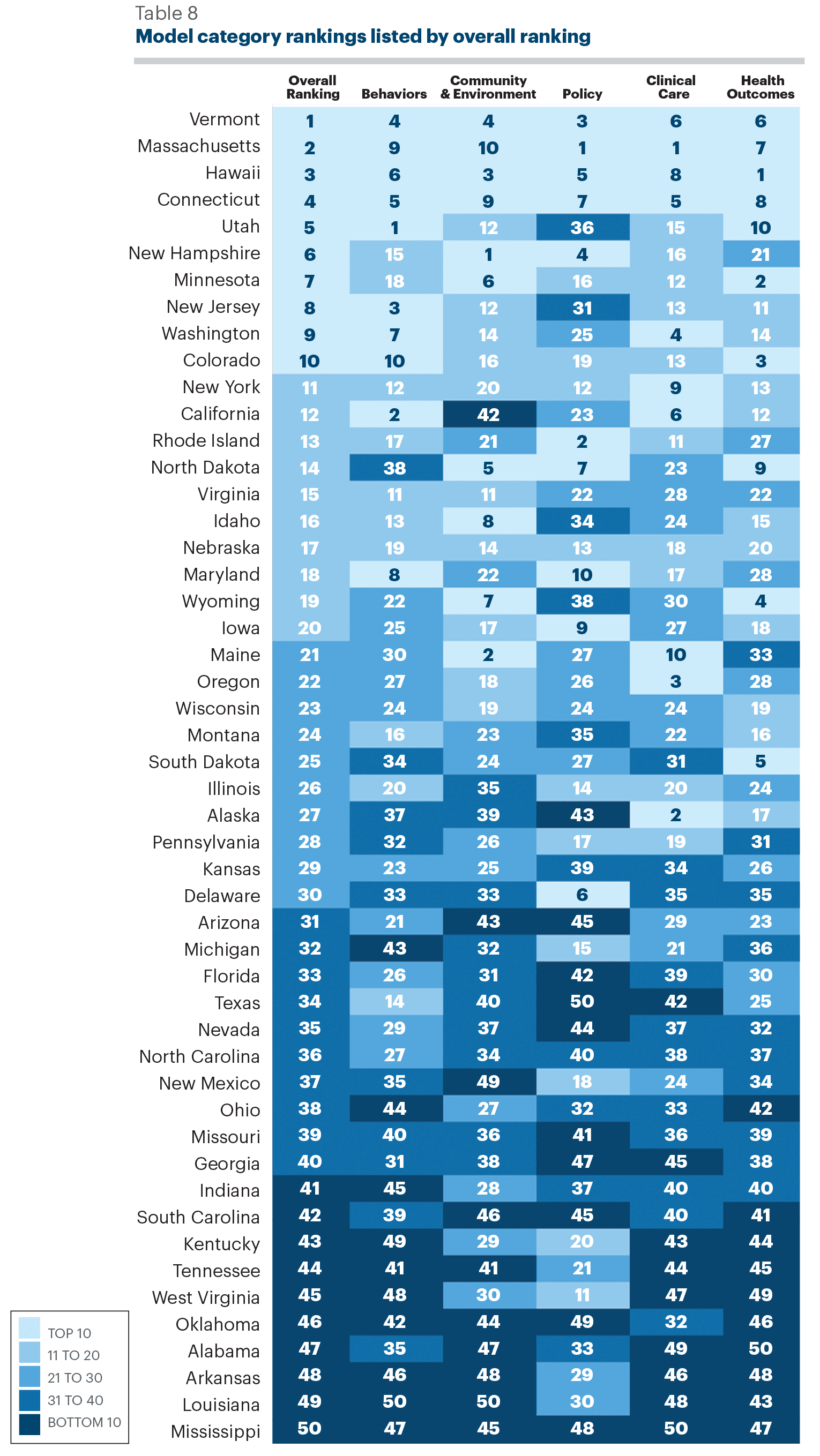
When examining model categories separately, variations emerge in the ranking within many states. Table 8 displays the five model categories sorted by overall rank and shaded by quintile. Six states are consistent across all five model categories.
Vermont (No. 1),
Massachusetts (No. 2),
Hawaii (No. 3) and
Connecticut (No. 4) rank in the first quintile (i.e., top 10 states), while
Nebraska (No. 17) ranks in the second quintile and
Mississippi (No. 50) in the fifth quintile (i.e., bottom 10 states). Most states do not perform equally well across all categories of health. For example,
California (No. 12) ranks in the top 10 in the behaviors and clinical care categories, near the middle in the policy category and in the bottom 10 in the community & environment category.
West Virginia (No. 45) ranks in the bottom 10 across the behaviors, clinical care and outcomes categories, yet ranks No. 11 in the policy category.

 Alabama
 Alaska
 Arizona
 Arkansas
 California
 Colorado
 Connecticut
 Delaware
 District of Columbia
 Florida
 Georgia
 Hawaii
 Idaho
Idaho Illinois
 Indiana
 Iowa
Iowa Kansas
 Kentucky
 Louisiana
 Maine
Maine Maryland
 Massachusetts
 Michigan
 Minnesota
 Mississippi
 Missouri
 Montana
 Nebraska
 Nevada
 New Hampshire
 New Jersey
 New Mexico
 New York
 North Carolina
 North Dakota
 Ohio
Ohio Oklahoma
 Oregon
 Pennsylvania
 Rhode Island
 South Carolina
 South Dakota
 Tennessee
 Texas
Texas Utah
Utah Vermont
 Virginia
 Washington
 West Virginia
 Wisconsin
 Wyoming
 US SummaryAppendixRankings Measures TableSupplemental Measures TableData Source DescriptionsThe Team