America's Health Rankings, United Health Foundation Logo
2019 Health of Women and Children Report

Social and Economic Factors

Download
Previous Page4 / 79Next Page
Close
Executive HighlightsIntroductionFindingsState RankingsSocial and Economic FactorsSuccessesChallengesState Rankings MeasuresBehaviors-WomenBehaviors-InfantsBehaviors-ChildrenCommunity & Environment-WomenCommunity & Environment-InfantsCommunity & Environment-ChildrenPolicy-WomenPolicy-InfantsPolicy-ChildrenClinical Care-WomenClinical Care-InfantsClinical Care-ChildrenOutcomes-WomenOutcomes-InfantsOutcomes-ChildrenSupplemental MeasuresState SummariesAlabamaAlaskaArizonaArkansasCaliforniaColoradoConnecticutDelawareDistrict of ColumbiaFloridaGeorgiaHawaiiIdahoIllinoisIndianaIowaKansasKentuckyLouisianaMaineMarylandMassachusettsMichiganMinnesotaMississippiMissouriMontanaNebraskaNevadaNew HampshireNew JerseyNew MexicoNew YorkNorth CarolinaNorth DakotaOhioOklahomaOregonPennsylvaniaRhode IslandSouth CarolinaSouth DakotaTennesseeTexasUtahVermontVirginiaWashingtonWest VirginiaWisconsinWyomingUnited StatesAppendixData Sources and Measures- WomenData Sources and Measures- InfantsData Sources and Measures- ChildrenData Sources and Measures- SupplementalThe Team
2019 Health of Women and Children Report2019 Health of Women and Children Report - Executive Highlights2019 Health of Women and Children Report - Report Data (All States)
‌‌‌‌‌
‌
‌
‌‌‌
‌
‌

Please tell us a little more about you

We appreciate you taking the time to help America’s Health Rankings better understand our audiences. Your feedback will allow us to optimize our website and provide you with additional resources in the future. Thank you.

Please select one option which best describes your profession or field of expertise

Journalist or media professional
Health Policy Professional
Public health professional (state, local, or community level)
Health care provider or administrator
Member of an advocacy group or trade organization
Academic, student, or researcher
Government administrator, legislator, or staffer
Concerned citizen
Other
Don't show me this again

Social and Economic Factors

The health of women, infants and children is fundamental to the health of communities, and vice versa. Health behaviors and outcomes are heavily influenced by social and economic factors at state, community, household and individual levels. Social and economic factors continue to challenge the well-being of families in communities across the country. This year’s report finds stark disparities by gender, race/ethnicity, geography and education across key measures of health. To achieve the highest level of health for all people, more work is needed to address and eliminate these disparities.
America’s Health Rankings Health of Women and Children Report finds that:
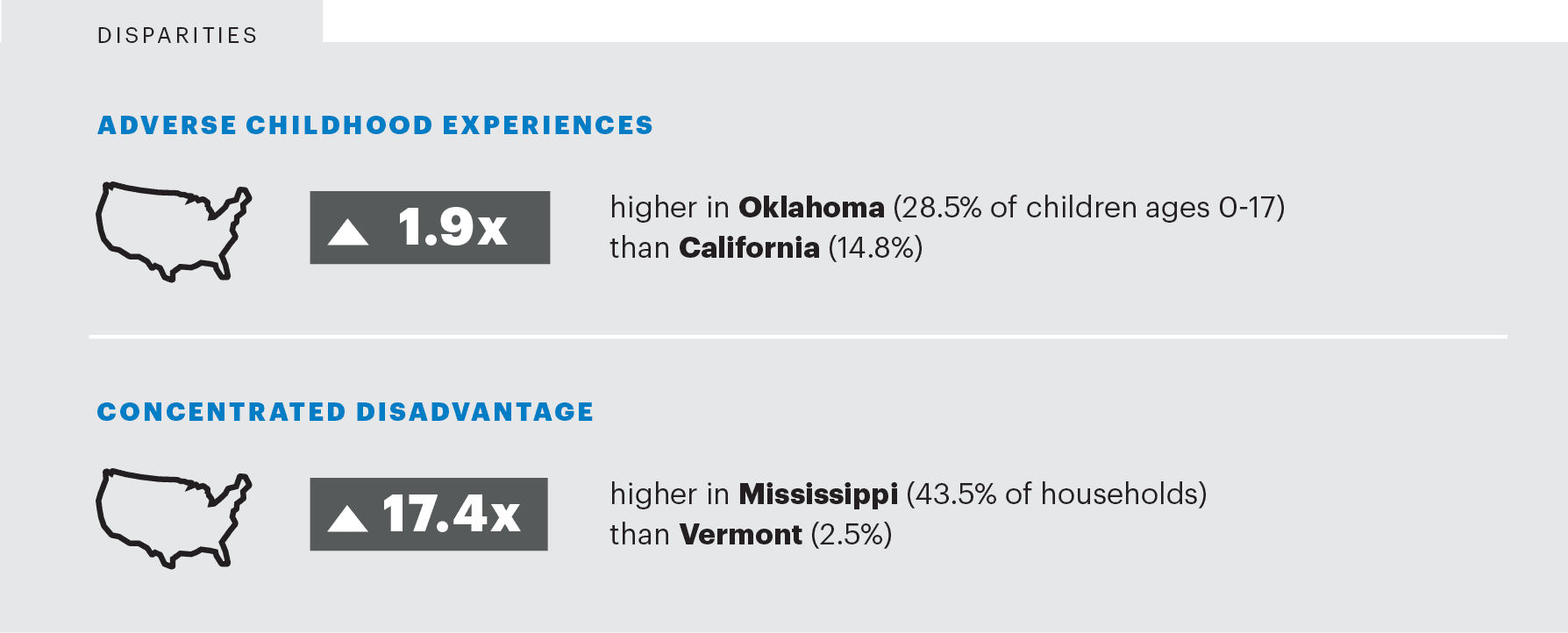
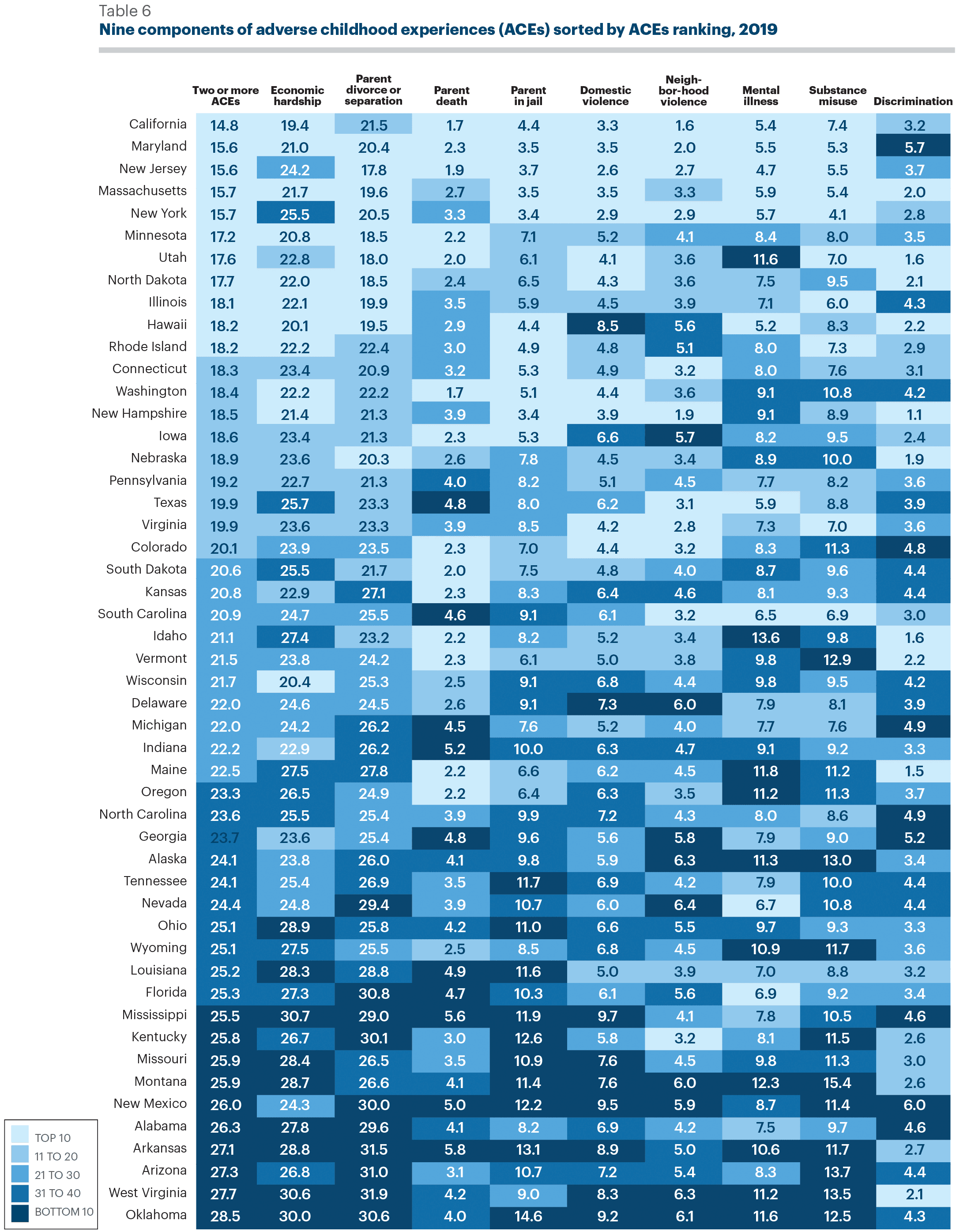
  • Nearly 14.7 million (20.5 percent) children ages 0-17 have at least two of nine adverse childhood experiences. Table 6 shows the nine components of the adverse childhood experiences measure at the state level. According to the Child and Adolescent Health Measurement Initiative, adverse childhood experiences (ACEs)
    external-link
    are stressful or traumatic events that affect children and have a lasting impact on health and well-being. Early experiences have a broad and profound impact on an individual’s development and subsequent emotional, cognitive, social and biological functioning.
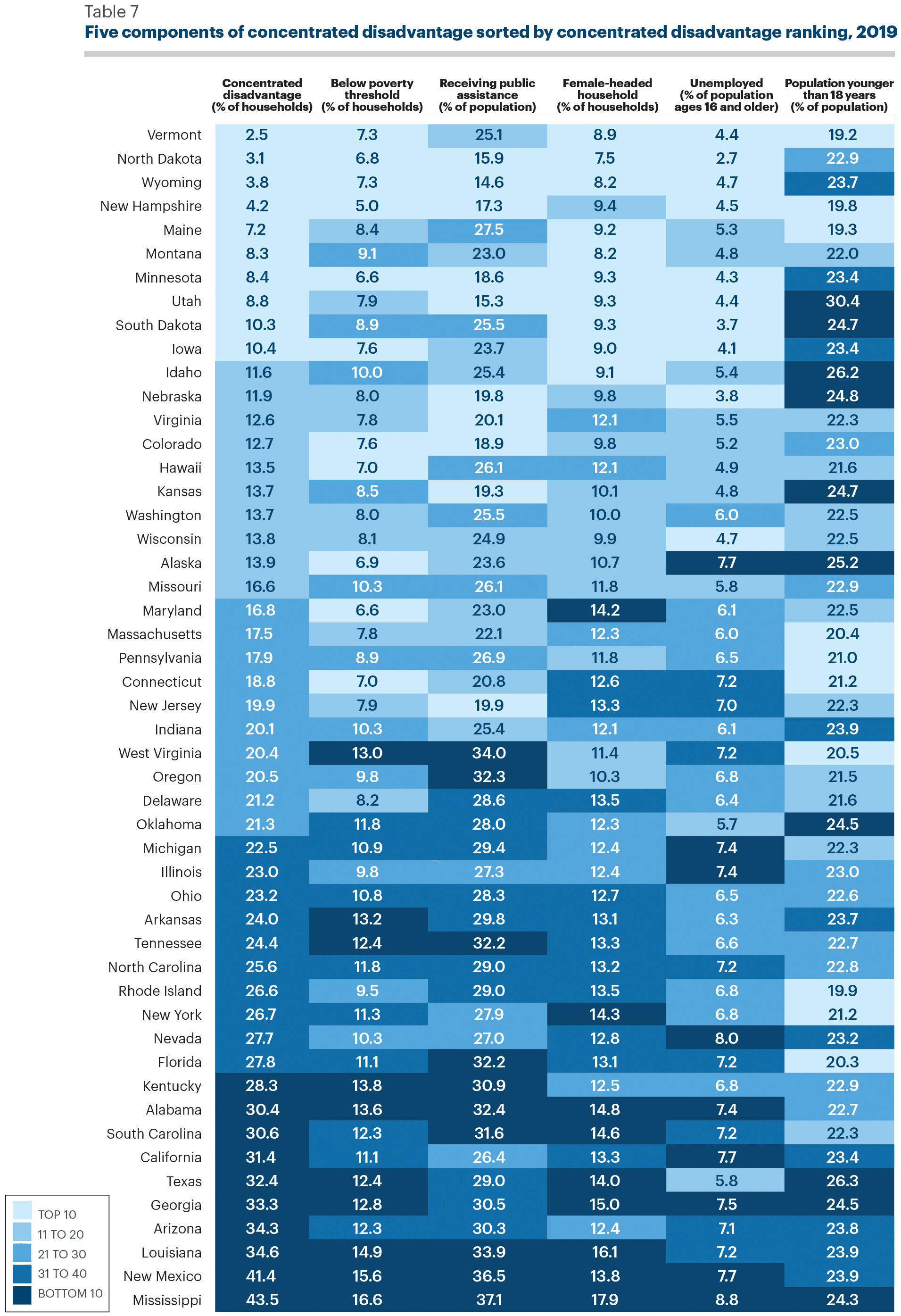
  • Nearly a quarter (24.0 percent) of households are in areas of concentrated disadvantage. This means there is a higher percentage of households headed by females (who are more likely to face wage discrimination than males); a higher percentage of children; and a higher percentage of people unemployed, living in poverty and receiving public assistance. Table 7 shows the five components of the concentrated disadvantage measure at the state level. According to the Association of Maternal and Child Health Programs (AMCHP), concentrated disadvantage
    external-link
    is a measure of community well-being that helps identify community-level concentrated poverty and economic segregation. Persistent high levels of concentrated disadvantage can harm physical and mental health and is associated with: poor birth outcomes
    external-link
    , child maltreatment
    external-link
    , lack of access to healthy foods and recreational areas
    external-link
    , poor educational outcomes
    external-link
    , teen pregnancy
    external-link
    and high rates of violent crime
    external-link
    .
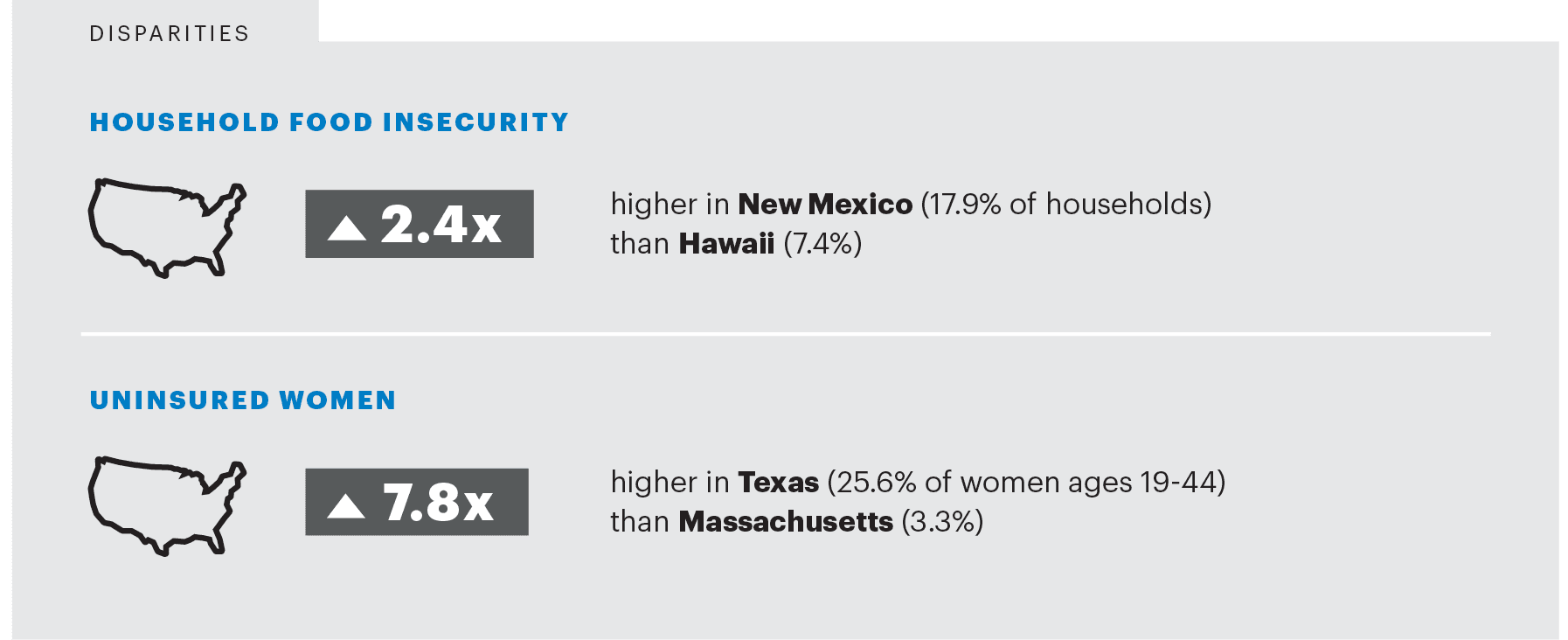
  • Nearly one in eight households (12.3 percent) in the nation don’t have adequate food due to lack of resources, despite improvements in food insecurity since 2016. Food insecurity has broad effects on health due to the mental and physical stress that it places on the body. In women
    external-link
    it is associated with obesity, anxiety, depression, risky sexual behavior, low birthweight and gestational diabetes. In children
    external-link
    it is associated with anemia, asthma, anxiety, depression, cognitive and behavioral problems as well as hospitalization.
  • Nearly 6.9 million women ages 19-44 (12.4 percent) are uninsured — ranging dramatically from 3.3 percent in Massachusetts to 25.6 percent in Texas. Health insurance is a critical factor in ensuring women receive needed care to achieve and maintain good health. Moreover, babies born to healthy mothers start off on a promising path to health that has the potential to last a lifetime. According to the Kaiser Family Foundation, the most common reason for being uninsured is cost
    external-link
    .
hwc2019pg10b
Download Image

hwc2019pg12a
Download Image

hwc2019table6

hwc2019table7
Download Image

America's Health Rankings, United Health Foundation Logo

Reports

Partner With Us

Explore the Data and Stay Tuned for New Insights

Want to be notified of our latest updates? Sign up now

America's Health Rankings, United Health Foundation Logo