CLINICAL CARE | Access to Care
The nation has improved in access to care measures of uninsured, mental health providers and primary care providers, though large geographic disparities remain.
Health insurance is critical in helping people receive the preventive and medical care they need to achieve and maintain good health. Compared with insured adults, uninsured adults have inadequate access to
preventive services, worse
health outcomes and higher rates of
premature death.
Changes over time. Nationally, the percentage of the population not covered by private or public health insurance decreased 7% from 9.2% to 8.6% between 2019 and 2021. The
uninsured rate significantly decreased in 15 states, led by 29% in
Maine (8.0% to 5.7%) and 19% in both
Idaho (10.8% to 8.8%) and
New Hampshire (6.3% to 5.1%).
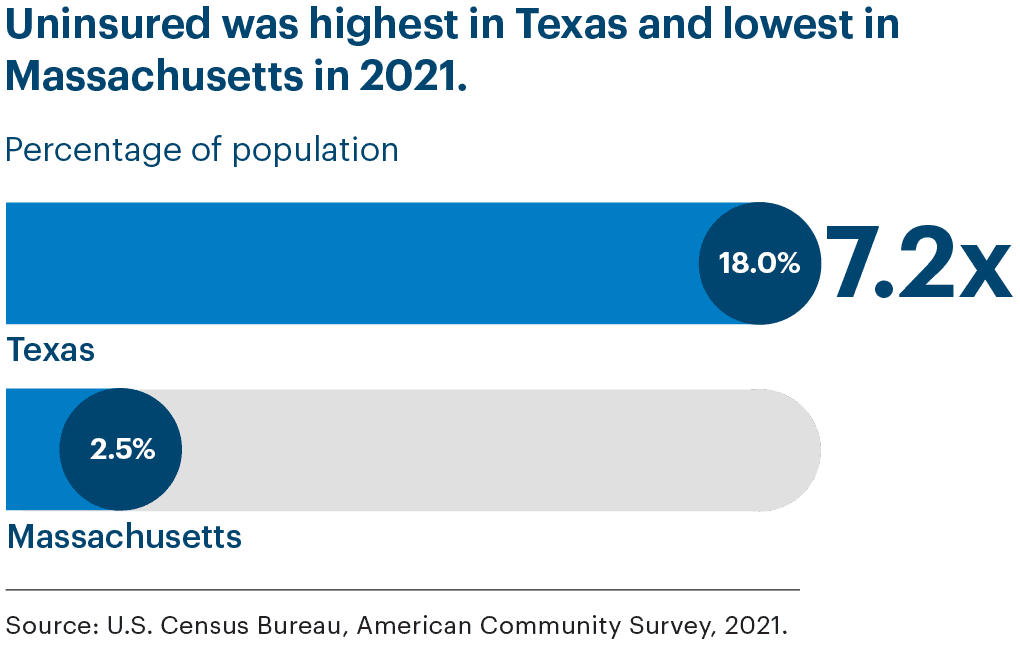
Disparities. The uninsured rate was 7.2 times higher in
Texas (18.0%) than in
Massachusetts (2.5%), the states with the highest and lowest rates in 2021. The rate significantly varied by education, race/ethnicity and age. It was:
Primary care physicians are typically the patient’s first point of contact with the health care system and provide critical preventive care, disease management and referrals to specialists. Having a sufficient supply of primary care physicians in a community has numerous
benefits, including lower rates of infants with low birthweight, lower all-cause mortality and longer life spans, reductions in health system costs and reductions in health disparities. Mental health providers offer
essential care to people with mental or behavioral disorders through assessments, diagnoses, treatments, medications and therapeutic interventions. Demand for mental health professionals is
projected to increase during and after the COVID-19 pandemic.
Changes over time. Nationally,
primary care providers† increased 5% from 252.3 to 265.3 providers per 100,000 population between September 2021 and September 2022. During this time,
mental health providers‡ increased 7% from 284.3 to 305.0 providers per 100,000 population, and 40% since
America’s Health Rankings first included the measure in 2017 (from 218.0). The supply of primary care providers increased by 5% or more in 32 states and the
District of Columbia, led by 11% in the district (494.0 to 546.4) and 8% in
Louisiana (226.8 to 243.9),
Florida (266.9 to 288.6) and
Arizona (221.2 to 239.9). The supply of mental health providers increased by 7% or more in 27 states and the
District of Columbia, led by 14% in both the district (589.6 to 670.5) and
Arizona (154.8 to 176.0) and 12% in
Texas (133.0 to 148.6).
Disparities. The supply of primary care providers was 1.9 times higher in
Massachusetts (383.1 providers per 100,000 population) than in
Nevada (205.1), and the supply of mental health providers was 5.6 times higher in
Massachusetts (722.2) than in
Alabama (128.8), the states with the highest and lowest rates in September 2022.
CLINICAL CARE | Preventive Clinical Services
COVID-19 vaccination rates varied by race/ethnicity.
COVID-19 Vaccination and Bivalent Booster Dose
COVID-19 vaccinations and boosters can protect both individuals and communities while reducing strain on health care systems. Currently, COVID-19 vaccines are recommended for everyone 6 months of age and older. The vaccine and booster combination continues to decrease risk of hospitalization and death for those who contract COVID-19.
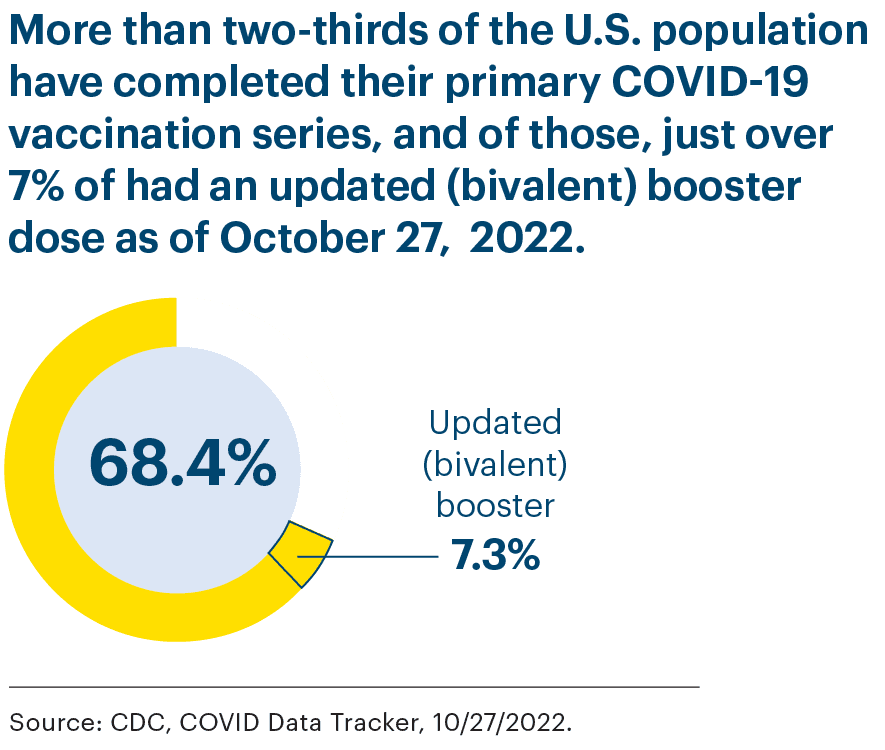
National estimate. As of October 27, 2022, 226,933,827 people or 68.4% of the total U.S. population completed a primary COVID-19 vaccination series, defined as having received one dose of a single-dose vaccine or two doses on different days (regardless of time interval) of either an mRNA or a protein-based series. In addition, 7.3% of the population with a completed primary vaccination series had an updated (bivalent) booster dose since September 1, 2022. COVID-19 vaccination rates remain lower among children than adults. A primary series was completed by 3.5% of children younger than age 5, 31.7% of children ages 5-11 and 60.9% of children ages 12-17.
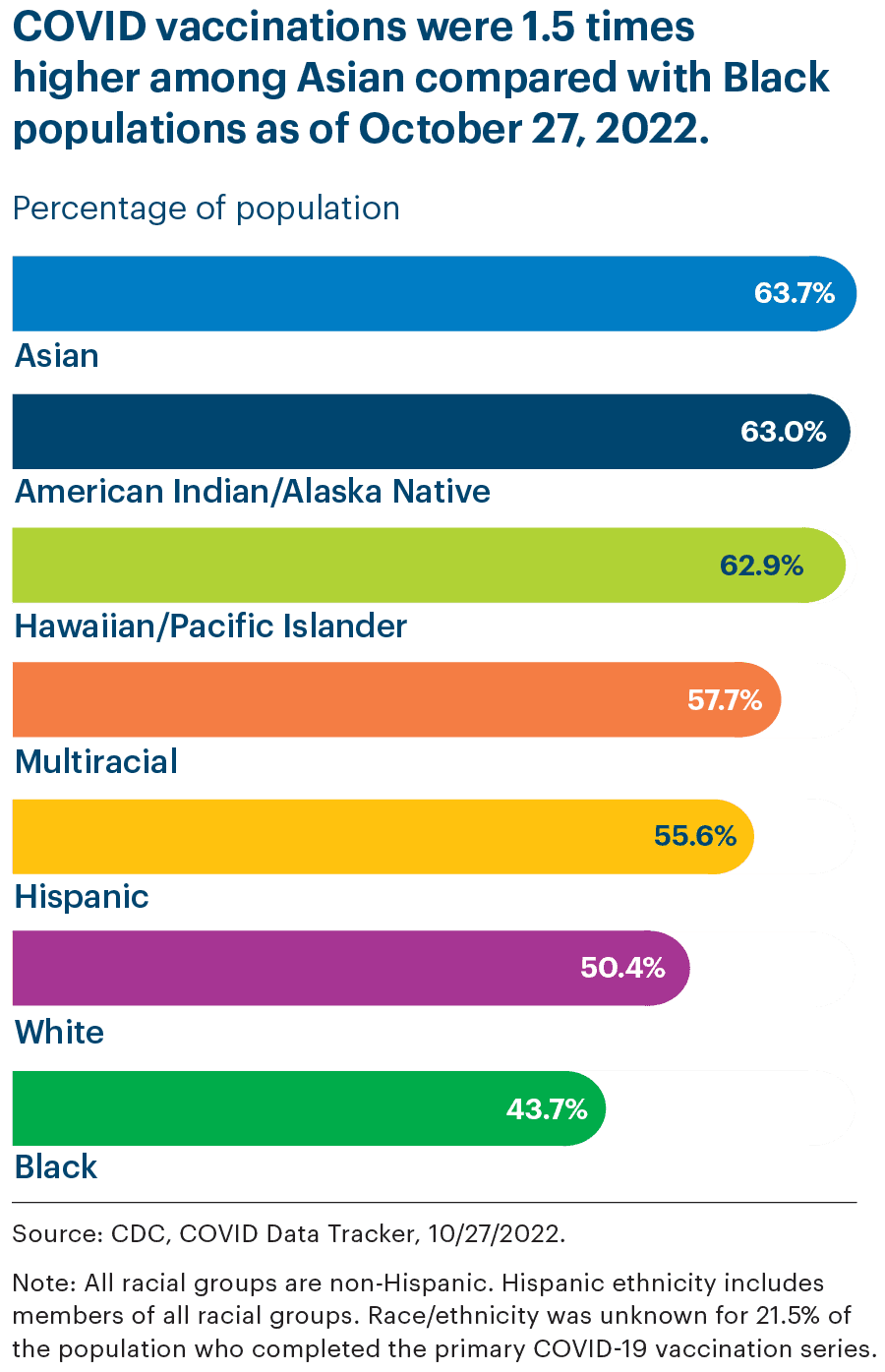
Disparities. The percentage of the population who completed a primary COVID-19 vaccination series was 1.6 times higher in Rhode Island (86.3%) than in Wyoming (52.4%), the states with the highest and lowest rates as of October 27, 2022. The percentage was 1.5 times higher among Asian (63.7%) compared with Black (43.7%) populations. However, data constraints limit our ability to understand the racial/ethnic breakdown of those who have been vaccinated against COVID-19. For 21.5% of the population who completed the primary COVID-19 vaccination series, their race was unknown — emphasizing the need to prioritize collecting demographic, including racial/ethnic, information in public health data.
Explore COVID-19 data.
* The values of the two highest groups were not significantly different from each other based on non-overlapping 95% confidence intervals.
† Primary care providers include general practice, family practice, obstetrics and gynecology, pediatrics, geriatrics and internal medicine providers, as well as physician assistants and nurse practitioners.
‡ Mental health providers include psychiatrists, psychologists, licensed clinical social workers, counselors, marriage and family therapists and advanced practice nurses specializing in mental health care.

 Alabama
 Alaska
 Arizona
 Arkansas
 California
 Colorado
 Connecticut
 Delaware
 District of Columbia
 Florida
 Georgia
 Hawaii
 Idaho
Idaho Illinois
 Indiana
 Iowa
Iowa Kansas
 Kentucky
 Louisiana
 Maine
Maine Maryland
 Massachusetts
 Michigan
 Minnesota
 Mississippi
 Missouri
 Montana
 Nebraska
 Nevada
 New Hampshire
 New Jersey
 New Mexico
 New York
 North Carolina
 North Dakota
 Ohio
Ohio Oklahoma
 Oregon
 Pennsylvania
 Rhode Island
 South Carolina
 South Dakota
 Tennessee
 Texas
Texas Utah
Utah Vermont
 Virginia
 Washington
 West Virginia
 Wisconsin
 Wyoming
 US Summary