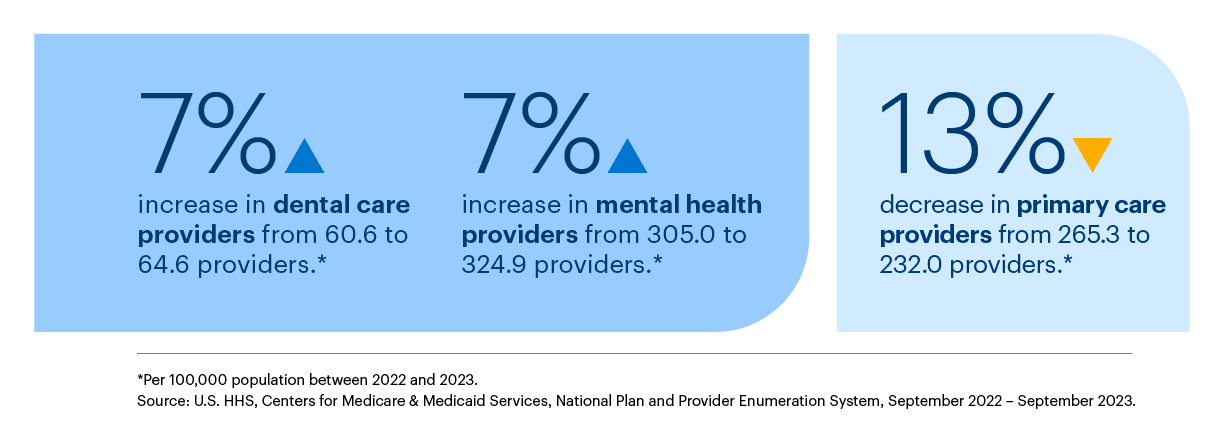
The uninsured rate as well as the supply of dental care and mental health providers improved, while avoided care due to cost increased and the supply of primary care providers dropped.
The high cost of health care in the U.S. is a
major reason why individuals avoid seeking needed care. People who don’t get needed care are at risk of
preventable hospitalizations and missed opportunities to
prevent disease and
manage chronic conditions — all of which can lead to worse and more expensive health outcomes.
Changes over time. Nationally, the percentage of adults who reported a time in the past 12 months when they needed to see a doctor but could not because of cost increased 15% from 8.8% to 10.1% between 2021 and 2022. In 2022, nearly 29.3 million adults
avoided care due to cost. Avoided care due to cost significantly increased in six states, led by 28% in
Alabama (11.1% to 14.2%), 24% in
Connecticut (7.4% to 9.2%) and 23% in both
New York (8.0% to 9.8%) and
Idaho (9.2% to 11.3%). The prevalence significantly increased among most income, educational attainment and age groups, and all metropolitan status and gender groups. By group, the largest increases were 28% among adults ages 25 and older with an annual household income of
$75,000 or more (3.6% to 4.6%), 21% among adults ages 25 and older with
less than high school education (18.1% to 21.9%), 16% among adults ages
18-44 (13.1% to 15.2%), 13% among adults living in
metropolitan areas (9.9% to 11.2%) and 12% among both
women (10.6% to 11.9%) and
men (9.1% to 10.2%).
Disparities. In 2022, avoided care due to cost significantly varied by income, age, educational attainment, disability status, geography, race/ethnicity, sexual orientation, veteran status and gender. The prevalence was:
- 4.8 times higher among adults ages 25 and older with a household income less than $25,000 (22.2%) than those with incomes of $75,000 or more.
- 4.1 times higher among adults ages 18-44 than those ages 65 and older (3.7%).
- 3.6 times higher among adults ages 25 and older with less than a high school degree than college graduates (6.1%).
- 3.3 times higher among adults with cognitive difficulty (25.9%) than those without a disability (7.8%).*
- 2.9 times higher in Texas (16.8%) than Hawaii (5.7%).
- 2.5 times higher among Hispanic (18.9%) than Asian (7.7%) adults.*
- 2.3 times higher among LGBQ+ (21.5%) than straight (9.5%) adults.
- 1.9 times higher among adults who have not served (11.6%) than those who have served (6.0%) in the U.S. armed forces.
- Higher among women than men.
Individuals who are uninsured or experience inconsistent health care coverage encounter more interruptions in accessing care and difficulties in covering medical expenses than individuals with
continuous insurance coverage.
Changes over time. Nationally, the percentage of the population not covered by private or public health insurance significantly decreased 7% from 8.6% to 8.0% between 2021 and 2022, reaching its lowest value in
Annual Report history. The
uninsured rate significantly decreased in 13 states, led by 18% in
New Mexico (10.0% to 8.2%), 15% in
Oklahoma (13.8% to 11.7%) and 11% in
Alabama (9.9% to 8.8%),
Colorado (8.0% to 7.1%) and
North Carolina (10.4% to 9.3%). The rate significantly decreased among most educational attainment and racial/ethnic groups and all age groups. By group, the largest decreases were 10% among those with
some post-high school education (8.1% to 7.3%); 9% among the
Black population (9.6% to 8.7%); and 8% among those ages
19-25 (14.2% to 13.0%), ages
35-44 (13.0% to 12.0%) and ages
55-64 (8.3% to 7.6%).
Disparities. In 2022, the uninsured rate significantly varied by geography, educational attainment, race/ethnicity and age. The prevalence was:
Changes over time. Nationally, the number of general dentists and advanced practice dental therapists increased 7% from 60.6 to 64.6 providers per 100,000 population between 2022 and 2023. There were over 215,000
dental care providers in 2023, an increase of approximately 14,000 since 2022. The supply of dental care providers increased at a rate equal to or greater than the nation in 28 states, led by 10% in
Maine (57.6 to 63.1 providers per 100,000 population) and 9% in
South Carolina (48.6 to 52.8),
Massachusetts (85.0 to 92.3),
Florida (51.9 to 56.6) and
Colorado (69.8 to 76.4).
Disparities. In 2023, the supply of dental care providers was 2.4 times higher in
Alaska (96.8 providers per 100,000 population) than
Delaware (40.5).
Mental health providers offer
essential care to adults and children with mental or behavioral disorders through assessments, diagnoses, treatments, medications and therapeutic interventions.
Changes over time. Nationally, the number of psychiatrists, psychologists, licensed clinical social workers, counselors, marriage and family therapists and advanced practice nurses specializing in mental health care increased 7% from 305.0 to 324.9 providers per 100,000 population between 2022 and 2023. There were nearly 1.1 million
mental health providers in 2023, an increase of about 70,600 since 2022. The supply of mental health providers increased at a rate equal to or greater than the nation in 29 states and the District of Columbia, led by 12% in
West Virginia (165.1 to 185.5 providers per 100,000 population) and 10% in the
District of Columbia (670.5 to 737.6).
Disparities. In 2023, the supply of mental health providers was 5.4 times higher in
Massachusetts (758.7 providers per 100,000 population) than
Alabama (140.0).
Having a better or sufficient supply of primary care physicians in a community has many
benefits, including lower rates of low birth weight among infants, lower all-cause mortality, longer life spans and reductions in health system costs and health disparities.
Changes over time. Nationally, the number of active primary care providers (including general practice, family practice, obstetrics and gynecology, pediatrics, geriatrics, internal medicine, physician assistants and nurse practitioners) decreased 13% from 265.3 to 232.0 providers per 100,000 population between 2022 and 2023. There were more than 773,000
primary care providers in 2023, a decrease of over 107,000 since 2022. The supply of primary care providers decreased at a rate equal to or greater than the nation in 23 states and the District of Columbia, led by 25% in the
District of Columbia (546.4 to 411.3 providers per 100,000 population) and 17% in both
Connecticut (300.2 to 248.9) and
New Jersey (217.4 to 181.4).
Disparities. In 2023, the supply of primary care providers was 1.8 times higher in
Massachusetts (322.1 providers per 100,000 population) than
California (178.9). The supply was highest in the District of Columbia.
* The estimates for adults with cognitive difficulty, self-care difficulty (24.8%) and independent living difficulty (24.7%) were not significantly different from each other based on non-overlapping 95% confidence intervals; the same was true for those who identify their race/ethnicity as Hispanic and Hawaiian/Pacific Islander (13.3%) as well as Asian and white (8.4%).
** The estimates for white and Asian (5.5%) populations were not significantly different from each other based on non-overlapping 95% confidence intervals; the same was true for populations who identify as other race and American Indian/Alaska Native populations (18.5%). 
 US Summary
 Alabama
 Alaska
 Arizona
 Arkansas
 California
 Colorado
 Connecticut
 Delaware
 District of Columbia
 Florida
 Georgia
 Hawaii
 Idaho
Idaho Illinois
 Indiana
 Iowa
Iowa Kansas
 Kentucky
 Louisiana
 Maine
Maine Maryland
 Massachusetts
 Michigan
 Minnesota
 Mississippi
 Missouri
 Montana
 Nebraska
 Nevada
 New Hampshire
 New Jersey
 New Mexico
 New York
 North Carolina
 North Dakota
 Ohio
Ohio Oklahoma
 Oregon
 Pennsylvania
 Rhode Island
 South Carolina
 South Dakota
 Tennessee
 Texas
Texas Utah
Utah Vermont
 Virginia
 Washington
 West Virginia
 Wisconsin
 Wyoming