Three new physical environment measures were added this year: climate risks, transportation health risks and renewable energy. Improvements were made in renewable energy generation, while air pollution worsened and exceeded pre-pandemic levels. Meanwhile, approximately 115.3 million people lived in areas with high climate risks, and 78.0 million people lived in areas with high transportation health risks.
Exposure to fine particle air pollution has been
linked to heart and lung problems, including decreased lung function, asthma, irregular heartbeat and heart attack. According to a 2019 study, fine particle air pollution originating from human activity was responsible for an estimated
107,000 premature deaths in 2011.
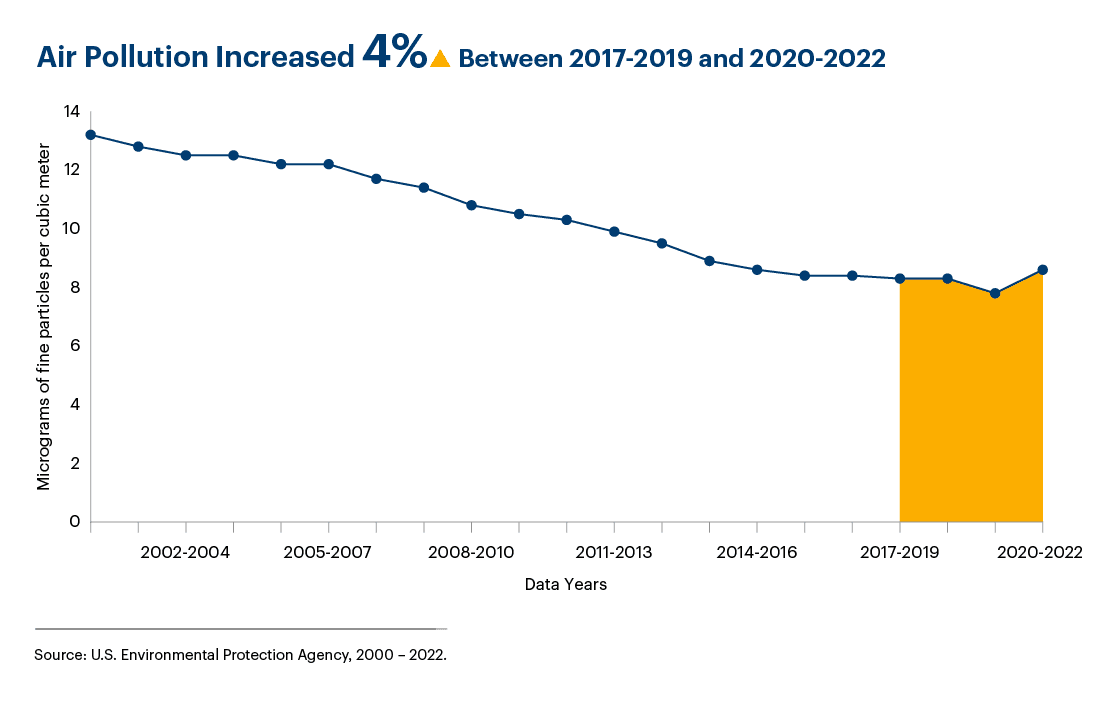
Changes over time. Nationally, the average exposure of the general public to particulate matter of 2.5 microns or less increased 4% from 8.3 to 8.6 micrograms of fine particles per cubic meter between 2017-2019 and 2020-2022. During this time,
air pollution increased at a rate equal to or greater than the nation in 31 states, led by 29% in
Arizona (8.6 to 11.1 micrograms of fine particles per cubic meter), 25% in
Nevada (8.3 to 10.4) and 24% in
Idaho (6.6 to 8.2); it decreased 4% or more in eight states and the District of Columbia, led by 19% in
Connecticut (7.0 to 5.7), 16% in
Nebraska (7.0 to 5.9) and 15% in
Hawaii (4.8 to 4.1).
Disparities. In 2020-2022, air pollution was 3.3 times higher in
California (13.4 micrograms of fine particles per cubic meter) than Hawaii.
Renewable energy is used to generate electricity and is produced from naturally replenishing sources, such as wind, solar, water (hydroelectric), biomass (plants, wood, or waste) or geothermal (heat). Generating electricity from clean, sustainable and affordable energy sources can
improve health outcomes by reducing air and water pollutants emitted by coal and natural gas plants.
Changes over time. Nationally, the percentage of electricity generated from renewable sources increased 8% from 19.0% to 20.5% between 2021 and 2022. During this time,
renewable energy generation increased at a rate equal to or greater than the nation in 18 states and the District of Columbia, led by 43% in the
District of Columbia (35.0% to 49.9%), 42% in
Rhode Island (7.2% to 10.2%) and 33% in
Mississippi (0.6% to 0.8%); it decreased 8% or more in five states, led by 21% in
Louisiana (1.4% to 1.1%) and 13% in both
Arkansas (7.5% to 6.5%) and
Delaware (3.2% to 2.8%). Between 2021 and 2022, the percentage of electricity generated by
solar and
wind increased 21% (2.8% to 3.4%) and 12% (9.2% to 10.3%), respectively.
Biomass and
geothermal energy generation stayed the same (both at 0.4%), and
hydroelectric energy decreased 2% (6.1% to 6.0%).
Natural hazards, including extreme weather events, can worsen existing medical conditions and cause
injury and death, as well as stress and mental health issues. Natural disasters can also affect
infrastructures that support public health, safety and medicine.
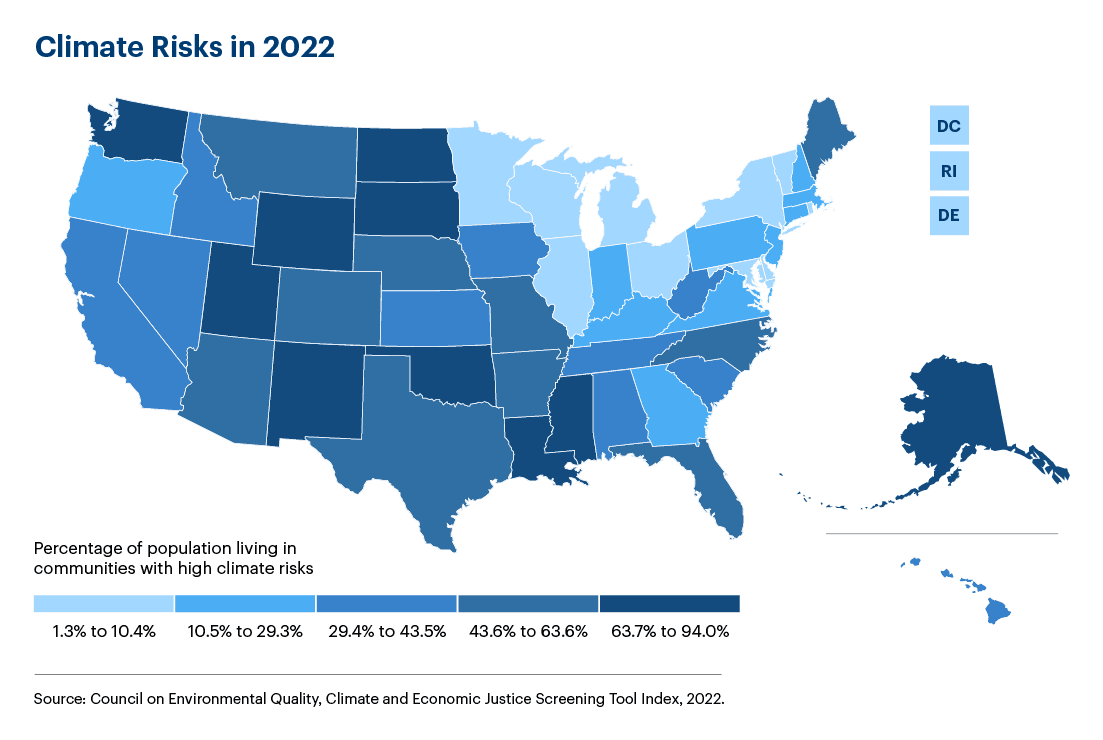
Nationally in 2022, 35.5% of the population lived in areas with high
climate risks, which is defined as disadvantaged census tracts (at or above the 90th percentile) based on any of the following risks: agricultural value losses, building value losses, or fatalities and injuries due to 14 types of natural hazards (avalanche, coastal flooding, cold wave, drought, hail, heat wave, hurricane, ice storm, landslide, riverine flooding, strong wind, tornado, wildfire and winter weather); or projected flood or wildfire risk. Almost 115.3 million people were living in census tracts with high climate risks in 2022.
Transportation Health Risks
Traffic-related congestion creates concentrated areas of air and noise pollution, which
disproportionately affect those with lower socioeconomic status. Cardiovascular disease and respiratory conditions such as wheezing and childhood asthma are associated with
traffic-related air pollution.
Nationally in 2022, 24.0% of the population lived in areas with high
transportation health risks, which is defined as disadvantaged census tracts (at or above the 90th percentile) based on any of the following risks: diesel particulate matter exposure, transportation barriers (related to cost and time) or traffic proximity and volume. Approximately 78.0 million people lived in census tracts with high transportation health risks in 2022.

 US Summary
 Alabama
 Alaska
 Arizona
 Arkansas
 California
 Colorado
 Connecticut
 Delaware
 District of Columbia
 Florida
 Georgia
 Hawaii
 Idaho
Idaho Illinois
 Indiana
 Iowa
Iowa Kansas
 Kentucky
 Louisiana
 Maine
Maine Maryland
 Massachusetts
 Michigan
 Minnesota
 Mississippi
 Missouri
 Montana
 Nebraska
 Nevada
 New Hampshire
 New Jersey
 New Mexico
 New York
 North Carolina
 North Dakota
 Ohio
Ohio Oklahoma
 Oregon
 Pennsylvania
 Rhode Island
 South Carolina
 South Dakota
 Tennessee
 Texas
Texas Utah
Utah Vermont
 Virginia
 Washington
 West Virginia
 Wisconsin
 Wyoming