Behaviors | Smoking and Tobacco Use
E-cigarette use among women ages 18-44 exceeded 10%, while rates of smoking among women decreased.
E-Cigarette Use Among Women
Electronic cigarettes, also called
e-cigarettes, vapes or vape pens, are devices that use heat to make an aerosol that users inhale. E-cigarettes may contain additives such as
ultrafine particles that can go deep into the lungs, cancer-causing chemicals and flavoring chemicals linked to
lung disease and
injury.
Nationally, 10.8% of women ages 18-44 — 5.8 million women — reported using
e-cigarettes or other electronic vaping products at least once in their lifetime and now use daily or some days in 2022.
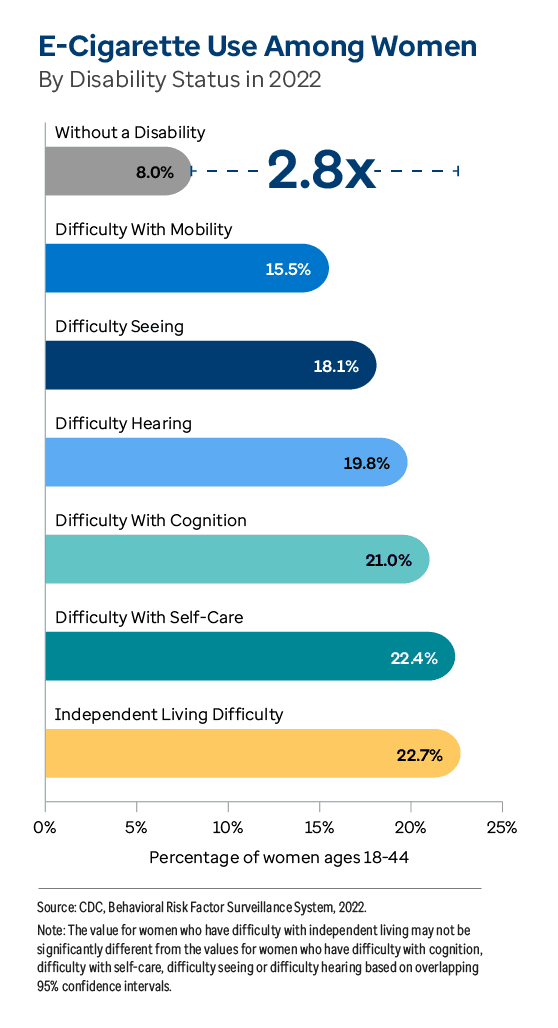
Disparities. E-cigarette use significantly varied by geography, disability, race/ethnicity, education, age, sexual orientation, income, veteran status and metropolitan status in 2022. The prevalence was:
Note: The value for women with independent living difficulty may not differ significantly from the values for those who have difficulty with cognition, those who have difficulty with self-care, those who have difficulty seeing and those who have difficulty with hearing based on overlapping 95% confidence intervals. The same is true for multiracial, Hawaiian/Pacific Islander and American Indian/Alaska Native women; and Asian, Black and Hispanic women; as well as women with incomes less than $25,000, women with incomes of $25,000-$49,999 and women with incomes of $50,000-$74,999.
As the
leading cause of preventable death in the U.S., cigarette smoking is responsible for the deaths of more than 480,000 Americans every year, including
201,770 women. One study estimated the probability of female smokers living to age 80 to be
38%, compared with 70% for female nonsmokers.
Changes over time. Nationally,
smoking — the percentage of women ages 18-44 who reported smoking at least 100 cigarettes in their lifetime and currently smoke daily or some days — decreased 16%, from 13.4% to 11.2% between 2019-2020 and 2021-2022. In 2021-2022, about 6 million women in the U.S. were active smokers, 1.1 million fewer women than in 2019-2020. The prevalence decreased among all ages and some educational attainment groups, as well as among women living in metropolitan areas. By group, the largest decreases were:
Smoking among women decreased in seven states, led by: 31% in both
Hawaii (12.4% to 8.6%) and
Kentucky (25.5% to 17.6%), and 30% in
Connecticut (11.4% to 8.0%).
Disparities. Smoking among women significantly varied by race/ethnicity, educational attainment, geography, income, disability and age in 2021-2022. The rate was:

Note: The values for multiracial, American Indian/Alaska Native and Hawaiian/Pacific Islander women may not differ significantly based on overlapping confidence intervals. The same is true for women with less than a high school education and high school graduates. It is also true for women who have difficulty with self-care, those who have difficulty with mobility, those with independent living difficulty and those who have difficulty hearing.
Changes over time. Nationally,
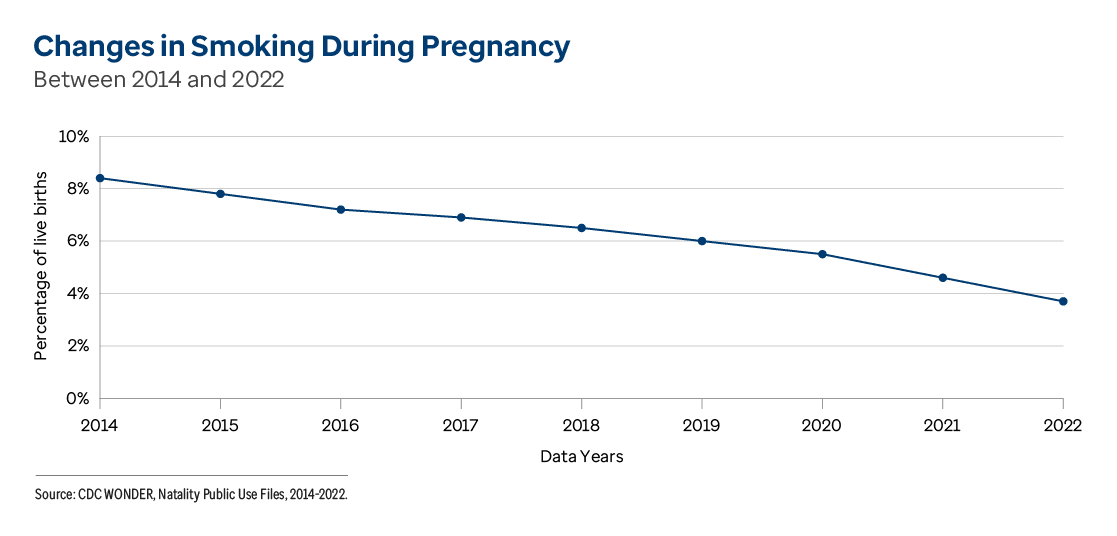
smoking during pregnancy — the percentage of mothers who reported smoking cigarettes during pregnancy — decreased 20%, from 4.6% to 3.7% between 2021 and 2022, and 56% (from 8.4%), between 2014 and 2022. In 2022, about 134,000 mothers smoked during pregnancy, 34,000 fewer than in 2021.
Thirty states and the District of Columbia had decreases greater than or equal to the national change, led by: 44% in the
District of Columbia (1.6% to 0.9% of live births), 38% in
Delaware (5.2% to 3.2%) and 31% in
Idaho (5.5% to 3.8%).
Disparities. Smoking during pregnancy varied by geography. In 2022, the rate was 21.9 times higher in
West Virginia (15.3%) than
California (0.7%).
Related Measure: Household Smoke Among Children
Changes over time. Household smoke — the percentage of children ages 0-17 who live in households where someone used cigarettes, cigars or pipe tobacco — decreased 16%, from 13.7% to 11.5% of U.S. children between 2020-2021 and 2022-2023.
The prevalence decreased among some racial/ethnic and educational attainment groups. By group, the largest decreases were:
The percentage decreased in two states: 33% in
Texas (15.7% to 10.5%) and 29% in
Indiana (19.7% to 14.0%).
Disparities. The prevalence of household smoke significantly varied by geography, caregiver educational attainment and race/ethnicity in 2022-2023. The percentage was:
Note: The values among American Indian/Alaska Native, multiracial, Black and Hawaiian/Pacific Islander children may not differ significantly based on overlapping 95% confidence intervals. The same is true for Asian, Hispanic and Hawaiian/Pacific Islander children.

 US Summary
 Alabama
 Alaska
 Arizona
 Arkansas
 California
 Colorado
 Connecticut
 Delaware
 District of Columbia
 Florida
 Georgia
 Hawaii
 Idaho
Idaho Illinois
 Indiana
 Iowa
Iowa Kansas
 Kentucky
 Louisiana
 Maine
Maine Maryland
 Massachusetts
 Michigan
 Minnesota
 Mississippi
 Missouri
 Montana
 Nebraska
 Nevada
 New Hampshire
 New Jersey
 New Mexico
 New York
 North Carolina
 North Dakota
 Ohio
Ohio Oklahoma
 Oregon
 Pennsylvania
 Rhode Island
 South Carolina
 South Dakota
 Tennessee
 Texas
Texas Utah
Utah Vermont
 Virginia
 Washington
 West Virginia
 Wisconsin
 Wyoming