Clinical Care | Access to Care
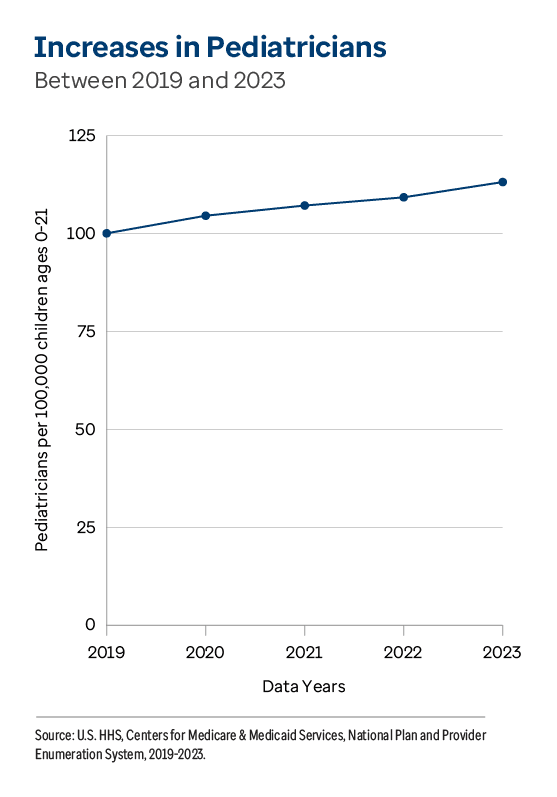
The percentage of uninsured women and children improved, as did the number of pediatricians per 100,000 children.
Uninsured Women and Children
Health insurance coverage promotes positive health outcomes, increases appropriate use of health care services and offers financial protection against high medical expenses. People without insurance are
more likely to delay or forgo necessary medical care because of cost and are less likely to have seen a doctor in the past year compared with people with insurance. Those without insurance often rely on
emergency departments to receive care, which costs more and is less efficient than preventive care.
Changes over time. Nationally, the percentage of women ages 19-44
not covered by private or public health insurance decreased 8%, from 11.8% to 10.9% between 2021 and 2022. In 2022, nearly 6.2 million American women did not have health insurance, 482,000 fewer women than in 2021. The uninsured rate among women decreased in nine states, led by: 30% in
South Dakota (14.7% to 10.3%), 20% in
Oklahoma (20.5% to 16.3%) and 17% in
Ohio (8.4% to 7.0%).
Disparities. The percentage of uninsured women and children significantly varied by geography in 2022. The percentage of uninsured women was 8.5 times higher in
Texas (23.0%) than in
Massachusetts and the
District of Columbia (both 2.7%). The percentage of uninsured children was 7.3 times higher in
Texas (10.9%) than
Massachusetts (1.5%).
There is currently a
shortage of pediatric specialists — such as those who specialize in developmental pediatrics or child psychiatry — in the U.S., and the uneven geographical distribution of pediatricians and family physicians has left many rural communities and
other underserved areas with insufficient child health care options. In addition to treating illnesses, pediatricians monitor childhood development and provide crucial
preventive care, including administering
vaccinations and tracking development, through wellness exams.
Changes over time. Nationally, the number of
pediatricians increased 4%, from 109.3 to 113.2 per 100,000 children ages 0-21 between September 2022 and September 2023. In September 2023, there were approximately 100,000 pediatricians in the U.S., an increase of almost 3,000 pediatricians since September 2022. Twenty-five states and the District of Columbia had increases greater than or equal to the national change, led by: 7% in both
South Dakota (73.6 to 78.5 per 100,000 children ages 0-21) and
Arkansas (78.0 to 83.7), and 6% in both
Wisconsin (102.9 to 108.8) and
Nevada (59.4 to 62.7).
Disparities. The number of pediatricians per 100,000 children varied by geography. The rate was 4.7 times higher in
Massachusetts (221.0 per 100,000 children ages 0-21) than
Idaho (46.9).
Clinical Care Measures Fall Short of Healthy People 2030 Targets
Low-risk cesarean delivery and
adequate prenatal care did not improve between 2021 and 2022 and have not met national public health goals. Low-risk cesarean delivery — the percentage of singleton, head-first, term (37 or more weeks) first births that were cesarean deliveries — remained at 26.3% in both 2021 and 2022, exceeding the
Healthy People 2030 target of 23.6%. Meanwhile, adequate prenatal care — the percentage of live births in which the mother received appropriate prenatal care in the first four months of pregnancy — was 74.9% in 2022, short of the
Healthy People 2030 target of 80.5%.
While the percentage of
well-woman visits did not change significantly between 2019-2020 and 2021-2022, the most recent prevalence was significantly higher than it was in 2013-2014, representing an improvement over time.

 US Summary
 Alabama
 Alaska
 Arizona
 Arkansas
 California
 Colorado
 Connecticut
 Delaware
 District of Columbia
 Florida
 Georgia
 Hawaii
 Idaho
Idaho Illinois
 Indiana
 Iowa
Iowa Kansas
 Kentucky
 Louisiana
 Maine
Maine Maryland
 Massachusetts
 Michigan
 Minnesota
 Mississippi
 Missouri
 Montana
 Nebraska
 Nevada
 New Hampshire
 New Jersey
 New Mexico
 New York
 North Carolina
 North Dakota
 Ohio
Ohio Oklahoma
 Oregon
 Pennsylvania
 Rhode Island
 South Carolina
 South Dakota
 Tennessee
 Texas
Texas Utah
Utah Vermont
 Virginia
 Washington
 West Virginia
 Wisconsin
 Wyoming