Despite modest gains, disparities by race/ethnicity and socioeconomic status also persist in poverty and housing
Poverty has an impact on an individual’s access to the resources that are needed to support
health and well-being, such as housing, food, safety, health care, education and employment.8,9 As a social and economic measure, poverty in this analysis is defined as the percentage of females ages 18-44 who live below the
federal poverty level.
In the time period 2018-2022, 15.4% of females ages 18-44 lived below the poverty level, which is a 23% decrease from 2010-2014 (20.0%). The rate of poverty declined by more than the national average among several groups:
- 30% among Hispanic (27.3% to 19.0%), 29% among multiracial (22.0% to 15.7%), 24% among Black (30.0% to 22.8%), and 24% among Hawaiian/Pacific Islander (24.1% to 18.4%) females.
- 23% among females with less than a high school education (42.6% to 32.7%).
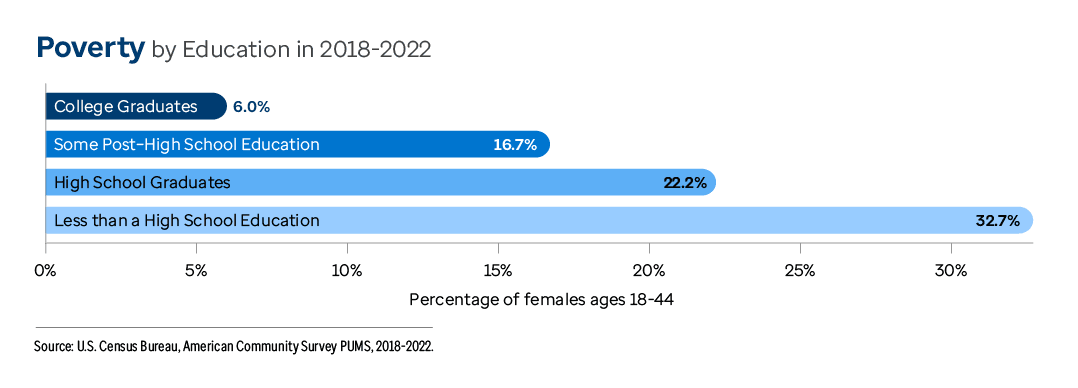
Despite these improvements, certain populations experienced poverty at greater rates. Persistent disparities exist by education level and race/ethnicity among females ages 18-44:
- 5.4 times higher among those with less than a high school education (32.7%) compared with college graduates (6.0%).
- 3.7 times higher among high school graduates (22.2%) compared with college graduates (6.0%).
- 2.8 times higher among those with some post–high school education (16.7%) compared with college graduates (6.0%).
- 2.4 times higher among American Indian/Alaska Native (26.5%) than Asian (11.1%) females, 2.1 times higher than white (12.5%), and 1.7 times higher than multiracial (15.7%) females.
- 2.1 times higher among Black (22.8%) than Asian (11.1%) females and 1.8 times higher than white (12.5%) females.
- 1.7 times higher among Hispanic (19.0%) than Asian (11.1%) females.
Between 2010-2014 and 2018-2022, poverty rates remained high for females in households with incomes below $25,000. During the same time, poverty rates increased significantly for females ages 18-44 in middle-income households; specifically, it rose by 33% for those with household incomes of $50,000-$74,999 (from 4.9% to 6.5%) and 26% for those with household incomes of $25,000-$49,999 (from 14.8% to 18.6%).