Community and Family Safety
The firearm death rate among both women and children continued to rise.
Firearm Deaths
The U.S. has seen an uptick in
firearm deaths over the last decade. In 2020, there were more than 45,000 deaths by gun violence, the
highest number recorded. Additionally, firearm deaths surpassed motor vehicle accidents as the
leading cause of death among children.
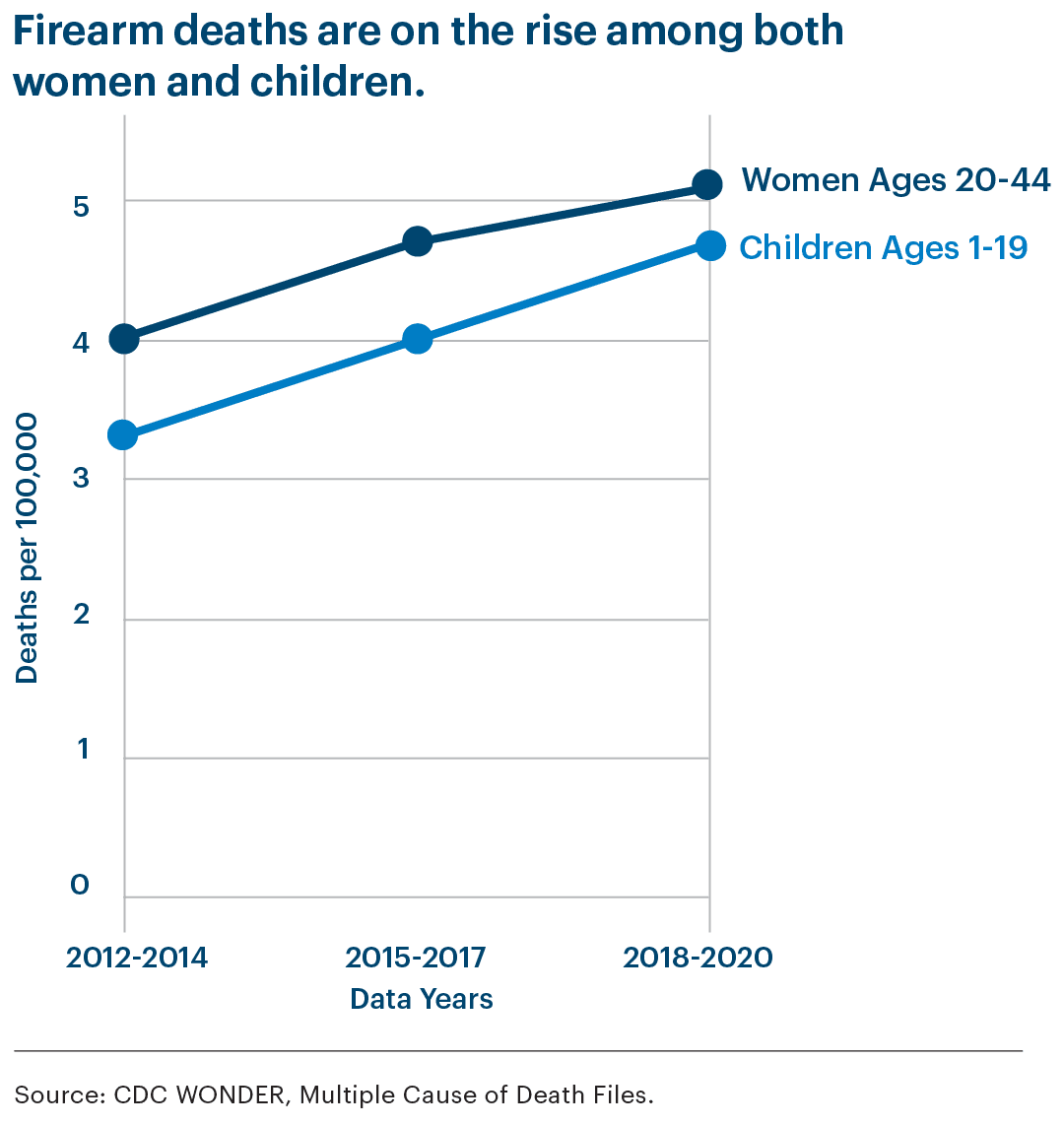
- Changes over time. Nationally, the firearm death rate — deaths due to firearm injury of any intent (unintentional, suicide, homicide or undetermined) per 100,000 — among women ages 20-44 significantly increased 9% from 4.7 to 5.1 between 2015-2017 and 2018-2020, and 28% (from 4.0) since 2012-2014. Among children ages 1-19, the rate significantly increased 18% from 4.0 to 4.7 between 2015-2017 and 2018-2020, and 42% (from 3.3) since 2012-2014. In 2018-2020, 8,288 women and 11,070 children died by firearm.
Among women ages 20-44, the firearm death rate (deaths per 100,000) increased 34% in Missouri, from 8.5 to 11.4 since 2015-2017. Among children ages 1-19, the rate increased in 11 states, led by 71% in
Mississippi (5.9 to 10.1).
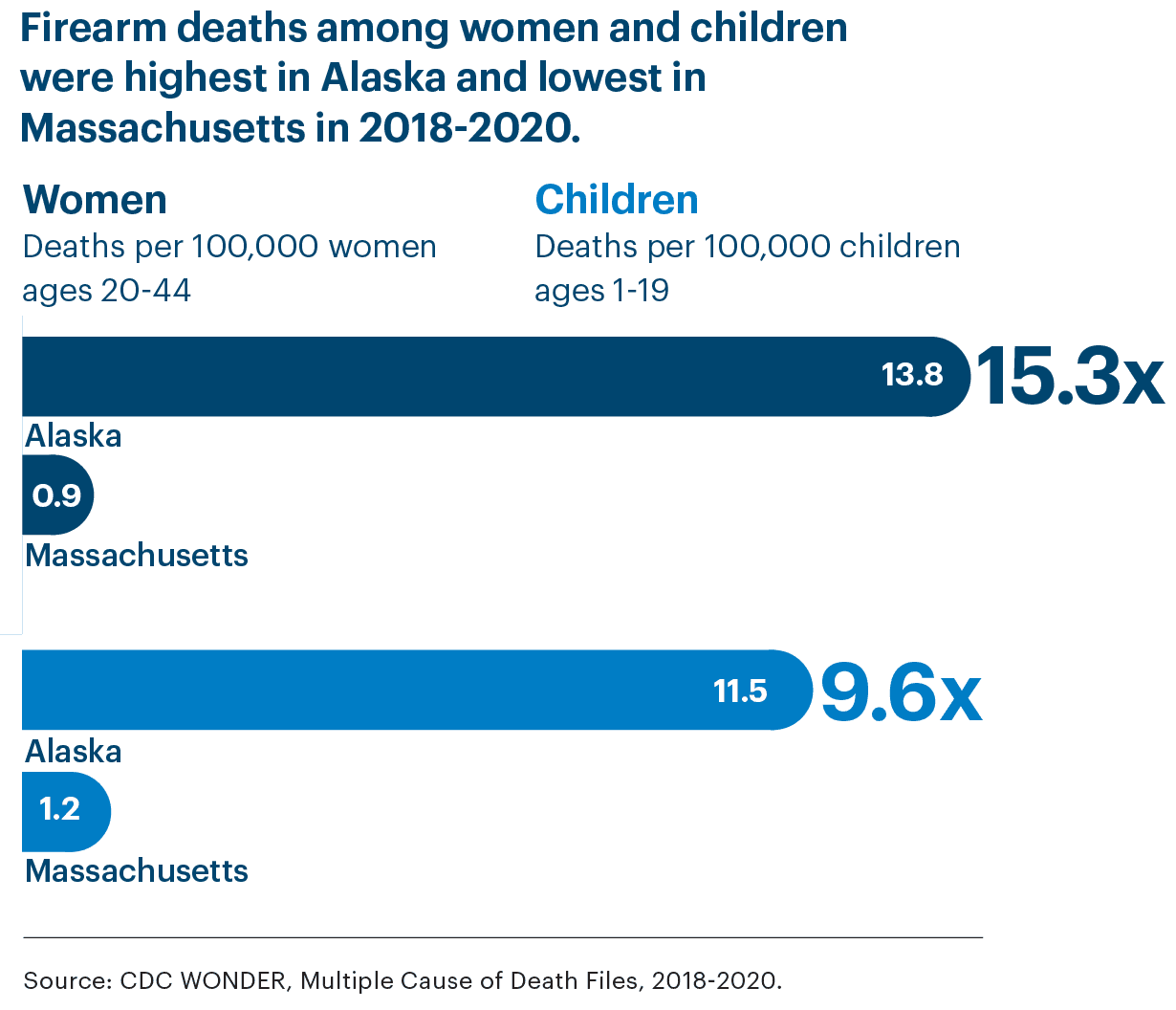
- Disparities. Among women and children, firearm death rates were highest in Alaska (13.8 deaths per 100,000 women ages 20-44 and 11.5 deaths per 100,000 children ages 1-19) and lowest in Massachusetts (0.9 and 1.2, respectively) in 2018-2020. Among children, the rate in the District of Columbia (14.8) was higher than the rate in any state. Rates among both women and children varied significantly by age and race/ethnicity. The rate was 24.5 times higher among children ages 15-19 (14.7) compared with children ages 1-4 (0.6). Firearm deaths were 12.4 times higher among Black children (14.9) compared with Asian children (1.2), 4.7 times higher compared with Hispanic and white children (both 3.2) and nearly twice as high compared with American Indian/Alaska Native children (7.7). The rate was 10.0 times higher among Black women (11.0) compared with Asian women (1.1).
Social Support and Engagement
Adverse childhood experiences impact millions of children. Access to neighborhood amenities worsened.
Adverse Childhood Experiences
Adverse childhood experiences (ACEs) are stressful or traumatic events that can impact children’s health and well-being throughout their lifespan. Early
experiences have a broad and profound impact on an individual’s development and subsequent emotional, cognitive, social and biological functioning.
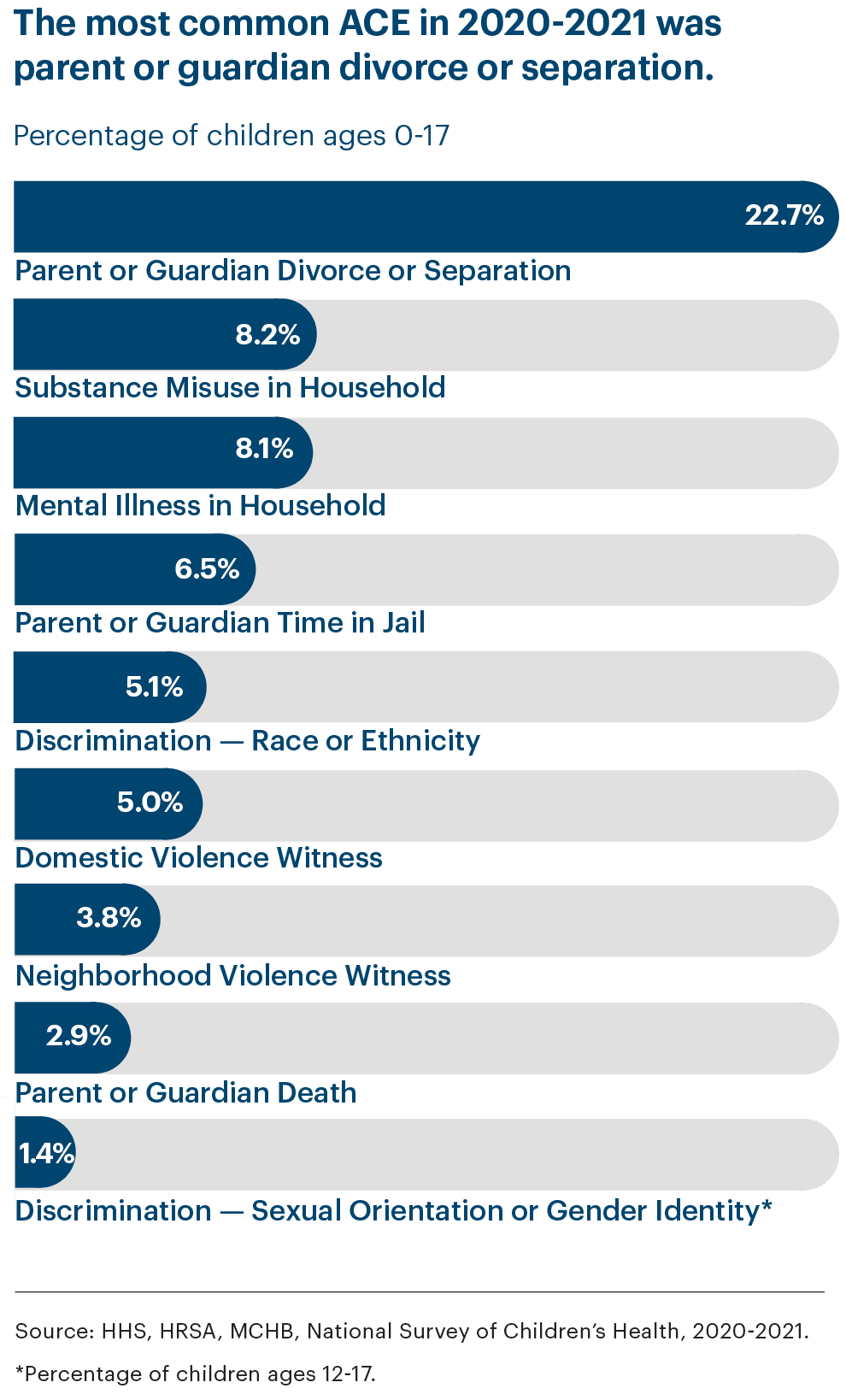
- Estimates in 2020-2021. Nationally, 14.0% of children ages 0-17 experienced two or more of nine adverse childhood experiences (ACEs), as reported by a caregiver, equating to 9.9 million children. The prevalence of two or more adverse childhood experiences was 2.5 times higher in New Mexico (24.7%), the state with the highest value, compared with New York (9.8%), the state with the lowest value.
- Changes over time. Between 2018-2019 and 2020-2021, the rate of being treated unfairly due to race or ethnicity significantly increased 19%, from 4.3% to 5.1%, and having a parent or guardian serve time in jail significantly decreased 13%, from 7.5% to 6.5%.
Neighborhood Amenities
Neighborhood amenities offer individuals opportunities to socialize, play, exercise and enjoy the neighborhood in which they live. There is evidence that safe neighborhoods with opportunities for and access to community engagement and healthy lifestyle habits
contribute positively to physical and mental health.
- Changes over time. Nationally, the percentage of children ages 0-17 whose caregiver reported that they had access to neighborhood amenities significantly decreased 8% from 38.7% to 35.5% between 2018-2019 and 2020-2021. Neighborhood amenities are defined as all of the following: a park or playground; recreation center, community center or boys' and girls' club; library or bookmobile; and sidewalks or walking paths. Access to neighborhood amenities significantly decreased 21% in Arizona (39.6% to 31.3%) and 17% in Washington (42.9% to 35.5%).
- Disparities. Access to neighborhood amenities was 4.1 times higher in Colorado and Illinois (both 53.4%), the states with the highest values, compared with Mississippi (12.9%), the state with the lowest value. The prevalence in the District of Columbia (67.0%) was higher than in any state.
The unemployment rate spiked during the COVID pandemic, disproportionately affecting women.
Unemployment
A stable and well-paying job makes it possible for people
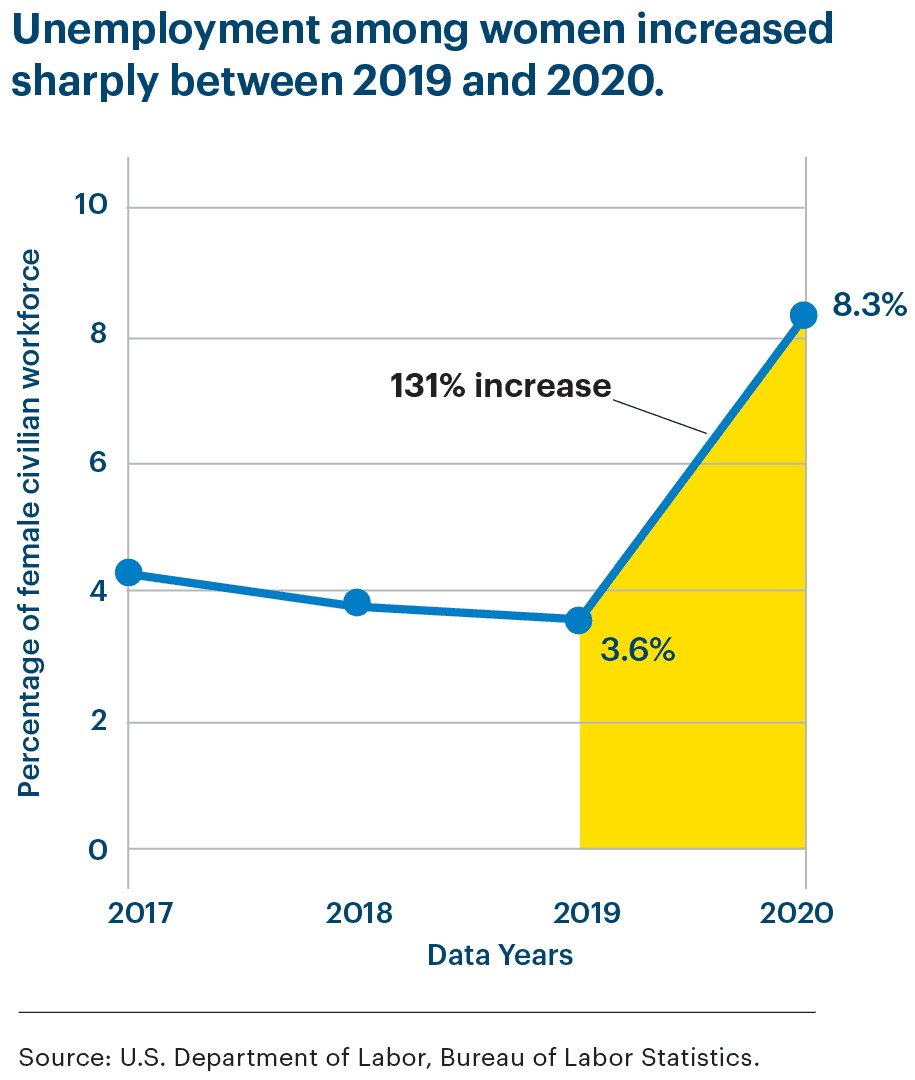
to maintain good health. Unemployment among women decreased between 2017 and 2019 but spiked in 2020 due to the COVID-19 pandemic. The rate among women
peaked at 15.4% in April of 2020, higher than the overall unemployment rate of 14.7%. Working women composed the majority of the
4.2 million Americans who left the labor force in 2020, with Hispanic and Black women experiencing a sharper decline in employment. By August 2022, the unemployment rate among women
had declined to 3.3%.
- Changes over time. Nationally, the percentage of the female civilian workforce who were unemployed increased 131% nationally from 3.6% to 8.3%, an increase of about 3.5 million women between 2019 and 2020. Unemployment among women significantly increased in 41 states and the District of Columbia, led by 480% in Hawaii (2.0% to 11.6%).
- Disparities. The unemployment rate among women was 3.1 times higher in Nevada (13.2%), the state with the highest value in 2020, compared with Nebraska (4.2%), the state with the lowest value.
Concentrated Disadvantage
- Estimates in 2016-2020. Nationally, 26.1% of households with children were located in areas of concentrated disadvantage, affecting an estimated 9.8 million people. Households were identified as being in an area of concentrated disadvantage if the averaged z-score was above the 75th percentile for the following factors: percentage of family households below the poverty line; percentage of individuals receiving public assistance; percentage of female-headed households; percentage of unemployed population ages 16 and older; and percentage of population younger than age 18. The most common factor was receiving public assistance (24.4%), and the least common was being unemployed (5.4%).
- Disparities. Concentrated disadvantage was 16.4 times higher in New Mexico (47.6%), the state with the highest value, compared with Vermont (2.9%), the state with the lowest value.
College Graduate

 Alabama
 Alaska
 Arizona
 Arkansas
 California
 Colorado
 Connecticut
 Delaware
 District of Columbia
 Florida
 Georgia
 Hawaii
 Idaho
Idaho Illinois
 Indiana
 Iowa
Iowa Kansas
 Kentucky
 Louisiana
 Maine
Maine Maryland
 Massachusetts
 Michigan
 Minnesota
 Mississippi
 Missouri
 Montana
 Nebraska
 Nevada
 New Hampshire
 New Jersey
 New Mexico
 New York
 North Carolina
 North Dakota
 Ohio
Ohio Oklahoma
 Oregon
 Pennsylvania
 Rhode Island
 South Carolina
 South Dakota
 Tennessee
 Texas
Texas Utah
Utah Vermont
 Virginia
 Washington
 West Virginia
 Wisconsin
 Wyoming
 US SummaryAppendixMeasures Table – WomenMeasures Table – ChildrenData Source DescriptionsMethodology