Changes over time. Nationally, the percentage of adults ages 65 and older who live below the poverty level significantly increased 10% from 9.4% to 10.3% between 2019 and 2021. In 2021 this corresponded to 5.6 million older adults, an increase of 638,347 since 2019. Between 2019 and 2021,
poverty significantly increased in 16 states, led by 49% in
Vermont (6.1% to 9.1%), 43% in
South Dakota (7.7% to 11.0%) and 38% in
Idaho (6.9% to 9.5%). By race/ethnicity, the prevalence significantly increased 21% among
multiracial (12.5% to 15.1%) and 12% among
white (7.3% to 8.2%) older adults.
* The estimate for the highest group was not significantly different from the American Indian/Alaska Native and Hawaiian/Pacific Islander estimates, based on non-overlapping 95% confidence intervals.
Related Measure: Housing Cost Burden
In 2021, 31.8% of households with one or more adults ages 65 and older were
housing cost-burdened — meaning housing costs were more than 30% of household income — corresponding to nearly 12.4 million households. Between 2018 and 2021, housing cost burden among older adults significantly decreased in three states: 9% in
Indiana (27.4% to 24.9%), 8% in
Pennsylvania (32.1% to 29.5%) and 7% in
Ohio (29.7% to 27.6%). During the same period, housing cost burden significantly increased 8% in
Texas (29.0% to 31.3%). Housing cost burden was 2.1 times higher in
California (40.5%) than
West Virginia (19.1%) in 2021.
Changes over time. Nationally, the percentage of adults ages 60 and older who faced the threat of hunger in the past 12 months decreased 6% from 12.6% to 11.9% between 2019 and 2020 and 11% (from 13.3%) since 2018.
Food insecurity decreased by 11% or more in 21 states between 2017-2018 and 2019-2020, led by 48% in
Nevada (20.9% to 10.8%), 31% in
Utah (10.7% to 7.4%) and 28% in both
Kansas (15.5% to 11.2%) and
New Mexico (18.8% to 13.5%). Over the same period, food insecurity increased by 11% or more in seven states, led by 39% in
Kentucky (14.4% to 20.0%), 31% in
Rhode Island (10.5% to 13.8%) and 27% in
Wyoming (9.9% to 12.6%).
Disparities. Food insecurity was 3.3 times higher in
Louisiana (21.0%) than
New Hampshire (6.4%), the states with the highest and lowest rates in 2019-2020.
Social Support and Engagement
Community Support Expenditures
Most older adults
value living in their own home safely and independently. Since the Older Americans Act (OAA) of 1965, the
Administration on Aging has provided funding to states for community, social and nutritional services that assist adults ages 60 and older and their caregivers. A 2013 study found that increases in home- and community-based services for older adults — such as home-delivered meals, congregate meals or senior centers — were associated with a
decrease in the proportion of low-care residents in nursing homes.
Changes over time. Nationally,
community support expenditures — dollars captured by the Administration on Aging per adult ages 60 and older — increased 5% from $59 to $62 between 2020 and 2021 and 9% (from $57) since 2019. Community support expenditures increased by 5% or more in 22 states and the
District of Columbia, led by 273% in
North Carolina ($37 to $138 per adult ages 60 and older), 30% in
Maine ($30 to $39) and 29% in
Minnesota ($24 to $31). Over the same period, community support expenditures decreased by 5% or more in 14 states, led by 32% in
South Carolina ($25 to $17), 30% in
Idaho ($27 to $19) and 26% in
Delaware ($57 to $42).
Disparities. The rate of community support expenditures per capita was 16.0 times higher in
Massachusetts ($272 per adult ages 60 and older) than
South Carolina ($17), the states with the highest and lowest rates in 2021. However, the highest rate was in the
District of Columbia ($338).
Related Measure: Home-Delivered Meals
Nationally, the number of adults ages 60 and older served an OAA-funded
home-delivered meal per 100 adults ages 60 and older with independent living difficulty increased 79% from 8.9 to 15.9 between 2019 and 2021. The rate of home-delivered meals was 14.0 times higher in
North Dakota (81.3 per 100 adults ages 60 and older with independent living difficulty) than
Georgia (5.8), the states with the highest and lowest rates in 2021.
Related Measure: Senior Centers
Nationally, the number of
senior centers receiving OAA Title III funds per 100,000 adults ages 60 and older decreased 5% from 6.4 to 6.1 between 2020 and 2021 and 23% (from 7.9) since 2019, meaning funds were diverted from senior centers to other programs like home-delivered meals. Senior centers receiving OAA funds decreased by 5% or more in 17 states, led by 98% in
New Jersey (5.4 to 0.1 per 100,000 adults ages 60 and older), 48% in Iowa (14.5 to 7.6) and 43% in Hawaii (1.4 to 0.8). Over the same period, senior centers receiving OAA funds increased by 5% or more in seven states, led by 263% in
Rhode Island (3.0 to 10.9), 122% in
Oklahoma (9.8 to 21.8) and 87% in
Massachusetts (4.6 to 8.6). The rate of senior centers receiving OAA funds was highest in
Wyoming (45.1) and lowest in
Delaware,
Kansas,
Montana,
New Hampshire,
North Dakota and
West Virginia (all zero), the states with the highest and lowest rates in 2021.
Changes over time. Nationally, the percentage of households with adults ages 65 and older that had a broadband internet subscription and a computer, smartphone or tablet significantly increased 7% from 78.0% to 83.1% between 2019 and 2021. In 2021 this corresponded to nearly 45.3 million households. Between 2019 and 2021,
high-speed internet access significantly increased in 46 states, led by 14% in
Mississippi (63.8% to 72.5%) and 10% in
North Dakota (71.6% to 79.1%),
New Mexico (70.8% to 78.2%),
Maine (76.6% to 84.2%) and
Iowa (72.3% to 79.3%).
Disparities. High-speed internet access was 1.2 times higher in
Utah (88.6%) than
Mississippi (72.5%), the states with the highest and lowest rates in 2021.
Some
research has found that the percentage of adults ages 50-80 who felt isolated from others some of the time has largely improved from the height of the pandemic in 2020 but still exceeds pre-pandemic 2018 rates. Socially isolated older adults are left further vulnerable as they go through stressful life events common to aging, such as losing a close friend or family member, or changing or losing a familiar role (i.e., retiring), without the
buffering effects of social support.
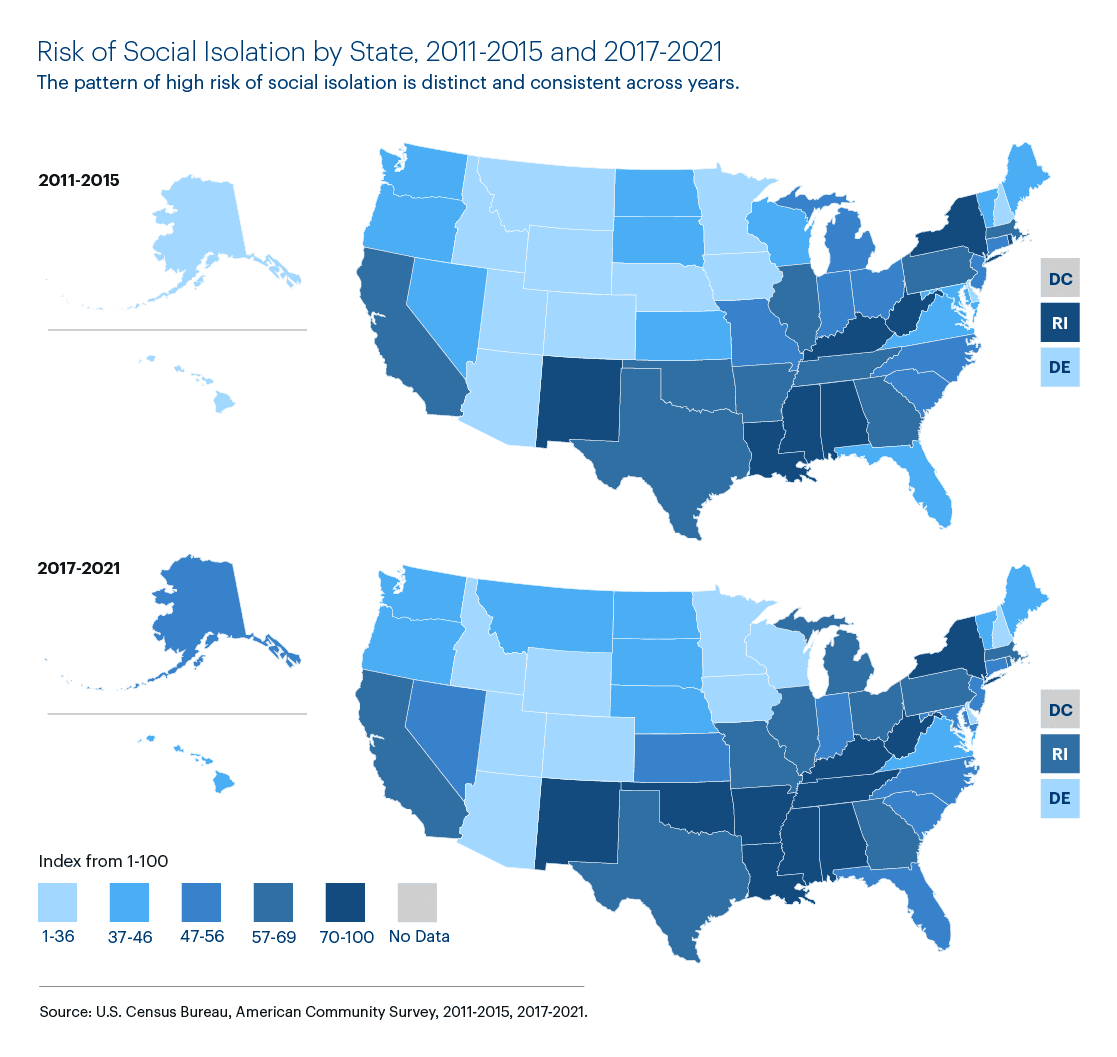
Risk of social isolation is an index of these social isolation risk factors: poverty; living alone; divorced, separated or widowed; never married; disability; and independent living difficulty. This index is normalized on a scale of 1 to 100, with a higher value indicating greater risk among adults ages 65 and older. Risk of social isolation was highest in
Mississippi (100) and lowest in
Utah (1) in 2017-2021. Nationally, the most common risk factors were being
divorced, separated or widowed (38.2%),
living alone (37.0%) and having a
disability (33.4%). The least common risk factor was having
never married (6.1%). County-level risk of social isolation maps are available for download on the
America’s Health Rankings website.
Changes over time. Nationally, the majority of risk factors for social isolation have significantly improved between 2011-2015 and 2017-2021:
- Independent living difficulty decreased 12% from 15.5% to 13.6%; however, the absolute number increased from 6.7 to 7.0 million older adults.
- Disability decreased 7% from 36.0% to 33.4%; however, the absolute number increased from 15.6 to 17.2 million older adults.
- Being divorced, separated or widowed decreased 5% from 40.2% to 38.2%; however, the absolute number increased from 17.9 to 20.2 million older adults.
- Living alone decreased 3% from 38.0% to 37.0%; however, the absolute number increased from 11.9 to 13.9 million older adults.
Over the same period, having
never married significantly increased 22% from 5.0% to 6.1% and from 2.2 to 3.2 million older adults.
Changes over time. Nationally, the percentage of adults ages 65 and older who reported volunteering in the past 12 months decreased 22% from 28.5% to 22.1% between 2019 and 2021.
Volunteerism decreased by 22% or more in 22 states, led by 45% in
Louisiana (26.6% to 14.7%), 39% in
Alabama (27.6% to 16.9%) and 38% in
Georgia (28.2% to 17.4%).
Disparities. Volunteerism was 3.0 times higher in
Utah (44.2%) than
Louisiana (14.7%), the states with the highest and lowest percentages in 2021.

 US Summary
 Alabama
 Alaska
 Arizona
 Arkansas
 California
 Colorado
 Connecticut
 Delaware
 District of Columbia
 Florida
 Georgia
 Hawaii
 Idaho
Idaho Illinois
 Indiana
 Iowa
Iowa Kansas
 Kentucky
 Louisiana
 Maine
Maine Maryland
 Massachusetts
 Michigan
 Minnesota
 Mississippi
 Missouri
 Montana
 Nebraska
 Nevada
 New Hampshire
 New Jersey
 New Mexico
 New York
 North Carolina
 North Dakota
 Ohio
Ohio Oklahoma
 Oregon
 Pennsylvania
 Rhode Island
 South Carolina
 South Dakota
 Tennessee
 Texas
Texas Utah
Utah Vermont
 Virginia
 Washington
 West Virginia
 Wisconsin
 Wyoming