Geriatricians and geriatric nurse practitioners are
specially trained to meet the unique needs of older adults. Specialized care can be helpful when an older person is coping with multiple chronic conditions or managing multiple medications, as some drugs may negatively interact with others or have side effects that impact well-being.
Changes over time. Nationally, the number of family medicine and internal medicine geriatricians and nurse practitioners per 100,000 adults ages 65 and older increased 8% from 33.8 to 36.4 between 2021 and 2022, and 26% (from 29.0) since 2018. There were 20,344
geriatric providers in 2022, an increase of 1,553 providers since 2021. Between 2021 and 2022, the rate of geriatric providers increased by 8% or more in 23 states and the
District of Columbia, led by 67% in
North Dakota (13.0 to 21.7 providers per 100,000 adults ages 65 and older), 21% in
Oklahoma (17.9 to 21.7) and 18% in
South Dakota (14.6 to 17.3).
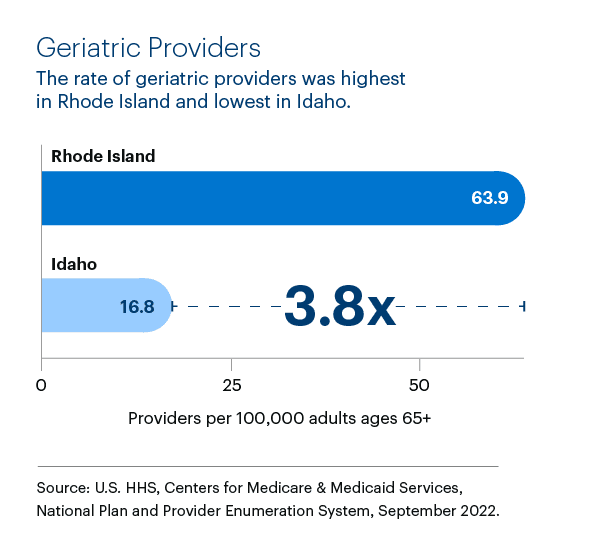
Disparities. The rate of geriatric providers was 3.8 times higher in
Rhode Island (63.9 providers per 100,000 adults ages 65) than
Idaho (16.8), the states with the highest and lowest rates in 2022. However, the highest rate was in the
District of Columbia (90.9).
Home health and
personal care aides enable older adults to remain in their homes as they age. These aides
provide short-term skilled nursing services, such as aiding in recovery from surgery, as well as long-term care for those with disabilities, functional decline or chronic illness. There is currently a
shortage of these workers in many communities and the need is expected to increase. The Bureau of Labor Statistics
projects employment of home health and personal care aids will grow by 25% between 2021 and 2031.
Changes over time. Nationally, the number of personal care and home health aides per 1,000 adults ages 65 and older increased 5% from 57.7 to 60.3 between 2020 and 2021, and 29% (from 46.9) since 2016. In 2021 there were nearly 3.4 million home health care workers, an increase of 154,890 since 2020. Between 2020 and 2021, the rate of
home health care workers increased by 5% or more in 18 states, led by 24% in
New Jersey (37.5 to 46.4 workers per 1,000 adults ages 65 and older), 20% in
California (100.0 to 120.4) and 15% in both
Michigan (37.8 to 43.4) and
Rhode Island (36.2 to 41.8). Over the same period, the rate decreased by 5% or more in 14 states, led by 29% in both
Hawaii (32.8 to 23.4) and
Vermont (56.5 to 40.3) and 15% in
Maryland (33.1 to 28.0).
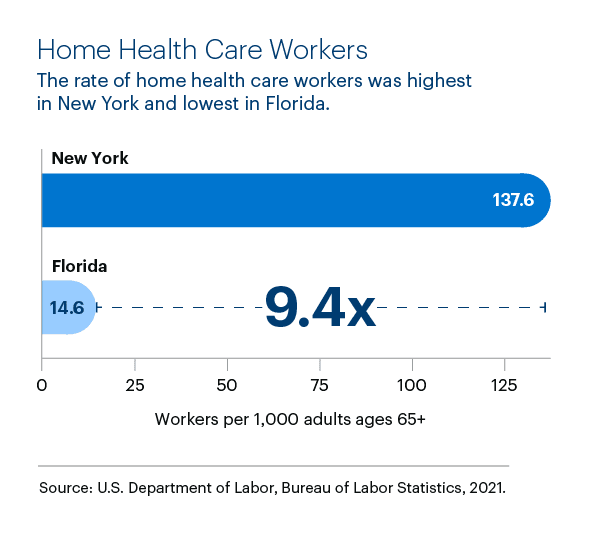
Disparities. The rate of home health care workers was 9.4 times higher in
New York (137.6 workers per 1,000 adults ages 65 and older) than
Florida (14.6), the states with the highest and lowest rates in 2021.
While standard medical care may focus on finding a cure, hospice care emphasizes
pain control and emotional support for patients and their families. Hospice care is provided in a patient’s home — where most individuals
prefer to die — or in a freestanding hospice facility, hospital or long-term care facility.
Changes over time. Nationally, the percentage of Medicare decedents who were in hospice at time of death decreased 8% from 50.7% to 46.7% between 2018 and 2020.
Hospice care decreased by 8% or more in nine states and the District of Columbia, led by 22% in the
District of Columbia (33.2% to 25.8%), 18% in
New York (30.0% to 24.7%), 13% in both
Delaware (59.4% to 51.9%) and
New Jersey (45.6% to 39.5%) and 11% in
Rhode Island (57.5% to 51.2%). Over the same period, hospice care increased 32% in
Alaska (22.8% to 30.1%); other states had increases but none equal to or greater than the national change.
Disparities. Hospice care was 2.5 times higher in
Utah (60.7%) than
New York (24.7%), the states with the highest and lowest percentages in 2020.
As of February 2023, 94.3% of adults ages 65 and older had completed a primary
COVID-19 vaccination series, and 41.3% had received a
bivalent booster dose; booster vaccination in this population doubled between October 2022 and February 2023. Roughly a quarter of older adults who had COVID-19, however, experienced symptoms consistent with
long COVID. By age group, the prevalence of long COVID was 28.5% among those
ages 60-69, 21.9% among those
ages 70-79 and 24.5% among those
ages 80 and older.

 US Summary
 Alabama
 Alaska
 Arizona
 Arkansas
 California
 Colorado
 Connecticut
 Delaware
 District of Columbia
 Florida
 Georgia
 Hawaii
 Idaho
Idaho Illinois
 Indiana
 Iowa
Iowa Kansas
 Kentucky
 Louisiana
 Maine
Maine Maryland
 Massachusetts
 Michigan
 Minnesota
 Mississippi
 Missouri
 Montana
 Nebraska
 Nevada
 New Hampshire
 New Jersey
 New Mexico
 New York
 North Carolina
 North Dakota
 Ohio
Ohio Oklahoma
 Oregon
 Pennsylvania
 Rhode Island
 South Carolina
 South Dakota
 Tennessee
 Texas
Texas Utah
Utah Vermont
 Virginia
 Washington
 West Virginia
 Wisconsin
 Wyoming