Community and Family Safety
The firearm death rate worsened among older adults, largely due to suicides.
In 2020,
firearms were the most common method of suicide in the U.S., accounting for
53% of all suicide deaths. This issue is of particular concern for older adults, who have
higher overall suicide rates and are significantly more likely to commit suicide by firearm. In 2018,
70% of suicide deaths among adults age 65 and older involved a firearm. The firearm homicide rate is also on the rise. In 2020,
79% of homicides in the U.S. used a firearm, a 35% increase from the year before and a record high since 1994.
Community violence interventions can address the specific needs of a local community with mental health and social support services. They are most effective when partnered with local government agencies that can expand their resources and reach. State-level policy recommendations include strengthening
firearm legislation, particularly background check and permit laws.
In 2020-2022, there were nearly 23,000
firearm deaths among older adults, almost 2,400 more than in 2017-2019. Between 2017-2019 and 2020-2022, the firearm death rate significantly increased in two states: 37% in
Iowa (10.7 to 14.7) and 25% in
Indiana (13.4 to 16.7). During this time, the rate also significantly increased 14% among those
age 85 and older (15.5 to 17.6) and 6% among those
ages 75-84 (15.1 to 16.0).
Disparities. In 2020-2022, the firearm death rate significantly varied by geography, gender, race/ethnicity and age group. The rate among adults age 65 and older was:
- 10.0 times higher in Wyoming (32.9 deaths per 100,000 adults age 65 and older) than Massachusetts (3.3).
- 9.9 times higher among men (26.8) than women (2.7).
- 9.6 times higher among white (16.4) than Asian (1.7) older adults.
- 1.5 times higher among those age 85 and older (17.6) than those ages 65-74 (11.5).
Food insecurity and poverty worsened among older adults, failing to make progress toward national Healthy People 2030 targets.
Many older adults subsist on
limited incomes and modest savings that may restrict their ability to afford basic medical care and put them at increased risk of
poor health outcomes and
mortality associated with poverty. Among older adults, poverty is linked to higher rates of
disability,
homelessness, and
physical and cognitive decline. In 2020, racial/ethnic minorities made up the
majority of older adults in poverty, despite accounting for only 24% of the U.S. older adult population. Many federal, state and local government programs exist to support and help reduce the number of older adults living in poverty, including
Social Security,
Supplemental Security Income,
Medicare,
Medicaid,
housing assistance and
SNAP benefits.
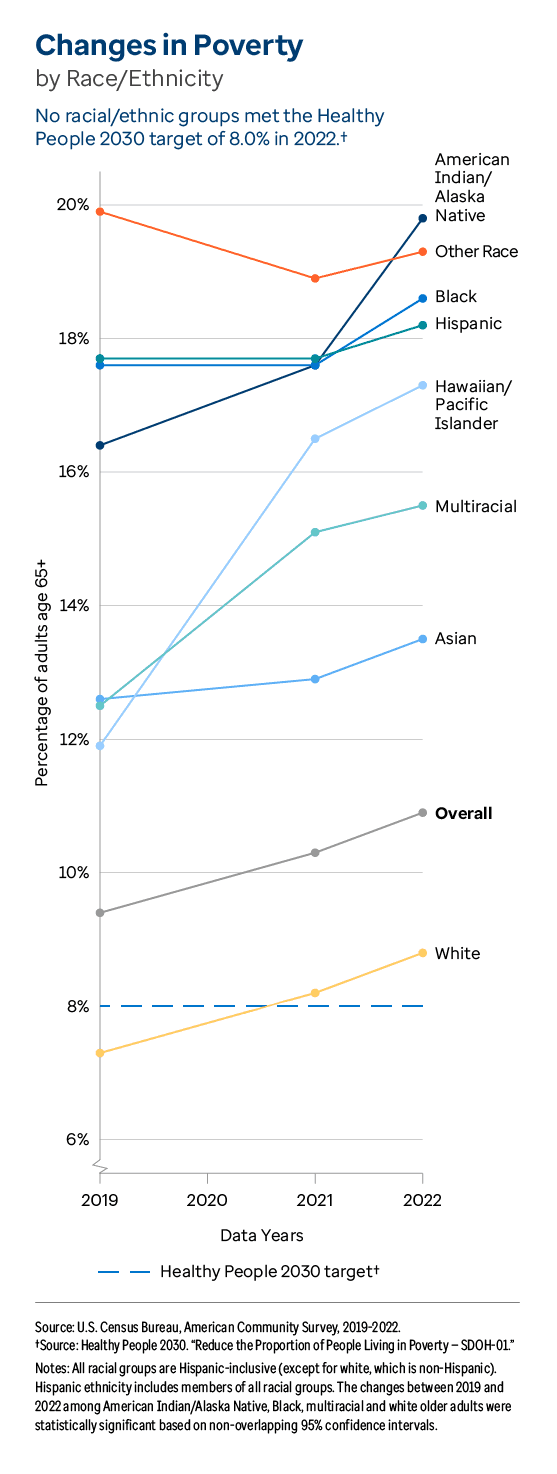
In 2022, there were approximately 6.2 million older adults living in poverty — nearly 1.2 million more than in 2019 and 550,000 more than in 2021. Between 2019 and 2022, the prevalence of poverty among older adults significantly increased in 31 states, led by: 45% in
Montana (8.6% to 12.5%), 42% in
South Dakota (7.7% to 10.9%) and 38% in
Rhode Island (8.9% to 12.3%). Between 2019 and 2022, the prevalence significantly increased:
Disparities. In 2022, poverty significantly varied by race/ethnicity and geography. The prevalence among adults age 65 and older was:
- 2.3 times higher among American Indian/Alaska Native (19.8%) than white (8.8%) older adults.*
- 2.1 times higher in the District of Columbia (15.9%), and 2.0 times higher in Louisiana (14.8%), than in Utah (7.5%), the state with the lowest rate. Utah, Delaware (7.7%), New Hampshire (7.9%), Vermont (7.9%) and Colorado (8.0%) are the states whose older adult populations have met the Healthy People 2030 target for poverty.
Food insecurity is an
economic and social condition involving limited or uncertain regular access to food. Many older adults who live at home report eating less or
skipping meals entirely due to challenges obtaining or preparing food. Food-insecure older adults have
significantly reduced intakes of vital nutrients and a higher prevalence of
health problems such as heart attack, congestive heart failure, asthma and depression.
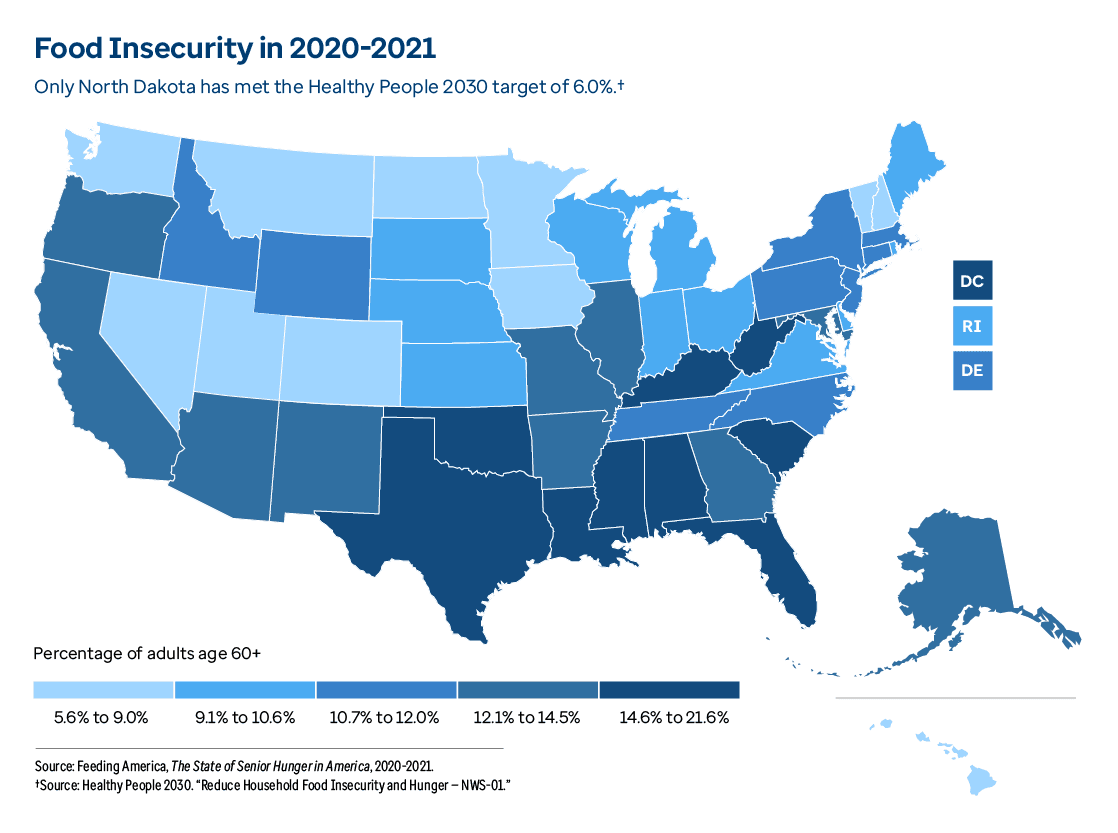
Changes over time. Nationally, the percentage of adults age 60 and older who faced the threat of hunger in the past 12 months increased 8% from 11.9% to 12.9% between 2020 and 2021, reversing a downward trend since 2014. The percentage of food-insecure older adults is more than double the
Healthy People 2030 target of 6.0% for all households nationwide.
Between 2018-2019 and 2020-2021, the prevalence of
food insecurity increased 8% or more (equal to or greater than the national change) in 14 states, led by: 34% in
Oklahoma (15.6% to 20.9%), 29% in
Massachusetts (9.3% to 12.0%) and 28% in
Minnesota (5.8% to 7.4%). During the same period, it decreased 8% or more in 23 states, led by: 47% in
Nevada (16.9% to 8.9%), 37% in
New Mexico (19.7% to 12.5%) and 36% in
Kansas (15.0% to 9.6%).
Disparities. The prevalence of food insecurity among adults age 60 and older was 3.9 times higher in
Mississippi (21.6%) than
North Dakota (5.6%) in 2020-2021.
Social Support and Engagement
The percentage of older adult households with high-speed internet access improved, along with several risk factors for social isolation. Additionally, more than 37.1 million people were supporting older adults as unpaid caregivers in 2021-2022.
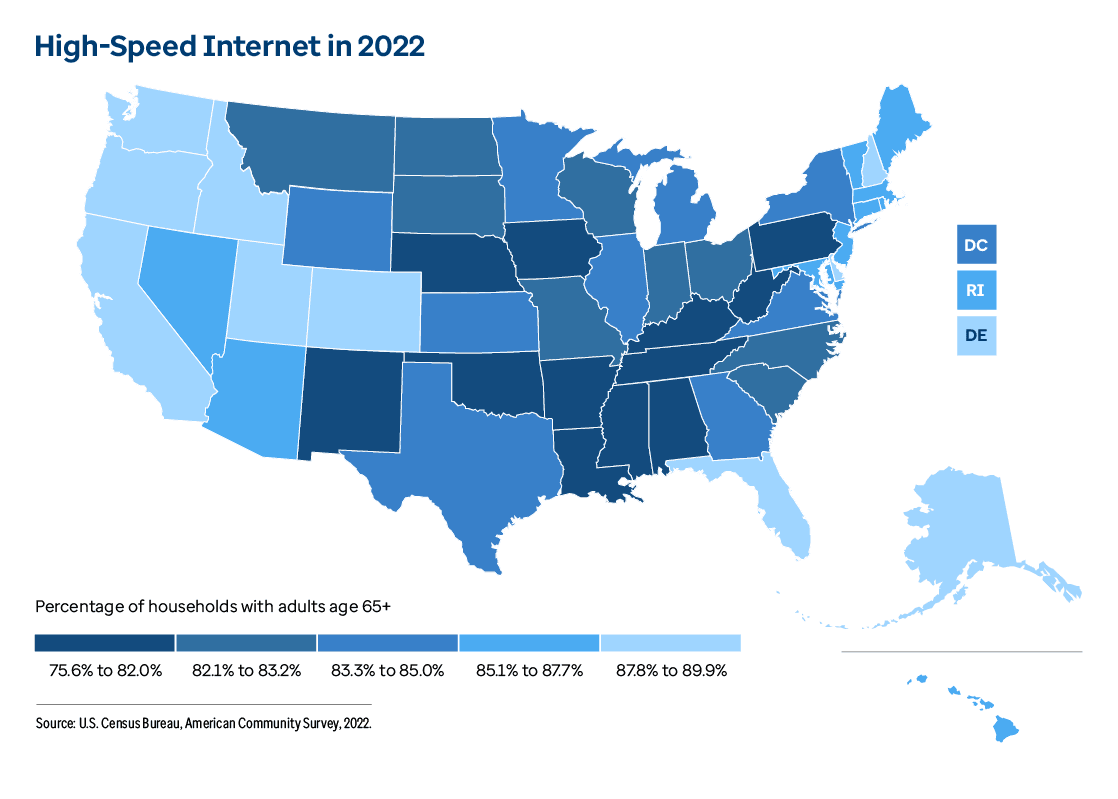
Changes over time. Nationally, the percentage of households with adults age 65 and older that had a broadband internet subscription and a computer, smartphone or tablet significantly increased 2% from 83.1% to 84.8% between 2021 and 2022. This measure has increased 19% (up from 71.1%) since 2016.
More than 47.5 million older adult households had
high-speed internet access in 2022, nearly 2.3 million more households than in 2021. Between 2021 and 2022, the prevalence of high-speed internet significantly increased in 25 states, led by: 5% in
Idaho (84.3% to 88.4%) and
Alabama (76.2% to 80.2%), and 4% in
Mississippi (72.5% to 75.6%).
Disparities. The prevalence of high-speed internet among households with adults age 65 and older was 1.2 times higher in
Utah (89.9%) than Mississippi (75.6%) in 2022.
Medicare Advantage plans have begun to offer more flexible supplemental benefits that address social isolation directly or indirectly, such as home-delivered meals, ride-sharing services and companionship initiatives.
Expanding collaboration between public transportation and public health to improve accessibility and supporting
employment opportunities for older adults at the structural level (e.g., by revising workplace policies or providing age-friendly training) are also effective avenues for improving social connectivity among older adults.
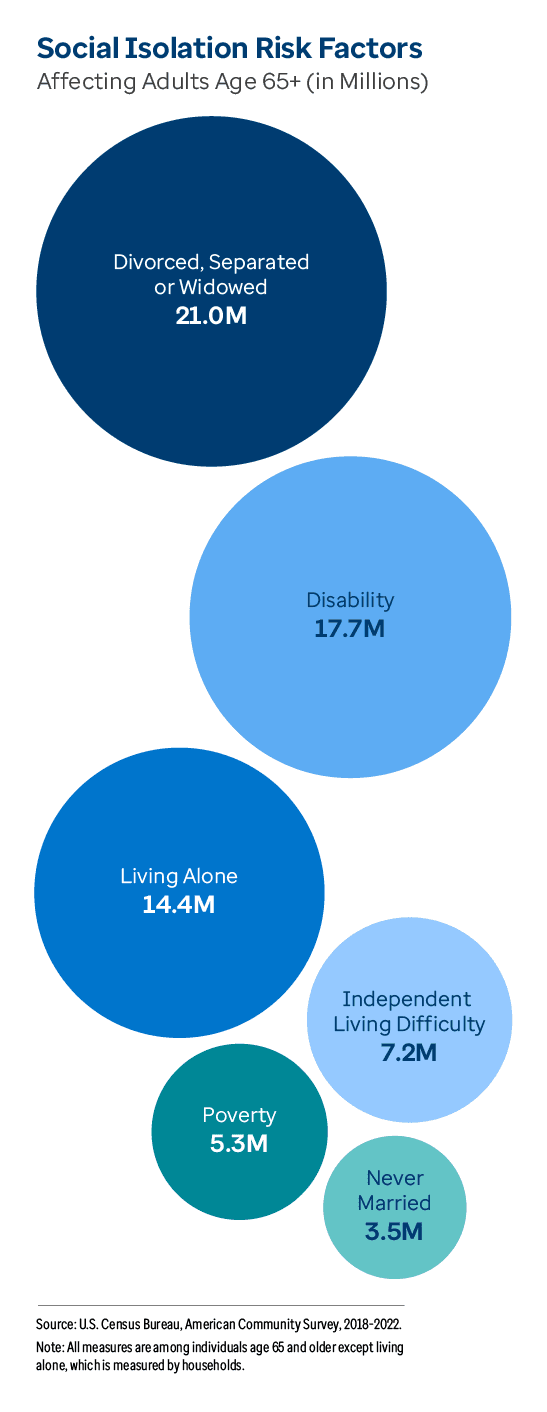
Risk of social isolation is an index of these risk factors: living in poverty; living alone; being divorced, separated or widowed; having never married; having a disability; and having an independent living difficulty. This index is normalized on a scale of 1 to 100, with a higher value indicating greater risk among adults age 65 and older. Risk of social isolation was highest in
Mississippi (100) and lowest in
Utah (1) in 2018-2022.
Changes over time. Nationally, most risk factors for social isolation among adults age 65 and older significantly improved between 2011-2015 and 2018-2022:
- Independent living difficulty decreased 12% from 15.5% to 13.6%, affecting 7.2 million older adults in 2018-2022.
- Disability decreased 8% from 36.0% to 33.3%, affecting 17.7 million older adults in 2018-2022.
- Being divorced, separated or widowed decreased 5% from 40.2% to 38.3%, affecting 21.0 million older adults in 2018-2022.
- Living alone decreased 2% from 38.0% to 37.2%, affecting 14.4 million households in 2018-2022.
Over the same period, however, the risk factors of living in
poverty and having
never married significantly increased.
Disparities. The prevalence of social isolation risk factors among adults age 65 and older varied by geography in 2018-2022:
- Independent living difficulty was 1.7 times higher in Mississippi (16.7%) than Wyoming (9.6%).
- Living alone was 1.6 times higher in North Dakota (44.0%) than Hawaii (28.1%).
- Disability was 1.4 times higher in Oklahoma (41.0%) than Connecticut (29.1%).
- Being divorced, separated or widowed was 1.3 times higher in Louisiana (41.9%) than Utah (31.7%).
While many older adults receive the additional care they need in assisted living facilities or from home health services, unpaid elder care is also often
provided by family members, friends or volunteers. Unpaid caregivers face various
challenges, including financial strain, worse health outcomes, caregiver burnout and higher rates of anxiety and
depression. The
majority of caregivers are women, and family caregiving responsibilities are frequently cited as a reason women
leave the workforce.
Addressing unpaid elder care in the U.S. requires implementing policies and programs that support caregivers, such as expanded tax credits. The
National Family Caregiver Support Program allocates funds to states and territories to assist family members and other informal caregivers in caring for older adults at home for as long as possible. Research indicates that the counseling, training and other services provided may
strengthen the health and well-being of caregivers and enable them to provide care for longer.
Nationally, 14.3% of individuals age 15 and older (37.1 million people) reported providing unpaid care or assistance to an adult age 65 or older who needed help because of a condition related to aging in 2021-2022. The prevalence of
unpaid elder care was 2.6 times higher in Louisiana (19.8%) than New Mexico (7.5%).
*The values for American Indian/Alaska Native, Hawaiian/Pacific Islander, Hispanic and Black older adults and older adults who identify their race as other may not be different based on non-overlapping 95% confidence intervals.

 US Summary
 Alabama
 Alaska
 Arizona
 Arkansas
 California
 Colorado
 Connecticut
 Delaware
 District of Columbia
 Florida
 Georgia
 Hawaii
 Idaho
Idaho Illinois
 Indiana
 Iowa
Iowa Kansas
 Kentucky
 Louisiana
 Maine
Maine Maryland
 Massachusetts
 Michigan
 Minnesota
 Mississippi
 Missouri
 Montana
 Nebraska
 Nevada
 New Hampshire
 New Jersey
 New Mexico
 New York
 North Carolina
 North Dakota
 Ohio
Ohio Oklahoma
 Oregon
 Pennsylvania
 Rhode Island
 South Carolina
 South Dakota
 Tennessee
 Texas
Texas Utah
Utah Vermont
 Virginia
 Washington
 West Virginia
 Wisconsin
 Wyoming