Social and Economic Factors | Community and Family Safety
Older adults faced rising rates of internet crime.
Changes over time. Nationally, the number of
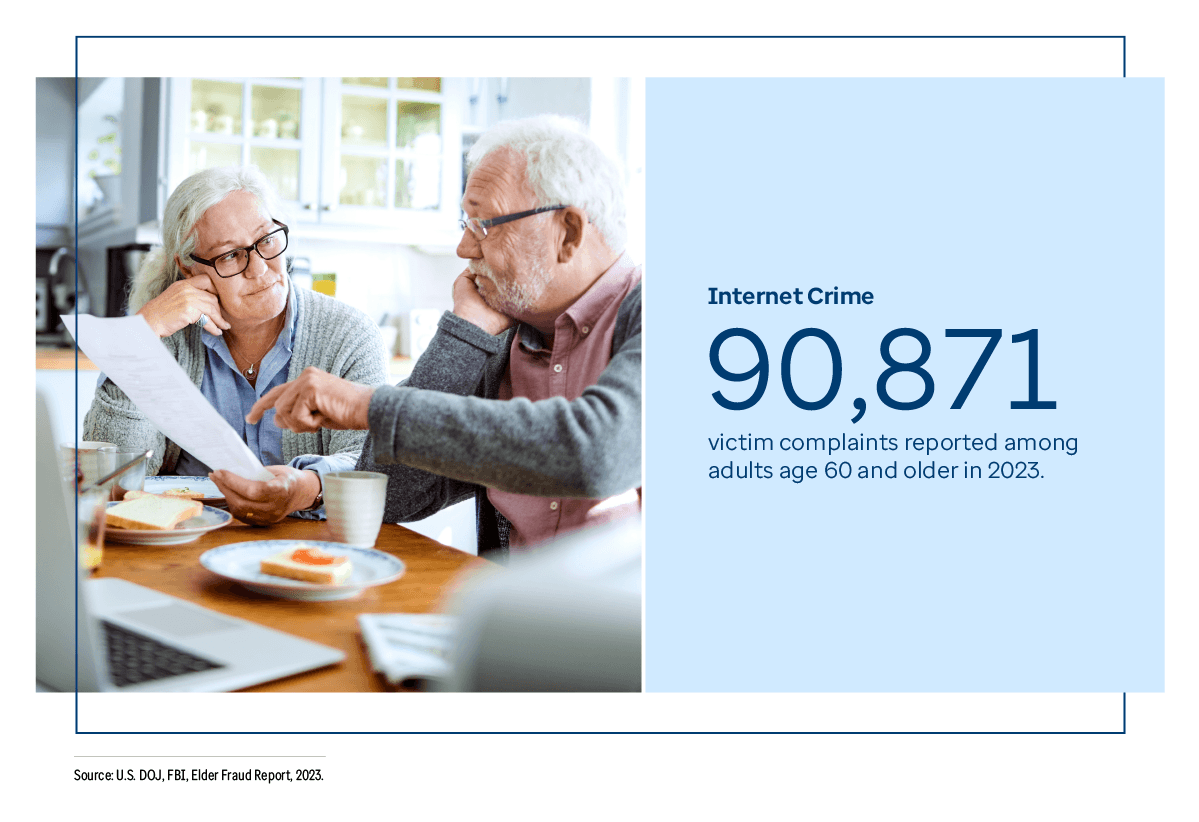
internet crime victim complaints increased 5% from 10.7 to 11.2 per 10,000 adults age 60 and older between 2022 and 2023. Nearly 90,900 internet crime victim complaints were reported among adults age 60 and older in 2023, almost 6,100 more than in 2022.
During this time, internet crime increased at a rate equal to or greater than the national change of 5% in 25 states. The largest increases were 36% in
Arizona (19.4 to 26.3 complaints per 10,000 adults age 60 and older), 25% in
Utah (13.2 to 16.5) and 22% in
Rhode Island (7.8 to 9.5). The rate also decreased in 10 states by 5% or more, led by 16% in both
Maine (10.9 to 9.2) and
Vermont (10.0 to 8.4), 15% in
New Jersey (10.6 to 9.0) and 13% in
Wyoming (14.2 to 12.4).
Differences. In 2023, the internet crime rate among older adults was 4.3 times higher in Arizona (26.3 complaints per 10,000 adults age 60 and older) than in
Mississippi (6.1).
Social and Economic Factors | Economic Resources
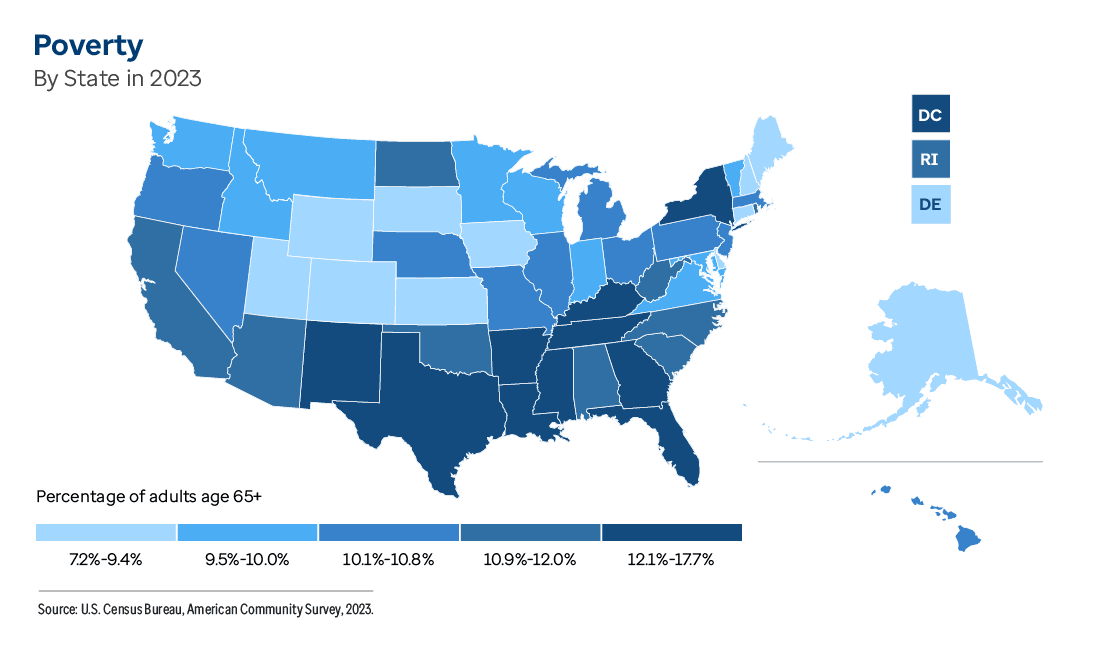
Poverty among older adults increased 4% in 2023 to another new high, with significant differences between populations.
Between 2022 and 2023, poverty among adults age 65 and older significantly increased 3% among
white older adults (8.8% to 9.1%).
During the same time, poverty increased in two states and decreased in one. Rates increased 11% in
Tennessee (11.0% to 12.2%) and 8% in
New York (13.2% to 14.3%), and decreased 24% in
Montana (12.5% to 9.5%).
Differences. In 2023, poverty significantly varied by geography and race/ethnicity. The prevalence among adults age 65 and older was:
- 2.2 times higher in Mississippi (15.8%) than in Alaska (7.2%).
- 2.1 times higher among other race (19.5%) and Black (19.2%) older adults compared with white older adults (9.1%).
Note: The values for other race, Black and
American Indian/Alaska Native (18.3%) older adults may not differ significantly from each other based on overlapping 95% confidence intervals.
Social and Economic Factors | Social Support and Engagement
Key social support measures improved, potentially bolstering older adults’ connectivity and engagement.
High-speed internet is a vital
resource for work, education and effective communication.
36 Many essential services require an internet connection, including
telemedicine and
telehealth.
37,38 Older adults in particular can benefit from broadband access, as it facilitates
social connectedness and enables access to news, information and essential services.
39 Some
studies have found that technology such as smartphones and social networking sites may help combat
loneliness among older adults.
40,41 Despite its necessity,
barriers to accessing high-speed internet remain, including cost and deficient infrastructure.
42 Changes over time. Nationally, the percentage of households with adults age 65 and older that have a broadband internet subscription and a computer, smartphone or tablet significantly increased 2% from 84.8% to 86.5% between 2022 and 2023, reaching another record in
Senior Report history. In 2023, 49.8 million older adult households had
high-speed internet access, 2.2 million more than in 2022.
Between 2022 and 2023, high-speed internet access increased in 28 states, led by 4% in both
South Dakota (82.4% to 85.6%) and
Nevada (87.7% to 90.8%).
Differences. In 2023, the prevalence of high-speed internet among households with adults age 65 and older was 1.2 times higher in Nevada (90.8%) than in
West Virginia (77.6%).
Volunteering serves the community and offers volunteers opportunities for
positive social interactions, increased social support, and a sense of
meaning and purpose during retirement.
43,44 Many volunteer opportunities involve active mental and physical engagement, socialization and learning, all good for
cognitive function.
45 Emerging evidence shows that older adults who volunteer regularly have fewer cognitive complaints and a lower risk for dementia compared with those who do not volunteer regularly.
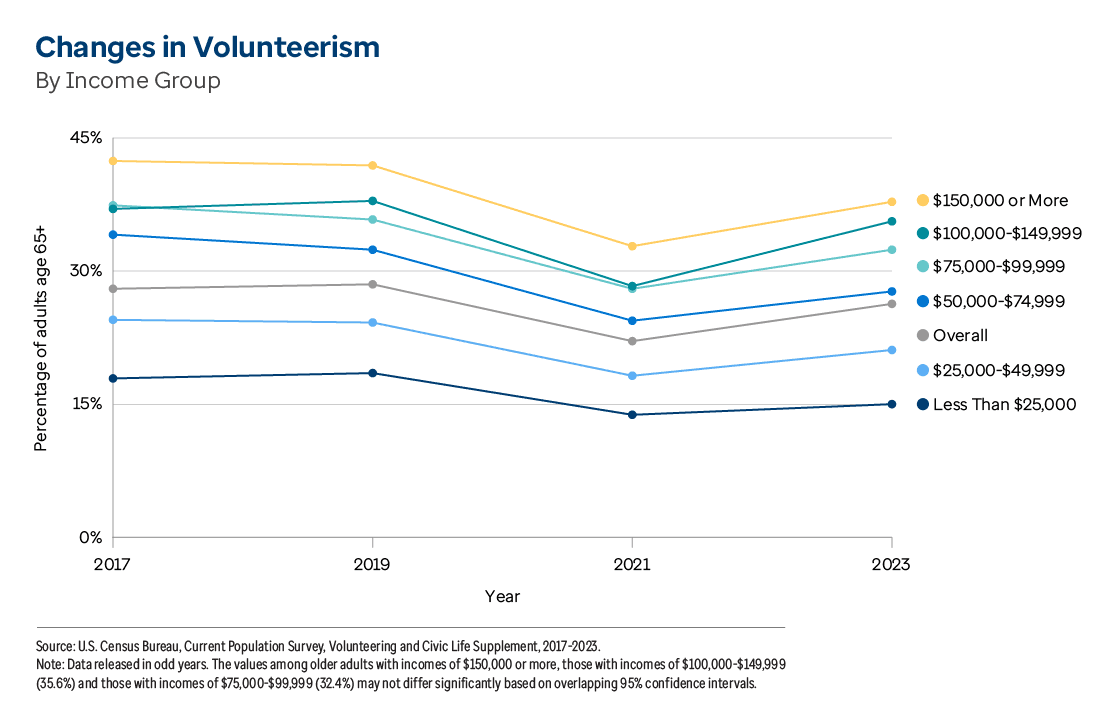
46 Changes over time. Nationally, the percentage of adults age 65 and older who reported volunteering in the past 12 months increased 19% from 22.1% to 26.3% between 2021 and 2023, nearly back to the 2019 rate (28.5%).
Between 2021 and 2023,
volunteerism among adults age 65 and older significantly increased:
During this time, volunteerism prevalence significantly increased in four states: 74% in
Tennessee (18.4% to 32.1%), 51% in
Oregon (23.8% to 36.0%), 47% in
Illinois (22.9% to 33.6%) and 36% in
California (15.2% to 20.6%).
Differences. In 2023, the prevalence of volunteerism significantly varied by educational attainment, race/ethnicity, geography and household income. The prevalence among adults age 65 and older was:
Note: The values for white and
multiracial (23.6%) older adults may not differ significantly from each other based on overlapping 95% confidence intervals. The same is true among Hispanic,
Asian (13.4%) and
American/Indian Alaska Native (17.1%) older adults; as well as among older adults with incomes of $150,000 or more, those with incomes of
$100,000-$149,999 (35.6%) and those with incomes of
$75,000-$99,999 (32.4%).

 US Summary
 Alabama
 Alaska
 Arizona
 Arkansas
 California
 Colorado
 Connecticut
 Delaware
 District of Columbia
 Florida
 Georgia
 Hawaii
 Idaho
Idaho Illinois
 Indiana
 Iowa
Iowa Kansas
 Kentucky
 Louisiana
 Maine
Maine Maryland
 Massachusetts
 Michigan
 Minnesota
 Mississippi
 Missouri
 Montana
 Nebraska
 Nevada
 New Hampshire
 New Jersey
 New Mexico
 New York
 North Carolina
 North Dakota
 Ohio
Ohio Oklahoma
 Oregon
 Pennsylvania
 Rhode Island
 South Carolina
 South Dakota
 Tennessee
 Texas
Texas Utah
Utah Vermont
 Virginia
 Washington
 West Virginia
 Wisconsin
 Wyoming