Early deaths among adults ages 65-74 have nearly returned to 2019 levels, social support and engagement measures are improving, and the number of geriatric clinicians is on the rise. Despite these successes, drug deaths and suicides reached the highest levels in Senior Report history, and socioeconomic challenges persist.
Health Outcomes | Behavioral Health
Drug overdose and suicide deaths among older adults reached new highs, while excessive drinking decreased.
Drug overdose deaths among older adults
have risen in the United States over the past two decades.
2 Drug abuse is hazardous for older adults because age-related changes in the liver reduce the ability to
metabolize medications, and most older adults take
one or more prescription medications.
3,4 They may also take
nonprescription medications and
dietary herbal supplements, which can further complicate drug interactions and lead to drug-induced death.
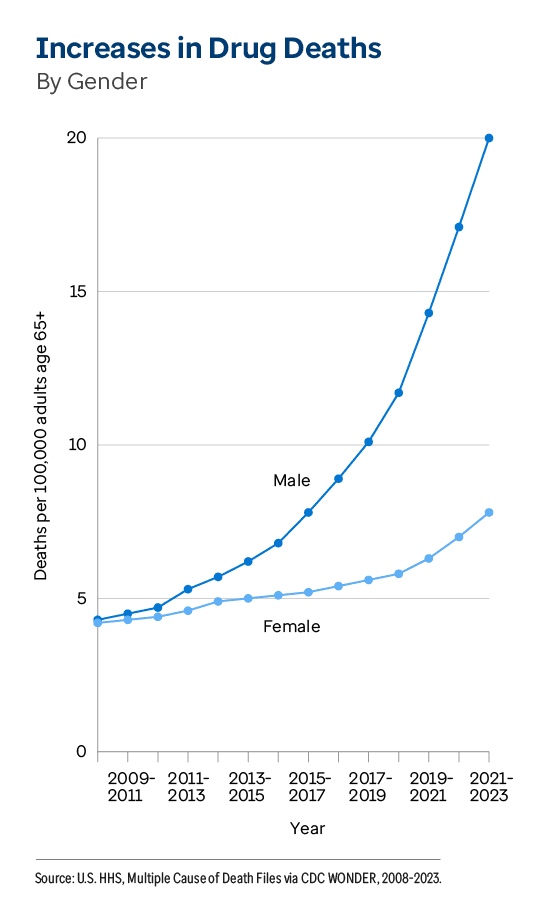
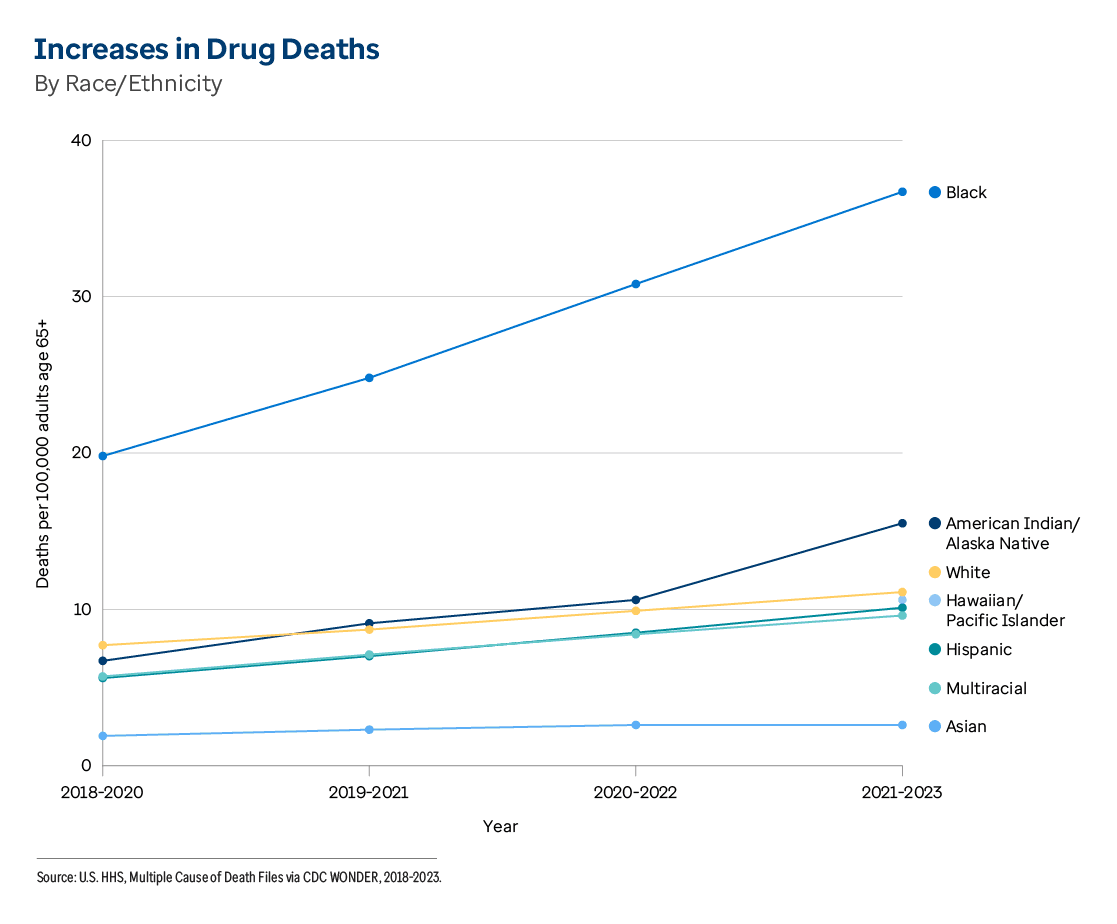
5,6 Between 2018-2020 and 2021-2023, the drug death rate among older adults significantly increased:
During this time frame, the drug death rate significantly increased in 37 states and the District of Columbia. The largest increases were: 120% in
Kansas (5.4 to 11.9), 115% in
Delaware (8.1 to 17.4) and 106% in
Maine (5.3 to 10.9).
Differences. In 2021-2023, the drug death rate significantly varied by geography, race/ethnicity and gender. The rate among older adults was:
- 24.1 times higher in the District of Columbia (98.9 deaths per 100,000 adults age 65 and older), and 5.5 times higher in Nevada (22.5), than in South Dakota (4.1).
- 14.1 times higher among Black (36.7) compared with Asian (2.6) older adults.
- 2.6 times higher among men (20.0) than women (7.8).
Excessive alcohol consumption is associated with many
adverse health outcomes, including unintentional injuries, cardiovascular conditions and mental health consequences.
8 Alcohol tolerance tends to decrease with age, which can make older adults more sensitive to its effects. Adults age 65 and older have a higher
alcohol-attributed death rate than adults ages 25-44
due to heightened alcohol sensitivity, higher rates of health problems and greater risk for interactions with medications.
9,8 Changes over time. Nationally, the percentage of adults age 65 and older who reported binge drinking (four or more drinks on one occasion in the past 30 days for females or five or more for males) or heavy drinking (eight or more drinks per week for females or 15 or more for males) decreased 10% from 7.7% to 6.9% of older adults between 2022 and 2023.
Between 2022 and 2023, the prevalence of
excessive drinking among older adults significantly decreased:
During this time, excessive drinking prevalence among older adults also decreased 36% in
Missouri (8.0% to 5.1%), the only state with a significant change.
Differences. In 2023, the prevalence of excessive drinking significantly varied by geography, race/ethnicity, disability status, gender, household income and educational attainment. The prevalence among adults age 65 and older was:
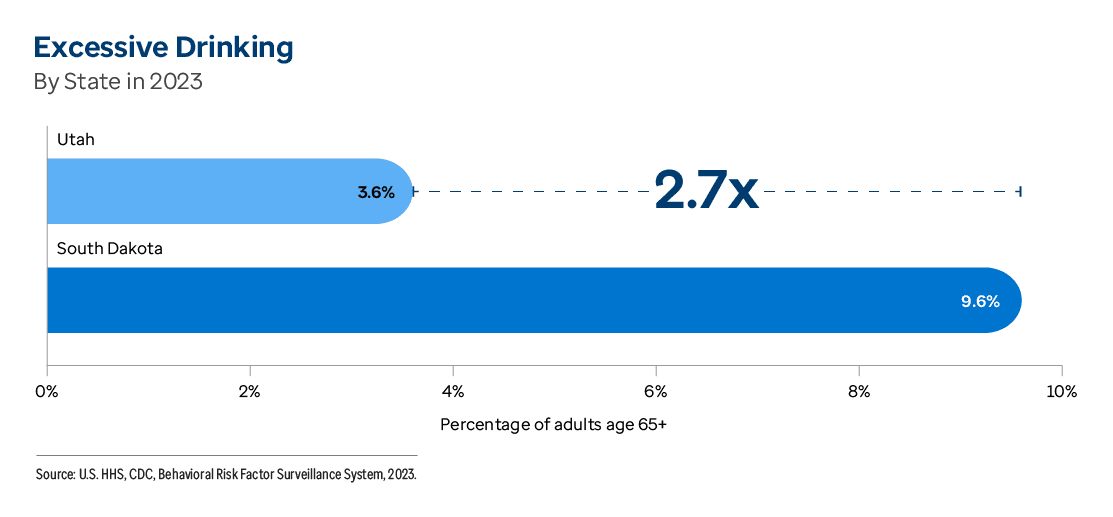
Note: No data were available for Kentucky or Pennsylvania in 2023. The values for American Indian/Alaska Native,
white (7.3%),
other race (7.3%),
Hispanic (6.6%),
multiracial (5.8%) and
Asian (5.0%) older adults may not differ significantly from each other based on overlapping 95% confidence intervals. The same is true among Black, Asian (5.0%), multiracial (5.8%), Hispanic (6.6%) and other race (7.3%) older adults; among older adults without a disability, those who have
difficulty with cognition (6.7%) and those with
difficulty seeing (6.4%); among older adults with independent living difficulty,
difficulty with mobility (5.3%),
difficulty with self-care (5.6%),
difficulty hearing (6.0%) and difficulty seeing (6.4%); among older adults with an annual household income less than $25,000, those with incomes of
$25,000-$49,999 (6.6%) and those with incomes of
$50,000-$74,999 (7.5%); among college graduates, those with
some post-high school education (7.2%) and
high school graduates (6.7%); and among older adults with less than a high school education, high school graduates and those with some post-high school education.
Suicide attempts among older adults are more likely to be
fatal than suicide attempts among younger people.
10 Risk factors for suicide among older adults include
mental illness, depression, previous suicide attempts, substance use problems, chronic pain, physical illness, declining function, disability, family discord or loss, family history of suicide and
social isolation.
10,11,12 Dementia and other forms of impaired cognitive ability have also been
linked to suicidal behavior in older adults.
13 Between 2018-2020 and 2021-2023, the suicide rate among older adults significantly increased:
- 14% among adults age 85 and older (20.0 to 22.7 deaths per 100,000) and 6% among adults ages 75-84 (18.6 to 19.8).
- 6% among white older adults (20.2 to 21.4).
- 6% among women (5.1 to 5.4) and 3% among men (31.6 to 32.6).
The suicide rate significantly increased in four states between 2018-2020 and 2021-2023: 69% in
Delaware (10.2 to 17.2), 36% in
West Virginia (19.3 to 26.3), 23% in
Indiana (16.0 to 19.7) and 16% in
North Carolina (15.7 to 18.2).
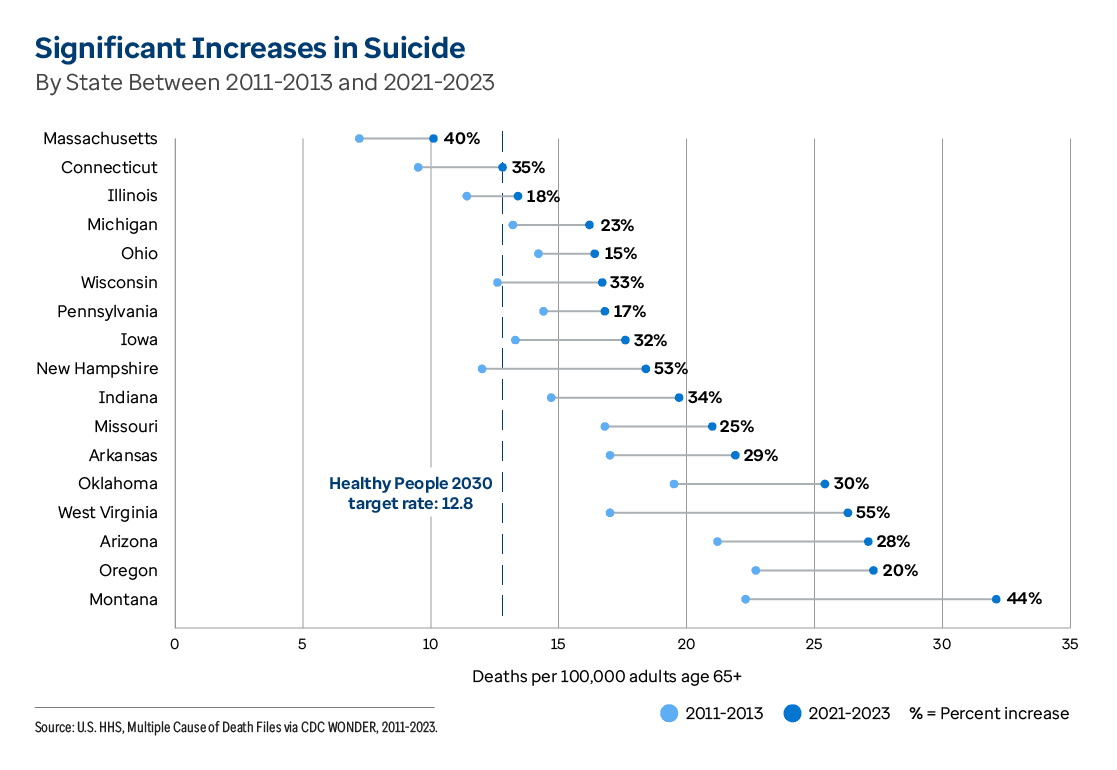
In the past decade, the suicide rate has significantly increased in 17 states. The largest increases between 2011-2013 and 2021-2023 were: 55% in West Virginia (17.0 to 26.3), 53% in
New Hampshire (12.0 to 18.4) and 44% in
Montana (22.3 to 32.1).
Differences. In 2021-2023, the suicide rate significantly varied by gender, race/ethnicity, geography and age group. The rate among older adults was:
- 6.0 times higher among men (32.6 deaths per 100,000 adults age 65 and older) compared with women (5.4).
- 4.5 times higher among white (21.4) compared with Black (4.8) older adults.
- 4.0 times higher in Montana (32.1) than in the District of Columbia (8.0), and 3.3 times higher in Montana than in New Jersey and Rhode Island (both 9.6).
- 1.4 times higher among adults age 85 and older (22.7) than those ages 65-74 (15.7).
Note: The values for Black and
multiracial (6.3) older adults may not differ significantly from each other based on overlapping 95% confidence intervals.
Related Measure: Firearm Deaths
In 2021-2023, there were approximately 23,900 firearm deaths among adults age 65 and older, almost 2,800 more than in 2018-2020. Of these, 90.8% were due to suicide and 7.6% were due to homicide.
Between 2018-2020 and 2021-2023, the firearm death rate among older adults significantly increased:
- 16% among Black older adults (5.5 to 6.4 deaths per 100,000 adults age 65 and older) and 7% among white older adults (15.7 to 16.8).
- 16% among adults age 85 and older (15.7 to 18.2), 7% among adults ages 75-84 (15.2 to 16.2) and 4% among adults ages 65-74 (11.3 to 11.8).
- 5% among men (26.0 to 27.2).
During the same time, the firearm death rate increased in four states: 32% in
West Virginia (18.4 to 24.2 deaths per 100,000 adults age 65 and older), 21% in both
Indiana (14.2 to 17.2) and
Illinois (8.0 to 9.7), and 17% in
North Carolina (13.6 to 15.9).
Differences. In 2021-2023, the firearm death rate significantly varied by gender, geography, race/ethnicity and age group. The rate among older adults was:
- 9.7 times higher among men (27.2 deaths per 100,000 adults age 65 and older) compared with women (2.8).
- 8.4 times higher in Wyoming (27.8) than in Massachusetts (3.3).
- 7.6 times higher among white (16.8) compared with Asian (2.2) older adults.
- 1.5 times higher among adults age 85 and older (18.2) than those ages 65-74 (11.8).
Health Outcomes | Mortality
Early death rates among adults ages 65-74 dropped 9% in 2023, as COVID-19 exited the top 10 causes of death.
Based on calculations from 2023, the average 65-year-old in the U.S. should expect to live another
19.5 years.
16 However, many older adults do not live to see their 75th birthday. Research estimates that
48% of all early deaths involve behavioral and other preventable causes — among them,
social isolation, which affects approximately
a quarter of older adults.
17,18,12 Changes over time. Nationally, the
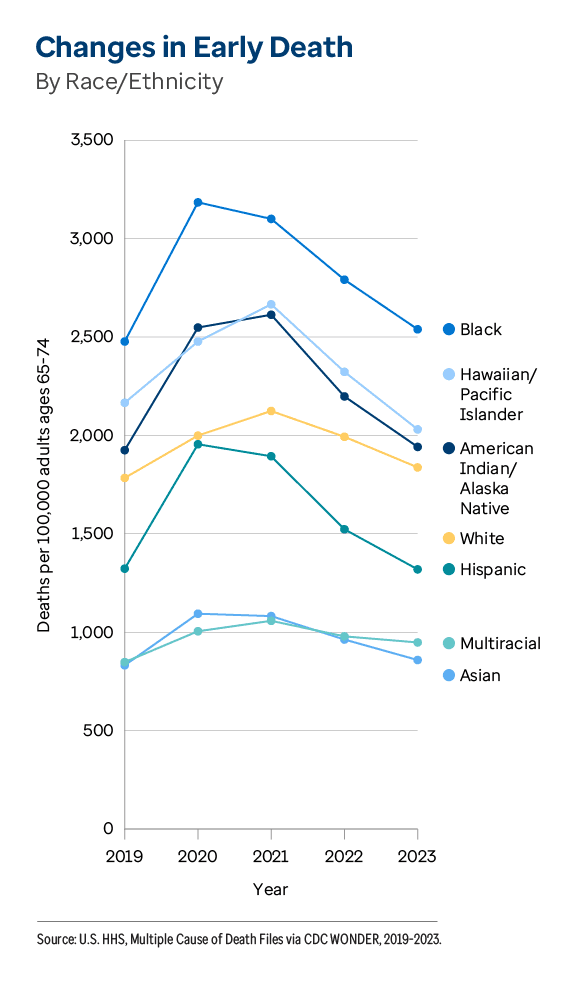
early death rate decreased 9% from 1,979 to 1,810 deaths per 100,000 adults ages 65-74 between 2022 and 2023, nearly back to the 2019 rate (1,765). In 2023, there were 627,700 deaths among adults ages 65-74, 40,900 fewer than in 2022. This improvement follows a sharp rise in early deaths between 2019 and 2021, when the rate reached 2,151 deaths per 100,000 adults ages 65-74. In 2023, for the first time since its emergence, COVID-19 was not among the
top 10 causes of death for people ages 65-74. Chronic diseases accounted for six of the top 10 causes of death among adults ages 65-74 in 2023. The chronic conditions in the top 10 were cancer, heart diseases, chronic lower respiratory diseases, cerebrovascular diseases, diabetes and liver disease. Unintentional injury was the sixth-leading cause of death, with more than half of these cases attributed to unintentional poisonings (including drug deaths) and falls.
Between 2022 and 2023, the early death rate among adults ages 65-74 significantly decreased:
- 13% among both Hispanic (1,523 to 1,319 deaths per 100,000 adults ages 65-74) and Hawaiian/Pacific Islander (2,323 to 2,031) older adults, 12% among American Indian/Alaska Native older adults (2,198 to 1,942), 11% among Asian older adults (963 to 859), 9% among Black older adults (2,791 to 2,539) and 8% among white older adults (1,993 to 1,838).
- 9% among men (2,420 to 2,212) and 8% among women (1,586 to 1,452).
During the same time, the early death rate significantly decreased in 38 states, led by: 16% in
Delaware (1,919 to 1,607), 13% in
Oklahoma (2,789 to 2,432), and 12% in both
Nevada (2,211 to 1,947) and
New Jersey (1,625 to 1,437).
Differences. In 2023, the early death rate significantly varied by race/ethnicity, geography and gender. The rate among older adults was:
- 3.0 times higher among Black (2,539 per 100,000 adults ages 65-74) compared with Asian (859) older adults.
- 1.8 times higher in Mississippi (2,578) than in New Jersey (1,437).
- 1.5 times higher among men (2,212) than women (1,452).
Health Outcomes | Physical Health
The prevalence of falls and obesity among older adults remained stable.
Falls among older adults
can cause serious injuries that may lead to high medical costs and threaten their independence over time.
19 The fatality rate from falls
has increased steadily over the last few decades, particularly among those age 85 and older.
20 In 2021, there were more than
38,700 deaths related to falls among older adults in the U.S.
21 Changes over time. Nationally, 27.8% of adults age 65 and older reported
falling in the past 12 months in 2023. The overall rate has not changed since it significantly decreased between 2016 and 2018.
Between 2020 and 2023, the prevalence of falls among adults age 65 and older significantly increased:
During the same time, the prevalence of falls significantly increased in three states: 41% in
Illinois (20.0% to 28.2%), 25% in
Connecticut (21.3% to 26.7%) and 18% in
Montana (29.9% to 35.3%).
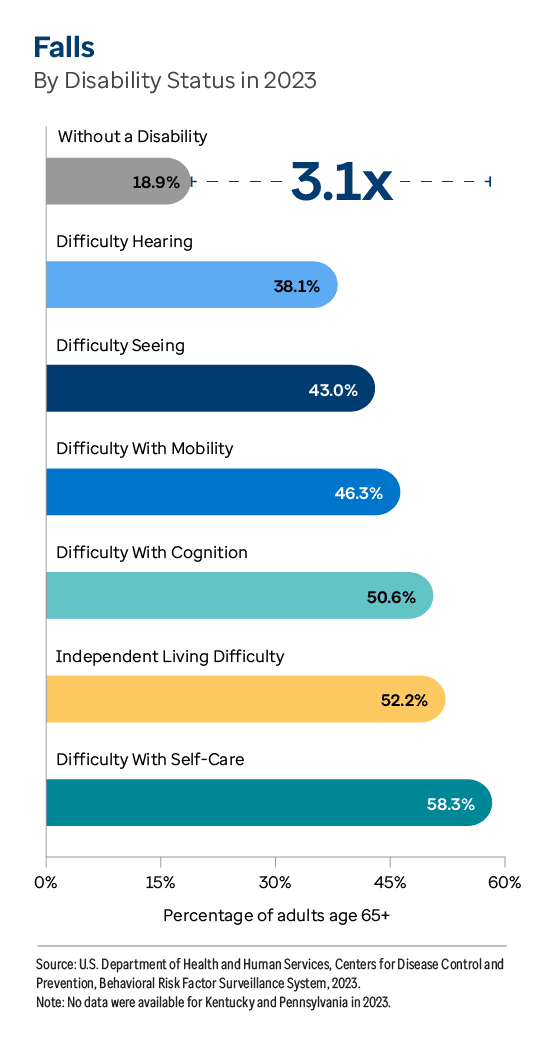
Differences. In 2023, the prevalence of falls significantly varied by disability status, race/ethnicity, geography, household income, metropolitan status and sexual orientation. The prevalence among adults age 65 and older was:
- 3.1 times higher among those who have difficulty with self-care (58.3%) compared with those without a disability (18.9%).
- 2.5 times higher among multiracial (38.9%) compared with Asian (15.5%) older adults.
- 1.6 times higher in Montana (35.3%) than in New Jersey (22.0%).
- 1.4 times higher among older adults with an annual household income less than $25,000 (36.0%) compared with those with incomes of $75,000 or more (24.9%).
- 1.2 times higher among those living in nonmetropolitan areas (31.8%) than those in metropolitan areas (27.0%).
- 1.2 times higher among LGBQ+ (32.8%) compared with straight (27.9%) older adults.
The prevalence was also higher among older
women (29.1%) than older
men (26.3%), and among older adults who have
served in the U.S. armed forces (29.4%) than those who have
not served (27.5%).
Note: No data were available for Kentucky or Pennsylvania in 2023. The values for multiracial,
American Indian/Alaska Native (34.8%) and
other race (30.1%) older adults may not differ significantly from each other based on overlapping 95% confidence intervals. The same applies to Asian and
Hawaiian/Pacific Islander (19.3%) older adults.
Obesity is a
complex health condition with biological, economic, environmental, individual and societal causes.
22 Research suggests that the strength of the association between obesity and mortality risk
increases with age, making obesity among older adults an area of particular concern.
23 Changes over time. Nationally, 30.2% of adults age 65 and older had a body mass index of 30.0 or higher based on reported height and weight in 2023. This prevalence has leveled off after increasing steadily between 2011 (25.3%) and 2019 (29.3%).
Between 2022 and 2023, the prevalence of
obesity significantly increased in two states: 28% in
Oregon (25.9% to 33.2%) and 15% in
Maryland (27.9% to 32.0%). During the same time, the prevalence significantly decreased 9% among older adults with
difficulty hearing (34.6% to 31.5%).
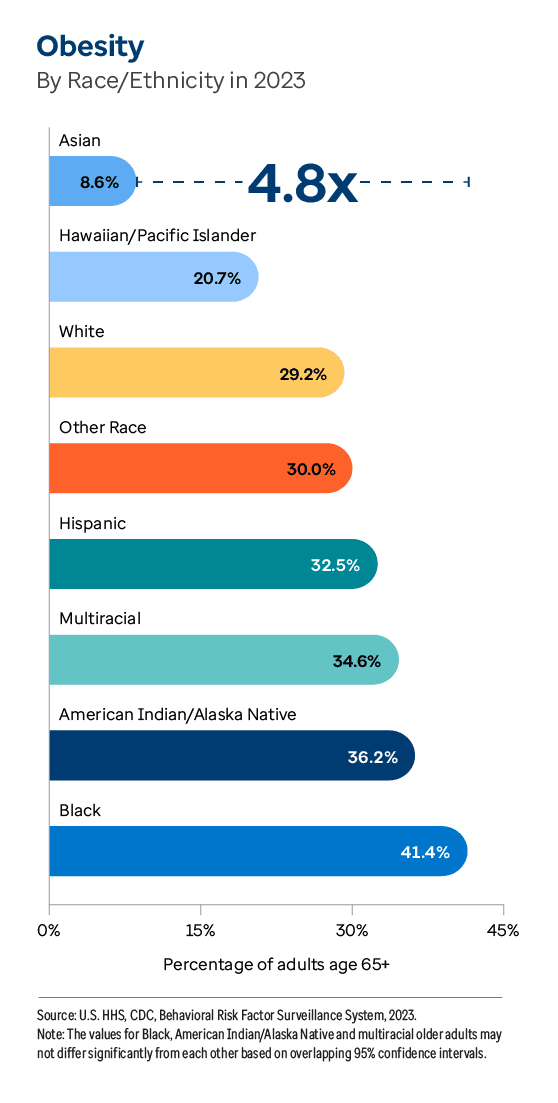
Differences. In 2023, the prevalence of obesity among older adults significantly varied by race/ethnicity, disability status, geography, educational attainment and household income. The prevalence among adults age 65 and older was:
Note: No data were available for Kentucky or Pennsylvania in 2023. The values for Black,
American Indian/Alaska Native (36.2%) and
multiracial (34.6%) older adults may not differ significantly from each other based on overlapping 95% confidence intervals. The same is true for older adults who have difficulty with self-care and
difficulty with mobility (44.5%); and among older adults with less than a high school education and
high school graduates (32.6%).

 US Summary
 Alabama
 Alaska
 Arizona
 Arkansas
 California
 Colorado
 Connecticut
 Delaware
 District of Columbia
 Florida
 Georgia
 Hawaii
 Idaho
Idaho Illinois
 Indiana
 Iowa
Iowa Kansas
 Kentucky
 Louisiana
 Maine
Maine Maryland
 Massachusetts
 Michigan
 Minnesota
 Mississippi
 Missouri
 Montana
 Nebraska
 Nevada
 New Hampshire
 New Jersey
 New Mexico
 New York
 North Carolina
 North Dakota
 Ohio
Ohio Oklahoma
 Oregon
 Pennsylvania
 Rhode Island
 South Carolina
 South Dakota
 Tennessee
 Texas
Texas Utah
Utah Vermont
 Virginia
 Washington
 West Virginia
 Wisconsin
 Wyoming