Clinical Care | Access to Care
The number of geriatric clinicians per 100,000 adults age 65 and older rose 5% nationally.
Geriatricians, or geriatric doctors and nurses, are medical practitioners trained to meet the unique needs of older adults. Special geriatric unit care and rehabilitative services involving a geriatrician have been shown to
improve patient outcomes and lead to better functioning.
47 In primary care settings, geriatricians provide better medication management than other clinicians and are better suited to treat aging-related diseases
such as dementia, incontinence and osteoporosis.
48 As the
baby boomer generation reaches older adulthood and average lifespans grow longer, the
demand for geriatricians is increasing more quickly than the supply.
1,49 Changes over time. Nationally, the number of family medicine and internal medicine geriatricians and nurse practitioners per 100,000 adults age 65 and older increased 5% from 38.0 to 39.9 between September 2023 and September 2024. In September 2024, there were approximately 23,700
geriatric clinicians across the country, nearly 1,720 more than in September 2023.
During this time frame, the number of geriatric clinicians increased at a rate equal to or greater than the national change of 5% in 27 states, led by: 19% in
New Jersey (51.6 to 61.3 clinicians per 100,000 adults age 65 and older), 15% in
Tennessee (32.3 to 37.1) and 14% in
Idaho (18.2 to 20.8). At the same time, geriatric clinicians decreased 5% in
Vermont (33.7 to 32.1).
Differences. In September 2023, the number of geriatric clinicians per 100,000 adults age 65 and older was 5.8 times higher in the
District of Columbia (100.3 clinicians per 100,000 adults age 65 and older) and 4.3 times higher in
Rhode Island (73.7) than in
South Dakota (17.2).
Clinical Care | Preventive Clinical Services
Flu vaccination rates fell among older adults between 2022 and 2023, with significant differences between populations.
Immune defense systems weaken with age, putting older adults at
increased risk of developing serious health
complications from influenza (the seasonal flu).
50,51 The rate of flu-related deaths is
highest among older adults.
52 About 50%-70% of seasonal flu-related hospitalizations and 70%-85% of seasonal flu-related deaths occur among those age
65 and older.
50 The influenza vaccine helps
protect against the flu, lowering the risk of infection and lessening the severity of symptoms in those who get sick.
53 Between 2021 and 2023, flu vaccinations significantly decreased 24% among
American Indian/Alaska Native older adults (60.5% to 46.2%) and 7% among
white older adults (70.3% to 65.3%).
Between 2022 and 2023, flu vaccinations among adults age 65 and older significantly decreased:
- 13% among LGBQ+ older adults (70.4% to 61.4%) and 8% among straight older adults (69.9% to 64.6%).
- 11% among those who have difficulty with self-care (65.3% to 58.0%), 8% among those with independent living difficulty (66.4% to 61.0%), 8% among those who have difficulty with cognition (64.9% to 59.4%), 7% among those who have difficulty with mobility (67.4% to 62.6%), 6% among those with difficulty hearing (68.8% to 64.5%) and 5% among those without a disability (67.8% to 64.2%).
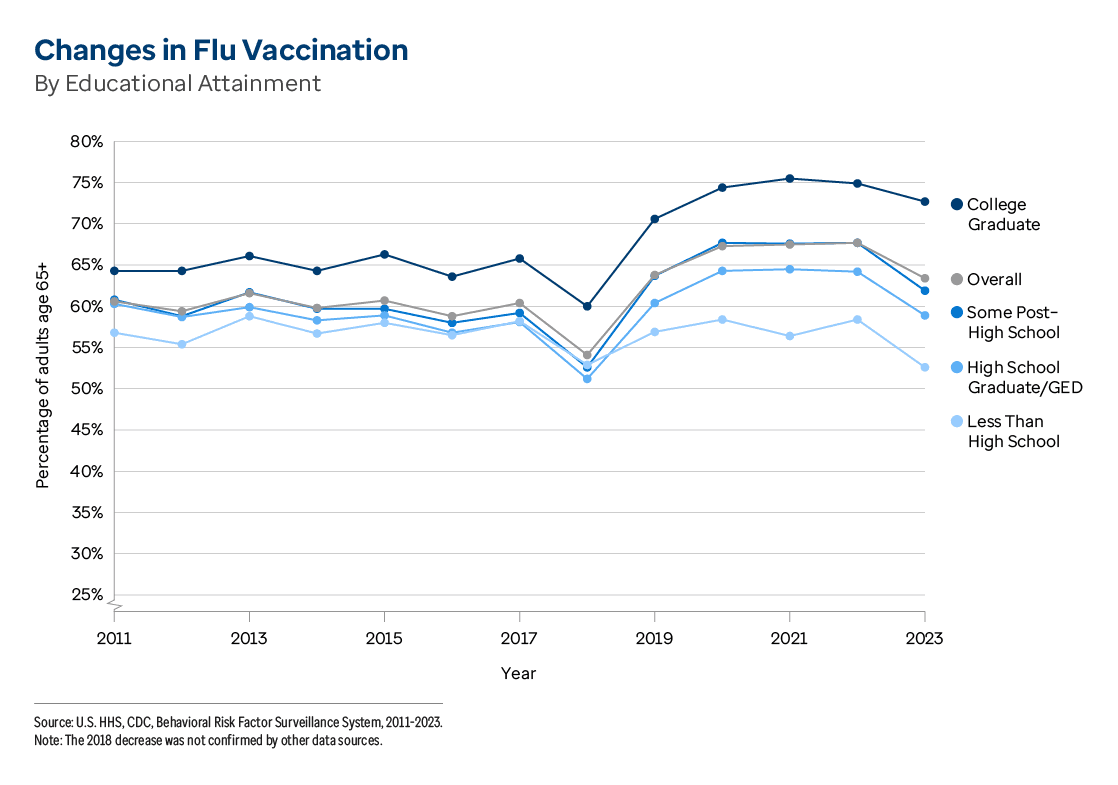
- 10% among those with less than a high school education (58.4% to 52.6%), 9% among those with some post-high school education (67.7% to 61.9%), 8% among high school graduates (64.2% to 58.9%) and 3% among college graduates (74.9% to 72.7%).
- 9% among those with an annual household income of $25,000-$49,999 (66.3% to 60.6%), 8% among those with incomes less than $25,000 (57.5% to 52.8%), 5% among those with incomes of $50,000-$74,999 (70.9% to 67.1%) and 5% among those with incomes of $75,000 or more (75.2% to 71.6%).
- 9% among those living in nonmetropolitan areas (64.1% to 58.1%) and 6% among those in metropolitan areas (68.8% to 64.5%).
- 7% among those who have not served in the U.S. armed forces (67.1% to 62.5%) and 5% among those who have served (70.8% to 67.4%).
- 7% among women (68.3% to 63.2%) and 5% among men (67.1% to 63.5%).
During this time frame, flu vaccinations significantly decreased in 27 states and the District of Columbia. The largest decreases were 18% in
Louisiana (64.3% to 52.9%); 15% in
Nebraska (72.8% to 61.7%); and 14% in the following states:
Alaska (61.1% to 52.8%),
Idaho (60.7% to 52.3%),
Michigan (74.6% to 64.2%) and
South Carolina (69.2% to 59.3%).
Differences. In 2023, flu vaccinations significantly varied by geography, race/ethnicity, educational attainment and household income. The prevalence among adults age 65 and older was:
- 1.4 times higher in Massachusetts (73.7%) than in Idaho (52.3%).
- 1.4 times higher among Asian (65.9%) than American Indian/Alaska Native (46.2%) older adults.
- 1.4 times higher among college graduates (72.7%) than those with less than a high school education (52.6%).
- 1.4 times higher among those with an annual household income of $75,000 or more (71.6%) compared with those who have incomes less than $25,000 (52.8%).
The prevalence was also higher among older adults living in metropolitan areas (64.5%) compared with those in nonmetropolitan areas (58.1%); among older adults with difficulty hearing (64.5%) compared with those who have difficulty with self-care (58.0%); and among older adults who have served in the U.S. armed forces (67.4%) compared with those who have not served (62.5%).
Note: No data were available for Kentucky or Pennsylvania in 2023. The values for Asian, white (65.3%),
Black (58.5%),
Hawaiian/Pacific Islander (57.4%),
Hispanic (56.7%),
multiracial (55.8%) and
other race (53.5%) older adults may not differ significantly from each other based on overlapping 95% confidence intervals. The same is true among American Indian/Alaska Native, other race, multiracial and Hawaiian/Pacific Islander older adults; among older adults with difficulty hearing, those without a disability (64.2%), those who have difficulty with mobility (62.6%) and those with independent living difficulty (61.0%); and among those who have difficulty with self-care,
difficulty seeing (58.8%), difficulty with cognition (59.4%) and independent living difficulty (61.0%).
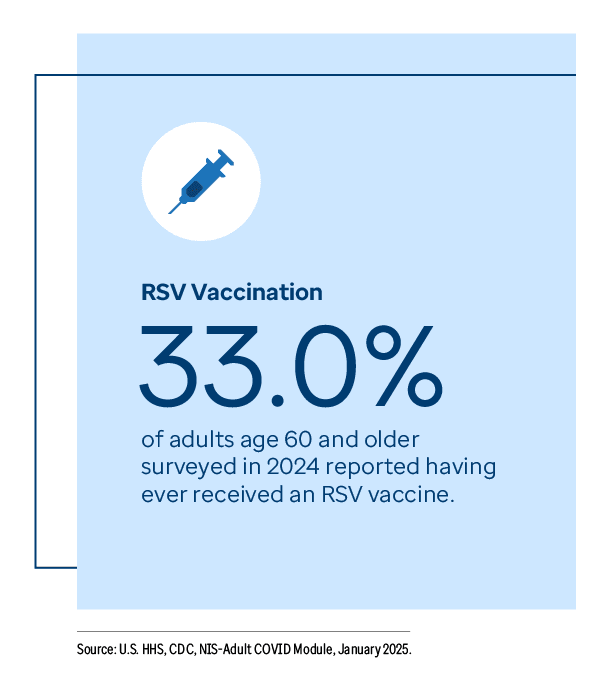
Related Measure: RSV VaccinationRespiratory syncytial virus (RSV) is a
common respiratory virus that causes cold-like symptoms and can
lead to pneumonia and worsen underlying conditions such as asthma, chronic obstructive pulmonary disease (COPD) and heart failure.
55,56 While RSV tends to be mild for healthy adults and children,
older adults are more likely to develop severe illness and require hospitalization.
55 Every year in the U.S., an estimated 100,000-150,000 adults age 60 and older are
hospitalized for RSV.
56 In 2024, the CDC’s Advisory Committee on Immunization Practices released
updated recommendations that everyone age 75 and older, as well as adults ages 60–74 who are at increased risk for severe RSV disease, should receive the RSV vaccine.
57 Clinical Care | Quality of Care
More older adults reported having a dedicated provider.
Dedicated Health Care Provider
Individuals with a
dedicated health care provider are better positioned to receive care that can prevent, detect and manage disease and other health conditions.
58 A regular health care provider helps patient and provider build a stable, long-term relationship with several
benefits, including lower health care costs and better overall health status.
59 Between 2022 and 2023, the prevalence of dedicated health care providers among adults age 65 and older significantly increased:
During this time frame, the prevalence of dedicated health care providers significantly increased in six states, led by: 3% in
North Carolina (94.7% to 97.7%),
Mississippi (94.3% to 97.2%) and
Georgia (94.9% to 97.3%); 2% in
New York (94.9% to 97.1%); and 1% in
Washington (95.2% to 96.5%). The prevalence also decreased 2% in
Nebraska (96.3% to 94.4%).
Differences. In 2023, the prevalence of dedicated health care providers among adults age 65 and older was higher in
Rhode Island (98.4%) than in
Wyoming (90.1%). The prevalence also significantly varied by race/ethnicity, educational attainment, household income and gender, and was higher among:
Note: No data were available for Kentucky or Pennsylvania in 2023. The values for Black,
white (96.5%),
Asian (95.5%),
multiracial (94.1%),
other race (92.3%) and
Hawaiian/Pacific Islander (92.2%) older adults may not differ significantly from each other based on overlapping 95% confidence intervals. The same is true among Hispanic,
American Indian/Alaska Native (91.8%), Hawaiian/Pacific Islander, other race and multiracial older adults; among college graduates and those with
some post-high school education (96.5%); and among those with an annual household income of $75,000 or more and those with incomes of
$50,000-$74,999 (97.1%).
Direct Care Worker Wage Competitiveness
The population of adults age 65 and older in the United States is expected to
increase from 57.8 million to 88.8 million between 2022 and 2060, driving up the demand for home health and caregiving services.
61 Despite this, there is a
shortage of direct care workers, in part due to low pay.
62 In 2022, direct care workers had a median
annual income of $25,015, leaving more than one-third of the workforce in or near poverty.
61 Changes over time. Nationally, the shortfall between the average hourly wage rate paid for
direct care jobs and the rate paid for comparable entry-level jobs increased 3% from $2.81 to $2.89 between 2019 and 2021.
During this time frame, the direct care worker wage shortfall increased (i.e., worsened) at a rate equal to or greater than the national change of 3% in 24 states and decreased in 21 states. The largest shortfall increases were: 193% in
New Mexico ($1.34 to $3.93), 102% in
Nevada ($1.15 to $2.32), 47% in
Maryland ($2.06 to $3.02) and 39% in
Indiana ($2.81 to $3.90). Of the states that had improvements, the largest shortfall reductions were: 31% in both
North Dakota ($3.23 to $2.23) and
Washington ($3.57 to $2.48), 30% in
Hawaii ($4.67 to $3.27) and 26% in
New Hampshire ($2.11 to $1.56).

 US Summary
 Alabama
 Alaska
 Arizona
 Arkansas
 California
 Colorado
 Connecticut
 Delaware
 District of Columbia
 Florida
 Georgia
 Hawaii
 Idaho
Idaho Illinois
 Indiana
 Iowa
Iowa Kansas
 Kentucky
 Louisiana
 Maine
Maine Maryland
 Massachusetts
 Michigan
 Minnesota
 Mississippi
 Missouri
 Montana
 Nebraska
 Nevada
 New Hampshire
 New Jersey
 New Mexico
 New York
 North Carolina
 North Dakota
 Ohio
Ohio Oklahoma
 Oregon
 Pennsylvania
 Rhode Island
 South Carolina
 South Dakota
 Tennessee
 Texas
Texas Utah
Utah Vermont
 Virginia
 Washington
 West Virginia
 Wisconsin
 Wyoming