How State Rankings Were Generated
This year, 99 measures (including 50 weighted and 49 unweighted measures) were analyzed for the
America’s Health Rankings 2025 Annual Report, using the most recent data available as of October 17, 2025, with the exception of National Survey of Children's Health data, which were released on December 2, 2025. Data years varied by measure because of the variety of data sources. Multiple data years were combined for some measures to ensure reliable state-level estimates. Measure definitions, sources and data years are available in the
Measures Table. Measure changes were based on input from the
Annual Report Advisory Committee and are detailed on the
2025 Annual Report Measures Selection and Changes webpage.
Each state was ranked according to its value for each measure, with a rank of No. 1 assigned to the state with the healthiest value. Ties in value were assigned equal ranks. If a state value was unavailable for a measure in this edition, it was noted as missing, unavailable or suppressed. Composite scores were generated overall and by model category. The rankings show how a state compares with other states across all weighted measures.
Overall state rankings were based on 50 weighted measures that:
- Represented current population health issues.
- Had state-level data available.
- Maintained consistent measurement across all 50 states.
- Were current and regularly updated.
- Allowed for improvement over time.
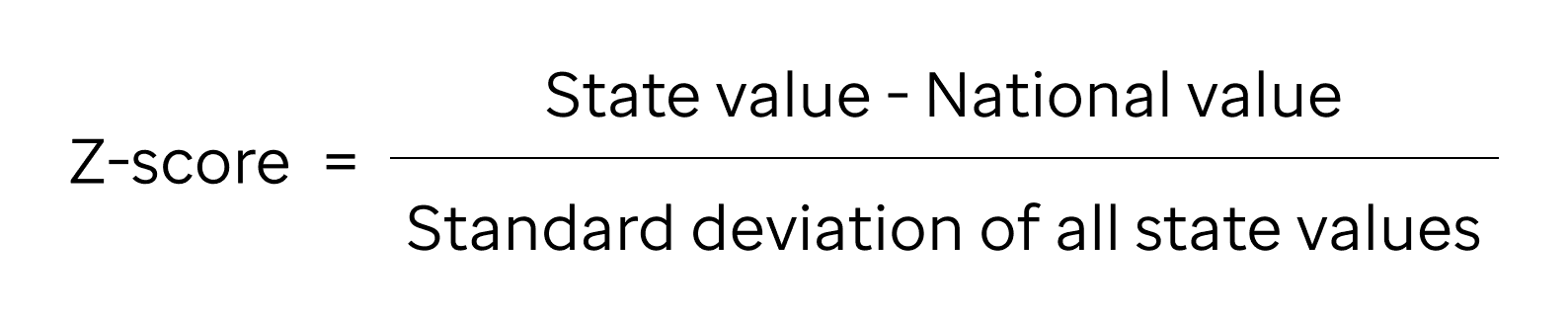
The state value for each measure was normalized into a z-score, hereafter referred to as “score,” using the following formula:
The score indicates the number of standard deviations a state value was above or below the U.S. value. Scores were capped at +/- 2.00 to prevent an extreme score from excessively influencing a state’s Overall score. If a U.S. value was unavailable from the original data source for a measure, the mean of all states and the District of Columbia was used. If a value was unavailable for a state, its value from the most recent available data year was used to generate a score.
Composite scores were calculated by adding the products of the score for each measure multiplied by that measure’s assigned model weight and association with health. Measures positively associated with population health, such as volunteerism and flu vaccination, were multiplied by 1. In contrast, measures with a negative association, such as smoking and premature death, were multiplied by -1. A state that ranked No. 1 will have a higher composite score (e.g., 2.00), reflecting better health, whereas a state that ranked No. 50 will have a lower composite score (e.g., -2.00). The overall state ranks were calculated by ranking the Overall score, which included all weighted measures in the model (see
Measures, Weights and Direction for model and measure weights).
Scores and ranks were not calculated for the District of Columbia because of its unique status as an entirely urban population with different governing and funding mechanisms than states. While the District of Columbia was not included in the overall state rankings, its data are available in this report and on the America’s Health Rankings website.
Findings. Data for all measures were analyzed and considered for inclusion in the report. Measures with updated data, measures with statistically significant changes (based on nonoverlapping 95% confidence intervals, when available) and new measures on emerging topics were prioritized for selection.
Health Disparities. Health disparities highlight significant differences within measures based on age, disability status, education, gender, income, metropolitan status, race/ethnicity, sexual orientation, special health care needs status among children and veteran status where data were available. Health disparities are presented as a ratio calculated by dividing the value of the group with the highest value by the value of the group with the lowest value. Only measures with significant differences, determined by nonoverlapping 95% confidence intervals, were considered. The groups with the largest health disparities, considering relevant risk factors, were prioritized for inclusion, along with health disparities by metropolitan status, the subject of this year's report spotlight. Not all statistically significant differences are detailed in the report. Full demographic data are published on the
America’s Health Rankings website. For more information, see
Disparity Measurement Methodology.
Strengths and Challenges represent measures with the greatest impact on a state’s overall ranking (from the 50 weighted measures). Measures with newly available data that span model categories and topic areas were given priority during selection. Unweighted measures were excluded from the ranking calculations, and the District of Columbia was assessed separately by comparing its values to those of the healthiest and least healthy states. The U.S. summary is a reference for calculating z-scores and overall rankings, so it does not include strengths and challenges.
Key Findings highlight notable trends, presented as percent changes between two time periods of interest, often capturing inflection points or describing short- or long-term trends. Only statistically significant changes, as determined by nonoverlapping 95% confidence intervals, were considered for measures with confidence intervals. Measures without confidence intervals were considered if the change between the two time periods was 5% or more. Findings were selected to include a mix of improving and worsening measures across model categories and topic areas. Measures that did not lend themselves to changes over time were excluded from the analysis.
Rural Spotlight presents the percentage of the population living in rural areas and features multiple chronic conditions by metropolitan status. Nonmetropolitan (rural) data were not available for Connecticut, Delaware, the District of Columbia, New Jersey and Rhode Island due to small sample sizes.
Demographic Group Definitions
Analyses were performed to illuminate health disparities by age, disability status, education, gender, income, metropolitan status, race/ethnicity, sexual orientation, special health care needs status among children and veteran status where data were available. Individual estimates were suppressed if they did not meet the reliability criteria set by the data source or internally established criteria. Some values had wide 95% confidence intervals, meaning the true value may be far from the estimate presented.
Age. Age data in this report were available for measures from the Centers for Disease Control and Prevention’s (CDC’s) Behavioral Risk Factor Surveillance System (BRFSS), CDC WONDER and the Voting and Registration Supplement of the Current Population Survey. BRFSS groupings included the following self-reported age ranges: 18-44, 45-64 and 65+. CDC WONDER groupings included the following age ranges: 15-24, 25-34, 35-44, 45-54, 55-64, 65-74, 75-84 and 85+. Voting and Registration Supplement groupings included the following age ranges: 18-24, 25-34, 35-44, 45-64 and 65+.
Disability Status. Disability status data in this report were available for measures from BRFSS. Groupings were based on responses to the questions in the core disability section. Responses of yes to the question, “Are you deaf or do you have serious difficulty hearing?” were coded as difficulty hearing. Responses of yes to the question, “Are you blind or do you have serious difficulty seeing, even when wearing glasses?” were coded as difficulty seeing. Responses of yes to the question, “Because of a physical, mental, or emotional condition, do you have serious difficulty concentrating, remembering, or making decisions?” were coded as difficulty with cognition. Responses of yes to the question, “Do you have serious difficulty walking or climbing stairs?” were coded as difficulty with mobility. Responses of yes to the question, “Do you have difficulty dressing or bathing?” were coded as difficulty with self-care. Responses of yes to the question, “Because of a physical, mental, or emotional condition, do you have difficulty doing errands alone such as visiting a doctor's office or shopping?” were coded as independent living difficulty. Responses of no or missing to all questions, with at least one response being no, were coded as without a disability. Disability groups are not mutually exclusive.
Education. Education data in this report were available for measures from BRFSS, the National Survey of Children’s Health (NSCH), the Researched Abuse, Diversion and Addiction-Related Surveillance (RADARS) System and the Volunteering and Civic Life Supplement of the Current Population Survey. BRFSS groupings were limited to adults age 25 and older and based on responses to the question, “What is the highest grade or year of school you completed?” Responses of grades nine through 11 were classified as less than high school. Responses of grade 12 or GED were classified as high school graduate/GED. Responses of college or technical school (one to three years) were classified as some post-high school. Responses of college (four years or more) were classified as college graduate. NSCH groupings were based on the highest level of education completed by an adult caregiver in the child’s household, grouped into four categories: Less than high school education was classified as caregiver less than high school, high school or GED was classified as caregiver high school graduate/GED, some college or technical school was classified as caregiver some post-high school, and college degree or higher was classified as caregiver college graduate. RADARS groupings were limited to adults age 18 and older and were based on responses to the question, “What is the highest degree or level of school you have completed? Select one.” A response of less than a high school diploma was classified as less than high school. A response of regular high school diploma, GED or alternative credential was classified as high school/GED. Responses of some college credit but no degree, trade school or associate degree were classified as some post-high school. Responses of bachelor’s degree, master’s degree, doctorate or professional degree were classified as college graduate. Volunteering and Civic Life Supplement groupings were based on responses to the question, “What is the highest level of school you have completed or the highest degree you have received?” Responses of grades below 12 or 12th grade with no diploma were summed and classified as less than high school. Responses of high school diploma or equivalent (GED) were classified as high school graduate/GED. Responses of some college but no degree were classified as some post-high school. Responses of associate degree, bachelor’s degree, master’s degree, professional school degree or doctoral school degree were classified as college graduate.
Gender. This report stratified gender as men and women for adults and female and male for data including children as available through public data sources — even though not all people identified with these two categories. Data did not differentiate between assigned sex at birth and current gender identity. While sex and gender influence health, the current data collection practices of some national surveys limit the ability to describe the health of transgender and nonbinary individuals, especially at the state level.
Sexual Orientation. Sexual orientation data in this report were available for measures from BRFSS. Groupings were based on responses to the question, “Which of the following best represents how you think of yourself?” Responses of lesbian or gay, gay, bisexual or something else were summed and classified as LGBQ+. Responses of straight — that is, not gay — were summed and classified as straight.
Income. Income data in this report were available for measures from BRFSS, RADARS and the Volunteering and Civic Life Supplement. BRFSS groupings were limited to adults age 25 and older and based on responses to the question, “[What] is your annual household income from all sources?” Responses were classified as less than $25,000, $25,000 to $49,999, $50,000 to $74,999, $75,000 to $99,999, $100,000 to $149,999 and $150,000 or more. RADARS groupings were limited to adults age 18 and older and were based on responses to the question, “What was your combined household income during the last 12 months? Select one.” Responses were classified as less than $25,000, $25,000 to $74,999 and $75,000 or more. Volunteering and Civic Life Supplement groupings were based on responses to the question, “Which category represents your total combined income during the past 12 months (or the total combined income of all members of your family living in the household)? This includes money from jobs, net income from business, farm or rent, pensions, dividends, interest, social security payments and any other money income received by you (or by members of your family living in the household who are 15 years of age or older).” Responses were classified as less than $25,000, $25,000 to $49,999, $50,000 to $74,999, $75,000 to $99,999, $100,000 to $149,999 and $150,000 or more.
Metropolitan Status. Metropolitan status data in this report were available for measures from BRFSS and the Volunteering and Civic Life Supplement. Groupings were coded based on residence geography. Identification as large central metro, large fringe metro, medium metro and small metro were classified as metropolitan, and identification as micropolitan and noncore were classified as nonmetropolitan. Volunteering and Civic Life Supplement groupings were based on the 2010 definitions of metropolitan statistical area as determined by the Census Bureau.
Race/Ethnicity. Data were provided where available for the following racial and ethnic groups: American Indian/Alaska Native, Asian, Black, Hispanic, Hawaiian/Pacific Islander, white, multiracial, and those who identify as other race. Hispanic ethnicity includes members of all racial groups. Racial/ethnic groups were named and defined differently across data sources (details below). In summary, while American Community Survey data were collected and calculated as Hispanic-inclusive (except for white, which was non-Hispanic), all other sources collected race data as non-Hispanic. Those include: BRFSS; the CDC National Center for HIV, Viral Hepatitis, STD, and TB Prevention (NCHHSTP); CDC WONDER; the U.S. Department of Housing and Urban Development (HUD); the National Center for Education Statistics (NCES); the National Survey of Children’s Health (NSCH); RADARS; and the Volunteering and Civic Life and Voting and Registration Supplements.
Race and ethnicity categories by source:
- American Community Survey: American Indian and Alaska Native; Asian; Black or African American; Hispanic or Latino Origin (any race); Native Hawaiian or Other Pacific Islander; white (non-Hispanic); two or more races; and some other race.
- BRFSS: American Indian/Alaskan Native (non-Hispanic); Asian (non-Hispanic); Black or African American (non-Hispanic); Hispanic, Latino/a or Spanish origin (any race); Native Hawaiian or Other Pacific Islander (non-Hispanic); white (non-Hispanic); and multiracial (non-Hispanic).
- CDC NCHHSTP: American Indian or Alaska Native (non-Hispanic); Asian (non-Hispanic); Black or African American (non-Hispanic); Hispanic or Latino/a (any race); Native Hawaiian or Other Pacific Islander (non-Hispanic); white (non-Hispanic); and more than one race (non-Hispanic).
- CDC WONDER: American Indian or Alaska Native (non-Hispanic); Asian (non-Hispanic); Black or African American (non-Hispanic); Hispanic (any race); Native Hawaiian or Other Pacific Islander (non-Hispanic); white (non-Hispanic); and more than one race (non-Hispanic).
- HUD: American Indian or Alaska Native (non-Hispanic); Asian (non-Hispanic); Black or African American (non-Hispanic); Hispanic (any race); Pacific Islander (non-Hispanic); white (non-Hispanic); and other race, including multiple races (non-Hispanic).
- NCES: American Indian/Alaska Native (non-Hispanic); Asian (non-Hispanic); Black (non-Hispanic); Hispanic (any race); Native Hawaiian/Pacific Islander (non-Hispanic); white (non-Hispanic); and multiracial (non-Hispanic).
- NSCH: American Indian/Alaskan Native (non-Hispanic); Asian (non-Hispanic); Black or African American (non-Hispanic); Hispanic (any race); Native Hawaiian or Other Pacific Islander (non-Hispanic); white (non-Hispanic); and multiple race (non-Hispanic).
- RADARS: American Indian/Alaska Native (non-Hispanic); Asian (non-Hispanic); Black (non-Hispanic); Hispanic (any race); Hawaiian/ Pacific Islander (non-Hispanic); white (non-Hispanic); and other race (non-Hispanic).
- Volunteering and Civic Life Supplement: American Indian/Alaska Native (non-Hispanic); Asian (non-Hispanic); Black (non-Hispanic); Hawaiian/Pacific Islander (non-Hispanic); Hispanic (any race); multiracial (non-Hispanic); and white (non-Hispanic).
- Voting and Registration Supplement: Asian (non-Hispanic); Black (non-Hispanic); Hispanic (any race); and white (non-Hispanic).
Special Health Care Needs Status Among Children. Children with special health care needs (CSHCN) status data in this report were available for measures from NSCH. CSHCN are grouped into two categories and classified as children with special health care needs and children without special health care needs. Children were considered children with special health care needs if they either:
- Met the criteria from the Maternal and Child Health Bureau’s CSHCN Screener, a five-item screening tool that identifies special health care needs based on the health consequences a child experiences due to an ongoing health condition, regardless of diagnosis. The screening criteria are categorized as: 1) need or use of prescription medications, 2) need or use of services, 3) need or use of specialized therapies, 4) functional difficulties and 5) emotional, developmental, or behavioral problems for which treatment or counseling is needed.
- Or had at least one qualifying health condition and one qualifying functional difficulty. Conditions include autoimmune diseases, allergies, arthritis, asthma, blood disorders, cerebral palsy, cystic fibrosis, diabetes, Down syndrome, epilepsy, genetic or inherited conditions, heart conditions, frequent or severe headaches, Tourette syndrome, anxiety, depression, behavior problems, developmental delays, intellectual disabilities, speech disorders, learning disabilities, autism spectrum disorders, attention-deficit/hyperactivity disorder and fetal alcohol spectrum disorder. Functional difficulties include difficulty breathing, swallowing, and digesting food; difficulty with coordination, walking, using one’s hands, climbing stairs, dressing and bathing, and doing errands alone; deafness or difficulty hearing; blindness or difficulty seeing; physical pain; and serious difficulty concentrating, remembering, or making decisions because of a physical, mental or emotional condition.
Veteran Status. Veteran status data in this report were available for measures from BRFSS and the Volunteering and Civic Life Supplement. BRFSS groupings were based on responses to the question, “Have you ever served on active duty in the United States Armed Forces, either in the regular military or in a National Guard or military reserve unit?” Volunteering and Civic Life Supplement groupings were based on responses to the question, “Did you ever serve on active duty in the U.S. Armed Forces?” Responses of yes were classified as served. Responses of no were classified as not served.
Rankings are a relative measure of health. Not all changes in rank translate into actual declines or improvements in health. Data presented in this report were aggregated at the state level and cannot be used to make inferences at the individual level. Additionally, estimates cannot be extrapolated beyond the population upon which they were created. Values and ranks from prior years have been updated on the America’s Health Rankings website to reflect known errors and updates from the reporting source.
Use caution when interpreting data, as many measures are self-reported and rely on an individual’s perception of health and behaviors. Additionally, some health outcome measures are based on respondents being told by a health care professional that they have a disease and may exclude those who have not received a diagnosis or sought or obtained treatment.
This report provides health disparity data on various demographic group characteristics alongside socioeconomic factors and environmental influences. Relying solely on health disparity data may lead to misinterpretations of health outcomes, as they do not account for the
social drivers that significantly impact individuals’ access to care, quality of life and overall well-being.
79 Inclusivity in data collection is essential to documenting, analyzing and addressing the health disparities people experience.
Equitable systems must accurately represent diverse populations throughout the data life cycle, from data collection through analysis to interpretation.
80 Inadequate representation of populations may hinder the identification of trends and patterns within different demographic groups and limit the ability to tailor public health interventions and personalize care that empowers people to make better health choices.

 US Summary
 Alabama
 Alaska
 Arizona
 Arkansas
 California
 Colorado
 Connecticut
 Delaware
 District of Columbia
 Florida
 Georgia
 Hawaii
 Idaho
Idaho Illinois
 Indiana
 Iowa
Iowa Kansas
 Kentucky
 Louisiana
 Maine
Maine Maryland
 Massachusetts
 Michigan
 Minnesota
 Mississippi
 Missouri
 Montana
 Nebraska
 Nevada
 New Hampshire
 New Jersey
 New Mexico
 New York
 North Carolina
 North Dakota
 Ohio
Ohio Oklahoma
 Oregon
 Pennsylvania
 Rhode Island
 South Carolina
 South Dakota
 Tennessee
 Texas
Texas Utah
Utah Vermont
 Virginia
 Washington
 West Virginia
 Wisconsin
 Wyoming