Community and Family Safety
Gun violence continues to be a significant
public health issue in the U.S.
20 In 2023, firearms were responsible for
more than half (55%) of all suicide deaths nationally.
21 Furthermore, the U.S. has a significantly
higher rate of firearm deaths than 30 other populous high-income countries as defined by the Organization for Economic Co-operation and Development.
22 In 2023, firearm deaths accounted for more than
1.1 million years of potential life lost before age 65.
23 Between 2022 and 2023, the firearm death rate decreased:
- 9% among Black populations (33.8 to 30.9 deaths per 100,000 population).
- 8% among those ages 25-34 (22.9 to 21.1).
- 4% among males (25.0 to 24.1).
During the same time, the firearm death rate decreased 11% in
Missouri (24.1 to 21.4 deaths per 100,000 population) and 8% in
California (8.9 to 8.2). However, the rate increased 45% in the
District of Columbia (22.9 to 33.1).
Differences. The firearm death rate varied by race/ethnicity, geography, gender and age in 2023. It was:
- 9.7 times higher among Black (30.9 deaths per 100,000 population) compared with Asian (3.2) populations.
- 8.5 times higher in the District of Columbia (33.1) and 7.4 times higher in Mississippi (28.7) than in Massachusetts (3.9).
- 6.0 times higher among males (24.1) than females (4.0).
- 1.8 times higher among those ages 25-34 (21.1) compared with those ages 65-74 (11.8).
Note: The values for those ages 25-34 (21.1 per 100,000 population) and 15-24 (20.3) may not differ significantly based on overlapping 95% confidence intervals. In 2023, there were
22,830 homicides committed in the U.S., of which nearly 18,000 — or almost
80% — involved a firearm.
25,26 Between 2020-2021 and 2022-2023, the homicide rate significantly decreased:
During the same period, the homicide rate significantly decreased in 19 states, led by: 44% in
Delaware (9.5 to 5.3 deaths per 100,000 population), 32% in
Utah (2.8 to 1.9) and 26% in
New Jersey (4.2 to 3.1).
Differences. Homicide varied significantly by race/ethnicity, geography, age and gender in 2022-2023. The rate was:
- 20.7 times higher among Black (29.0 deaths per 100,000 population) compared with Asian (1.4) populations.
- 17.5 times higher in the District of Columbia (29.7) and 10.8 times higher in Mississippi (18.3) than in New Hampshire (1.7).
- 10.3 times higher among those ages 15-24 and those ages 25-34 (both 13.4) than those age 85 and older (1.3).
- 4.4 times higher among males (11.0) compared with females (2.5).
Note: The values for those age 85 and older (1.3 deaths per 100,000 population) and 75-84 (1.6) may not differ significantly based on overlapping 95% confidence intervals.
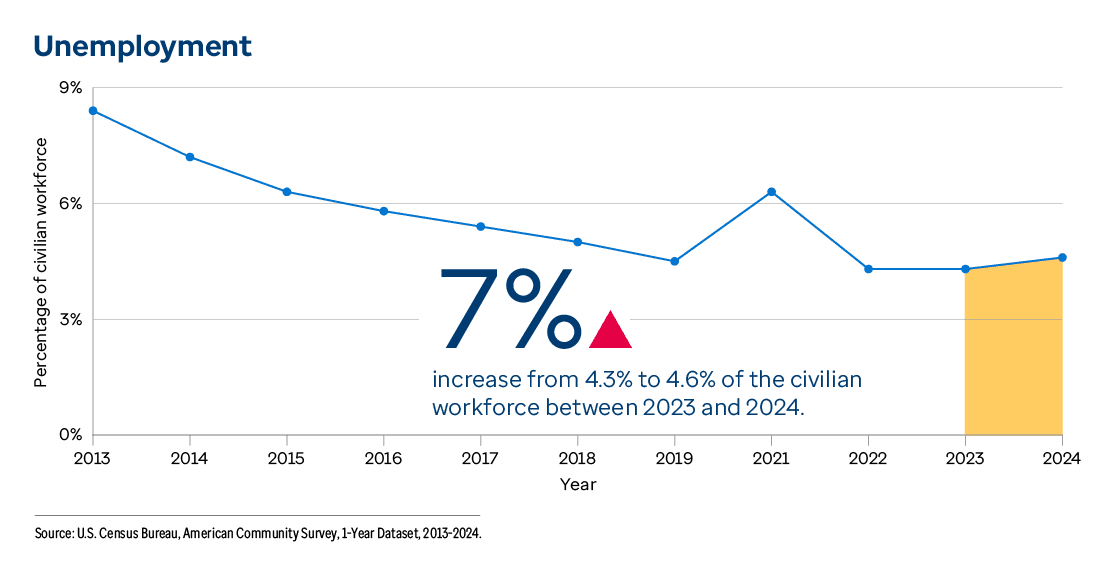
Changes over time. Nationally, the percentage of the civilian workforce that is unemployed increased 7% from 4.3% to 4.6% of workers ages 16-64 between 2023 and 2024. In 2024, more than 8.1 million civilians in the workforce were unemployed, 720,000 more than in 2023.
Between 2023 and 2024,
unemployment significantly increased 8% among both
Black (7.4% to 8.0%) and
Hispanic (5.3% to 5.7%) civilian workers, and 6% among
white (3.5% to 3.7%) civilian workers. The rate also increased in 11 states, with the largest increases being 46% in
Delaware (3.5% to 5.1%), 37% in
Nevada (4.6% to 6.3%) and 23% in
Minnesota (3.0% to 3.7%).
Differences. Unemployment varied significantly by geography and race/ethnicity in 2024. The rate was:
- 3.3 times higher in Nevada (6.3%) than in North Dakota (1.9%).
- 2.2 times higher among Black (8.0%) than white (3.7%) civilian workers.
Social Support and Engagement
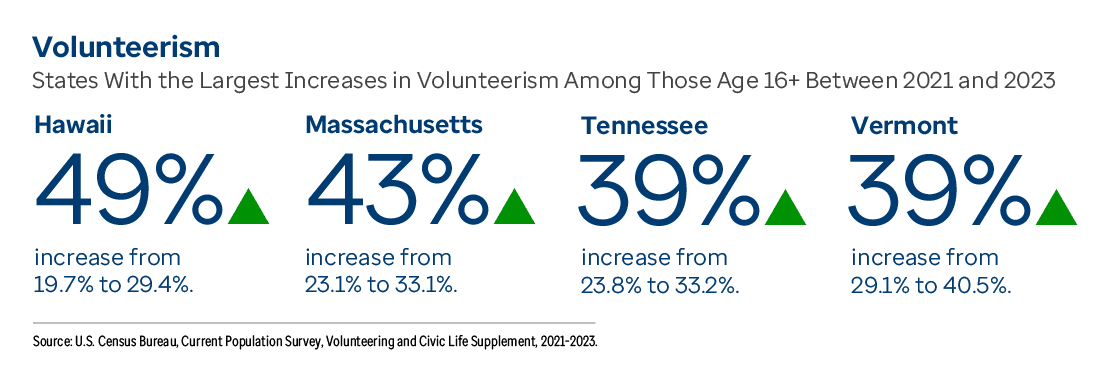
Changes over time. Nationally, the percentage of the population age 16 and older that reported volunteering increased 22% from 23.2% to 28.3% between 2021 and 2023.
- 48% among Asian (16.4% to 24.3%), 34% among Hispanic (12.6% to 16.9%), 28% among Black (17.9% to 22.9%) and 19% among white (27.8% to 33.1%) populations.
- 31% among those with less than a high school education (13.7% to 17.9%), 28% among those with some post-high school education (21.1% to 27.0%), 21% among high school graduates (13.5% to 16.4%) and 19% among college graduates (33.0% to 39.2%).
- 30% among those with an annual household income less than $25,000 (12.5% to 16.3%), 19% among those with incomes of $50,000 to $74,999 (20.7% to 24.6%), 17% among those with incomes of $25,000 to $49,999 (16.5% to 19.3%), 14% among those with incomes of $100,000 to $149,999 (29.3% to 33.5%), and 13% among both those with incomes of $75,000 to $99,999 (26.2% to 29.7%) and those with incomes of $150,000 or more (36.7% to 41.4%).
- 23% among those living in metropolitan areas (23.0% to 28.4%).
- 23% among adults who have not served in the U.S. armed forces (23.1% to 28.3%) and 16% among those who have served (23.3% to 27.0%).
- 22% among both females (25.3% to 30.9%) and males (21.0% to 25.6%).
Differences. Volunteerism varied significantly by geography, income, educational attainment, race/ethnicity and gender in 2023. The prevalence was:
- 2.5 times higher in Utah (46.6%) than in Rhode Island (18.5%).
- 2.5 times higher among those with an annual household income of $150,000 or more (41.4%) compared with those with incomes less than $25,000 (16.3%).
- 2.4 times higher among college graduates (39.2%) than high school graduates (16.4%).
- 2.0 times higher among multiracial (33.9%) compared with Hispanic (16.9%) populations.
- 1.2 times higher among females (30.9%) compared with males (25.6%).
Note: The values for high school graduates (16.4%) and those with less than a high school education (17.9%) may not differ significantly based on overlapping 95% confidence intervals. The same is true for multiracial (33.9%), white (33.1%) and Hawaiian/Pacific Islander (30.4%) populations During the same period, voter participation significantly decreased 14% in
Arizona (71.9% to 61.7%), and 9% in both
New York (64.7% to 59.2%) and
Texas (63.9% to 57.9%).
Differences. Voter participation varied significantly by geography in 2024, with participation 1.4 times higher in
Minnesota (75.9%) than in
Arkansas (52.8%).

 US Summary
 Alabama
 Alaska
 Arizona
 Arkansas
 California
 Colorado
 Connecticut
 Delaware
 District of Columbia
 Florida
 Georgia
 Hawaii
 Idaho
Idaho Illinois
 Indiana
 Iowa
Iowa Kansas
 Kentucky
 Louisiana
 Maine
Maine Maryland
 Massachusetts
 Michigan
 Minnesota
 Mississippi
 Missouri
 Montana
 Nebraska
 Nevada
 New Hampshire
 New Jersey
 New Mexico
 New York
 North Carolina
 North Dakota
 Ohio
Ohio Oklahoma
 Oregon
 Pennsylvania
 Rhode Island
 South Carolina
 South Dakota
 Tennessee
 Texas
Texas Utah
Utah Vermont
 Virginia
 Washington
 West Virginia
 Wisconsin
 Wyoming