America's Health Rankings, United Health Foundation Logo
2025 Annual Report

Spotlight: Rural Communities

Download
Previous Page9 / 68Next Page
Close
Executive BriefForewordIntroductionNational SnapshotFindingsHealth OutcomesSocial and Economic FactorsPhysical EnvironmentClinical CareSpotlight: Rural CommunitiesBehaviorsState RankingsInternational ComparisonAppendixMeasures TableData Source DescriptionsMethodologyReferencesState SummariesUS SummaryAlabamaAlaskaArizonaArkansasCaliforniaColoradoConnecticutDelawareDistrict of ColumbiaFloridaGeorgiaHawaiiIdahoIllinoisIndianaIowaKansasKentuckyLouisianaMaineMarylandMassachusettsMichiganMinnesotaMississippiMissouriMontanaNebraskaNevadaNew HampshireNew JerseyNew MexicoNew YorkNorth CarolinaNorth DakotaOhioOklahomaOregonPennsylvaniaRhode IslandSouth CarolinaSouth DakotaTennesseeTexasUtahVermontVirginiaWashingtonWest VirginiaWisconsinWyoming
2025 Annual Report2025 Annual Report – Executive Brief2025 Annual Report – State Summaries2025 Annual Report – Economic Hardship Index County-Level Maps2025 Annual Report – Measures Table2025 Annual Report – Infographics2025 Annual Report – Report Data (All States)
‌‌‌‌‌
‌
‌
‌‌‌
‌
‌

Please tell us a little more about you

We appreciate you taking the time to help America’s Health Rankings better understand our audiences. Your feedback will allow us to optimize our website and provide you with additional resources in the future. Thank you.

Please select one option which best describes your profession or field of expertise

Journalist or media professional
Health Policy Professional
Public health professional (state, local, or community level)
Health care provider or administrator
Member of an advocacy group or trade organization
Academic, student, or researcher
Government administrator, legislator, or staffer
Concerned citizen
Other
Don't show me this again

Icon to indicate insights into differences by metropolitan status

Spotlight
Rural Communities


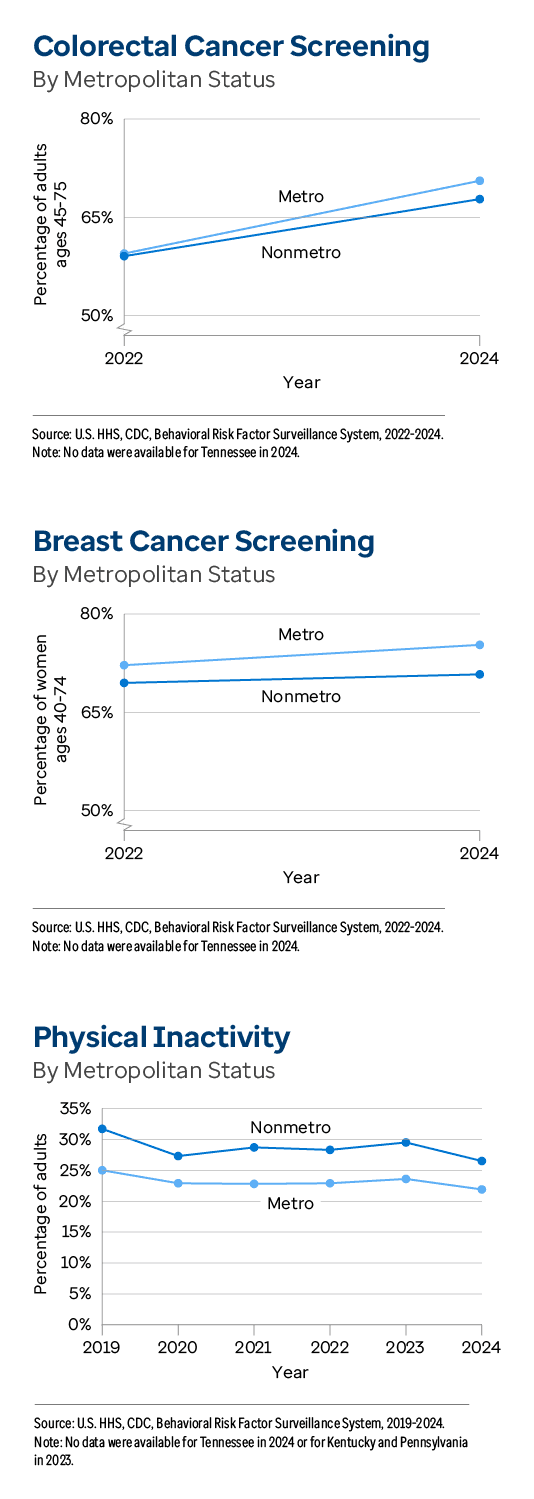
Graphic representation of Colorectal Cancer Screening, Breast Cancer Screening and PhysicalInactivity by Metropolitan Status information contained on this page. Download the full report PDF from the report Overview page for details.
Notable improvements were made among adults living in rural areas, but differences in cancer screenings and physical inactivity persist compared with metropolitan peers
Adults living in rural areas experienced meaningful improvements across some measures of clinical care and health behaviors, yet they continued to face distinct and persistent challenges that shape their health outcomes.
Cancer screening prevalence (which includes both colorectal and breast cancer screenings) improved 14% among adults in rural areas, from 53.6% to 61.3%, between 2022 and 2024. However, cancer screenings in metropolitan areas improved more during this time period, increasing 18% from 54.6% to 64.5%. Colorectal cancer screenings, which increased 15% in rural areas (59.1% to 67.8%) among adults ages 45-75, but 19% in metropolitan areas (59.5% to 70.6%). Additionally, breast cancer screening rates were 1.1 times higher among metropolitan (75.3%) compared with rural (70.8%) women ages 40-74 in 2024, a gap in prevalence that has persisted over time.
On the other hand, the percentage of adults who reported doing no physical activity or exercise other than their regular job decreased more in rural communities than among their metropolitan peers. The prevalence of physical inactivity among adults living in rural areas improved 10% (29.5% to 26.5%) between 2023 and 2024, compared with 7% among their metropolitan counterparts (23.6% to 21.9%). Additionally, physical inactivity remained 1.2 times higher among rural compared with metropolitan adults.
America's Health Rankings, United Health Foundation Logo

Reports

Partner With Us

Explore the Data and Stay Tuned for New Insights

Want to be notified of our latest updates? Sign up now

America's Health Rankings, United Health Foundation Logo