Community and Family Safety
Firearms are the most common method of suicide in the U.S., accounting for more than 50% of all suicide deaths.
18 This issue is of particular concern for older adults, who have
higher overall suicide rates and are significantly more likely to commit suicide by firearm.
19 Changes over time. Nationally, the
firearm death rate increased 5% from 13.1 to 13.7 deaths due to firearm injury of any intent (unintentional, suicide, homicide or undetermined) per 100,000 adults age 65 and older between 2019-2021 and 2022-2024. The majority of firearm deaths among older adults in 2022-2024 were suicides (12.5 deaths per 100,000 adults age 65 and older). There were 24,500 firearm deaths among adults age 65 and older in 2022-2024, 2,700 more than in 2019-2021. This rate is higher than the
Healthy People 2030 target to reduce firearm-related deaths to 10.7 per 100,000 population.20 Between 2019-2021 and 2022-2024, the firearm death rate increased in two states: 22% in
Missouri (16.0 to 19.5 per 100,000 adults age 65 and older) and 10% in
Florida (14.7 to 16.2).
Differences. In 2022-2024, the firearm death rate significantly varied by gender, geography, race/ethnicity and age group. The rate among adults age 65 and older was:
Changes over time. Nationally, the number of
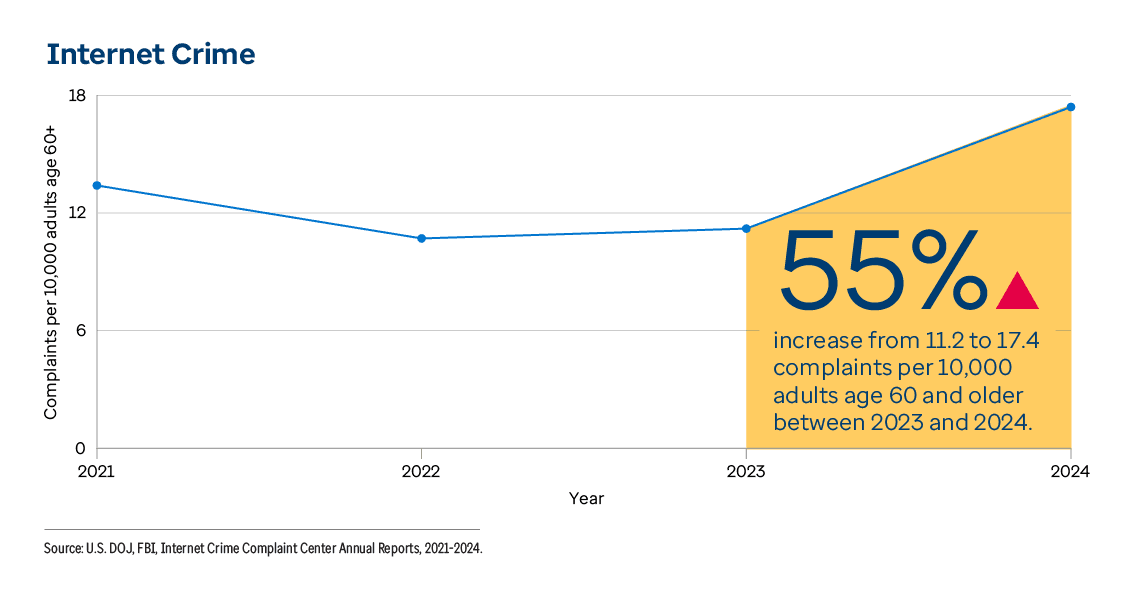
internet crime victim complaints increased 55% from 11.2 to 17.4 per 10,000 adults age 60 and older between 2023 and 2024. Nearly 143,200 internet crime victim complaints were reported among adults age 60 and older in 2024, 52,300 more than in 2023.
During this time, internet crime increased 55% or more in 17 states. The largest increases were: 315% in
Indiana (7.8 to 32.4 complaints per 10,000 adults age 60 and older) and 108% in both
Pennsylvania (8.6 to 17.9) and
Illinois (9.5 to 19.8).
Differences. In 2024, the internet crime rate among adults age 60 and older was 4.1 times higher in
Arizona (34.4 complaints per 10,000) than in
Mississippi (8.4).
Food insecurity is an
economic and social condition characterized by limited or uncertain regular access to food.
25 It differs from hunger, which is a physiological feeling. Many older adults face
barriers to food access, such as affordability, limited reliable transportation and health constraints.
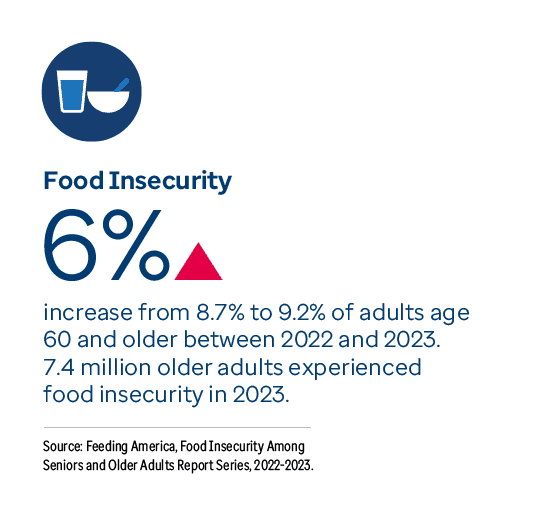
26 Changes over time. Nationally, the percentage of adults age 60 and older who lack access to enough food for an active and healthy life due to limited financial resources increased 6% from 8.7% to 9.2% between 2022 and 2023. In 2023, 7.4 million adults age 60 and older experienced
food insecurity, 500,000 more than in 2022.
Between 2022 and 2023, food insecurity among adults age 60 and older increased 6% or more in 33 states and the
District of Columbia. The largest increases were: 56% in
Kentucky (7.7% to 12.0%), 49% in
New Hampshire (3.5% to 5.2%) and 47% in
Minnesota (3.4% to 5.0%). During the same time, food insecurity decreased 6% or more in 10 states. The largest decreases were: 25% in
Utah (7.6% to 5.7%), 22% in
Delaware (7.2% to 5.6%) and 19% in
Missouri (7.8% to 6.3%).
Differences. In 2023, food insecurity among adults age 60 and older was 3.6 times higher in
Texas (13.6%) than in
North Dakota (3.8%).
The Supplemental Nutrition Assistance Program (SNAP) is an
anti-hunger program in the U.S. that helps millions of low-income Americans
access food and improve their economic security and health outcomes.
27,28 In 2023, older adults who lived alone received an average of
$162 a month in SNAP benefits.
29 Changes over time. Nationally,
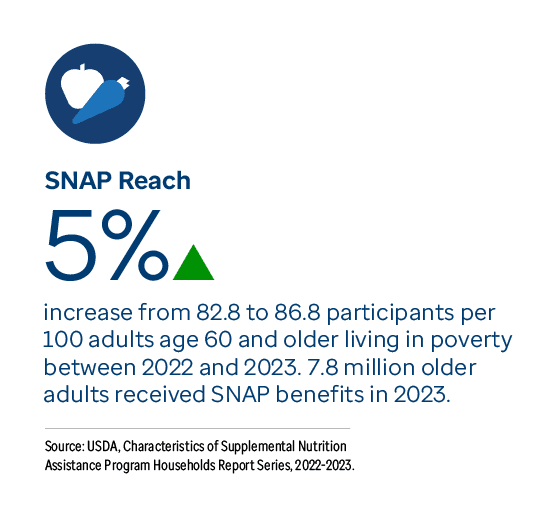
SNAP reach — the number of adults age 60 and older who participated in SNAP per 100 adults age 60 and older living in poverty — increased 5% from 82.8 to 86.8 between 2022 and 2023. In 2023, 7.8 million adults age 60 and older received SNAP benefits, 626,000 more than in 2022.
Between 2022 and 2023, SNAP reach among adults age 60 and older increased 5% or more in 13 states. The largest increases were: 23% in
Louisiana (63.1 to 77.5 participants per 100 adults age 60 and older living in poverty), 22% in
Maryland (67.9 to 82.7) and 20% in
South Dakota (38.3 to 45.9). During the same time, SNAP reach decreased 5% or more in 11 states. The largest decreases were: 35% in
New Jersey (91.5 to 59.1), 32% in
Indiana (51.9 to 35.5) and 31% in
Wyoming (21.4 to 14.8).
Community Support Expenditures
Several federal and state programs support older adults in remaining independent at home, ultimately
saving money for both individuals and the federal programs that fund nursing home care.
30 In fiscal year 2023,
$145.9 billion in Medicaid long-term services and supports spending went toward
home- and community-based services such as home health aides, adult day care, meal programs, in-home modifications and assistive equipment.
31,32 Changes over time. Nationally,
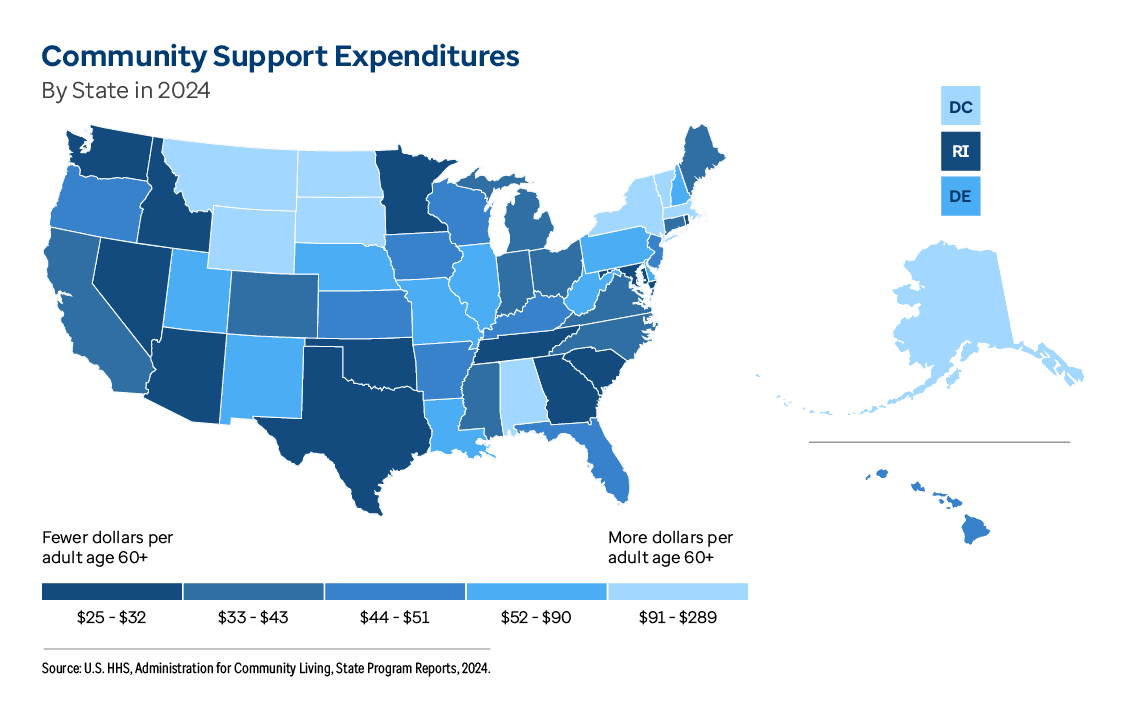
community support expenditures — measured in dollars per adult age 60 and older of Older Americans Act Title III funding spent on support services for older adults and caregivers, including congregate meals, home-delivered meals and senior centers — decreased 7% from $57 to $53 between 2019 and 2024. While community support expenditures rose to a high of $62 in 2021, they have since dropped back below 2019 levels.
Congregate meals decreased 15% from 2.0 to 1.7 persons served per 100 adults age 60 and older between 2019 and 2024, and
senior centers receiving Older Americans Act Title III funding decreased 11% from 7.9 to 7.0 senior centers per 100,000 adults age 60 and older during the same time period. However,
home-delivered meals increased 27% from 8.9 to 11.3 persons served per 100 adults age 60 and older with independent living difficulty between 2019 and 2024.
Between 2019 and 2024, community support expenditures decreased 7% or more in eight states. The largest decreases were: 73% in
Florida ($166 to $45 per adult age 60 and older), 37% in
Pennsylvania ($94 to $59) and 17% in
Massachusetts ($267 to $222).
During the same time, community support expenditures increased 7% or more in 40 states. The largest increases were 69% in
North Dakota ($84 to $142 per adult age 60 and older),
Kentucky ($26 to $44) and
Illinois ($35 to $59).
Differences. In 2024, community support expenditures were 11.6 times higher in the
District of Columbia ($289 per adult age 60 and older) and 8.9 times higher in Massachusetts ($222) than in
Arizona or
Georgia (both $25).

 US Summary
 Alabama
 Alaska
 Arizona
 Arkansas
 California
 Colorado
 Connecticut
 Delaware
 District of Columbia
 Florida
 Georgia
 Hawaii
 Idaho
Idaho Illinois
 Indiana
 Iowa
Iowa Kansas
 Kentucky
 Louisiana
 Maine
Maine Maryland
 Massachusetts
 Michigan
 Minnesota
 Mississippi
 Missouri
 Montana
 Nebraska
 Nevada
 New Hampshire
 New Jersey
 New Mexico
 New York
 North Carolina
 North Dakota
 Ohio
Ohio Oklahoma
 Oregon
 Pennsylvania
 Rhode Island
 South Carolina
 South Dakota
 Tennessee
 Texas
Texas Utah
Utah Vermont
 Virginia
 Washington
 West Virginia
 Wisconsin
 Wyoming