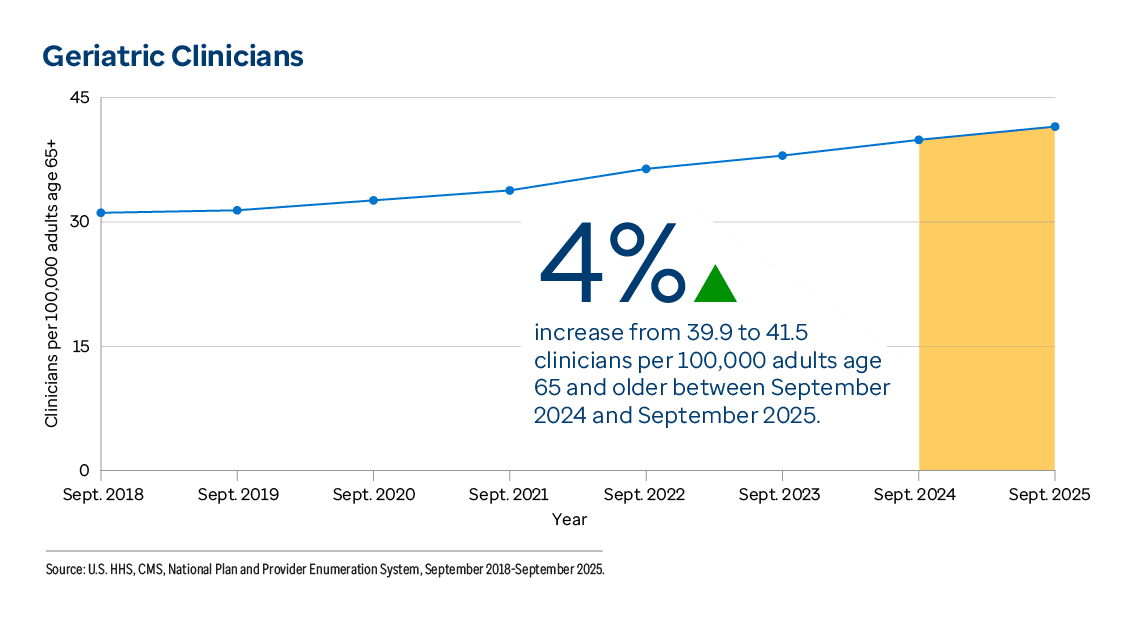
Changes over time. Nationally, the number of family medicine and internal medicine geriatricians and nurse practitioners per 100,000 adults age 65 and older increased 4% from 39.9 to 41.5 between September 2024 and September 2025. In September 2025, there were approximately 25,400
geriatric clinicians across the country, roughly 1,700 more than in September 2024.
During this time frame, the number of geriatric clinicians increased 4% or more in 26 states, led by: 34% in
Maine (34.9 to 46.6 clinicians per 100,000 adults age 65 and older), 13% in
Tennessee (37.1 to 42.1) and 9% in
Oregon (32.6 to 35.4). At the same time, geriatric clinicians decreased 6% in the
District of Columbia (100.3 to 94.5) and 4% in
New Hampshire (43.9 to 42.2).
Differences. In September 2024, the number of geriatric clinicians per 100,000 adults age 65 and older was 5.5 times higher in the District of Columbia (94.5 clinicians per 100,000 adults age 65 and older) and 4.3 times higher in
Rhode Island (74.1) than in
South Dakota (17.3).
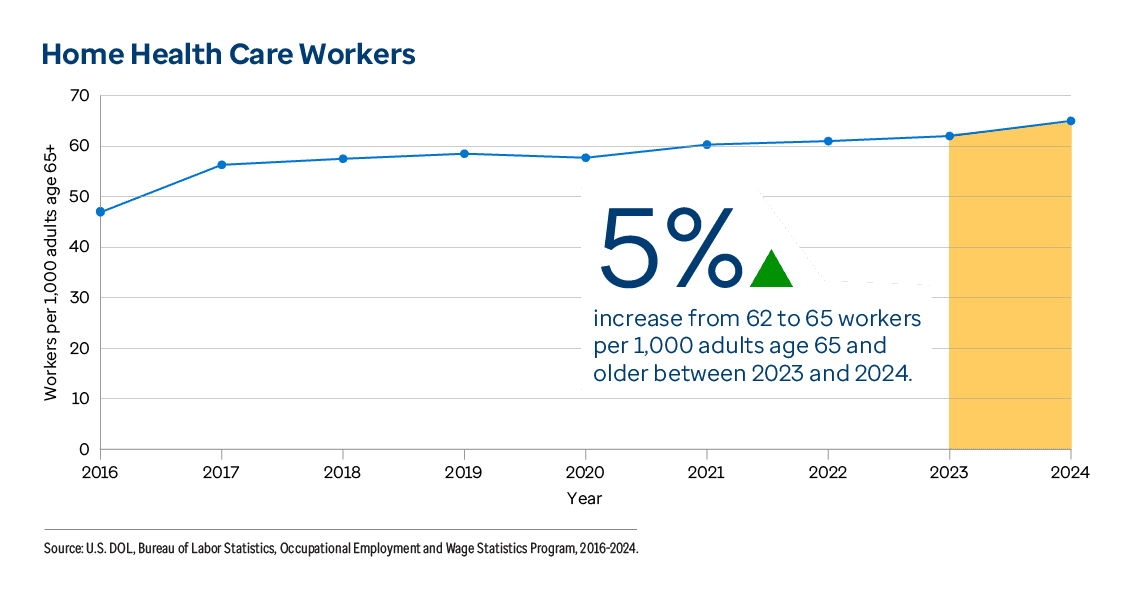
Changes over time. Nationally, the number of personal care and home health aides per 1,000 adults age 65 and older increased 5% from 62 to 65 between 2023 and 2024, and 38% since 2016.
Between 2023 and 2024, the supply of
home health care workers increased 5% or more in 25 states, led by: 24% in
Washington (59 to 73 aides per 1,000 adults age 65 and older), 21% in
Maryland (29 to 35) and 18% in
Indiana (38 to 45). At the same time, home health care workers decreased 5% or more in eight states, with the largest decreases being 13% in
Hawaii (23 to 20) and 8% in both
Massachusetts (88 to 81) and
West Virginia (52 to 48).
Differences. In 2024, the supply of home health care workers was 9.8 times higher in
New York (166 aides per 1,000 adults age 65 and older) than in
Florida (17).
Preventive Clinical Services
Changes over time. Nationally,
cancer screenings — the percentage of females ages 65-74 who reported having a mammogram in the past two years and the percentage of adults ages 65-75 who reported having a colorectal cancer screening within the recommended time period — increased 4% from 74.1% to 76.8% between 2022 and 2024.
Between 2022 and 2024, the prevalence of cancer screenings among adults ages 65-75 significantly increased:
During this time frame, cancer screenings significantly increased in four states: 11% in both
New Jersey (71.6% to 79.8%) and
Delaware (74.2% to 82.2%), 8% in
Massachusetts (76.9% to 83.3%) and 5% in
Minnesota (78.1% to 82.2%).
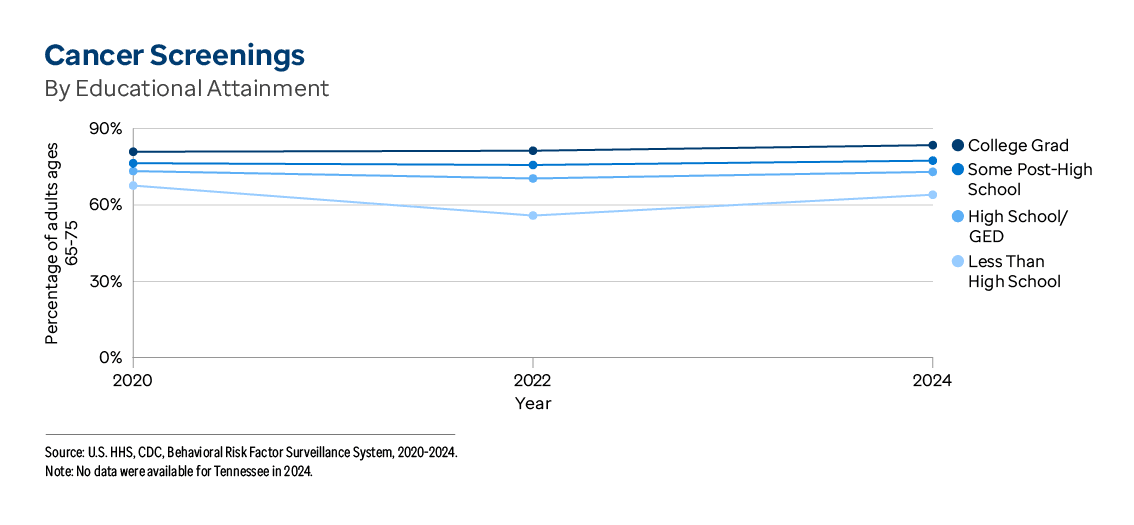
Differences. In 2024, cancer screenings significantly varied by geography, educational attainment, household income, gender, race/ethnicity and metropolitan status. The prevalence among adults ages 65-75 and older was:
- 1.3 times higher in Rhode Island (85.0%) than in Wyoming (65.0%).
- 1.3 times higher among college graduates (83.5%) compared with those with less than a high school education (64.0%).
- 1.3 times higher among those with an annual household income of $150,000 or more (86.6%) compared with those with an income less than $25,000 (65.1%).
- 1.2 times higher among men (82.6%) compared with women (71.1%).
- 1.2 times higher among Black (80.4%) compared with Asian (65.6%) adults.
- 1.1 times higher among those living in metropolitan areas (77.6%) compared with those in nonmetropolitan areas (72.8%).
Note: No data were available for Tennessee in 2024. Differences highlighted the groups with the highest and lowest values. However, the values for certain income and race/ethnicity groups may not differ significantly based on overlapping 95% confidence intervals. For more information, view cancer screenings data for older adults. During the
2023-2024 flu season, flu vaccinations prevented nearly 6,000 influenza-related deaths among adults age 65 and older in the U.S., as well as approximately 780,000 illnesses, 436,000 medical visits and 64,000 hospitalizations.
46 Differences. In 2024, the prevalence of flu vaccination significantly varied by geography, race/ethnicity, educational attainment, household income, metropolitan status and gender. The prevalence among adults age 65 and older was:
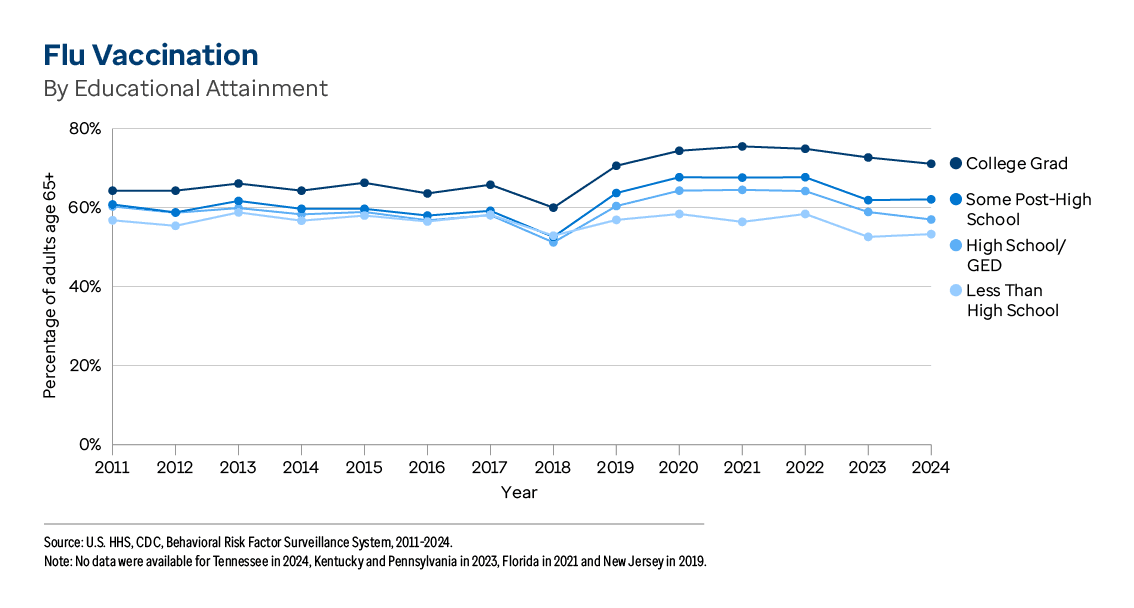
Note: No data were available for Tennessee in 2024 or for Kentucky and Pennsylvania in 2023. Differences highlighted the groups with the highest and lowest values. However, the values for certain race/ethnicity, education and income groups may not differ significantly based on overlapping 95% confidence intervals. For more information, view flu vaccination data for older adults. Every year, approximately
900,000 individuals in the U.S. are diagnosed with pneumonia, 150,000 of whom are hospitalized and 41,000 of whom die from pneumonia or its complications.
48 Hospitalization and
death rates from pneumococcal infections are highest among older adults.
49,50 Changes over time. Nationally, the percentage of adults age 65 and older who reported ever receiving a
pneumonia (pneumococcal) vaccine did not change significantly between 2023 and 2024 (70.2% to 69.8%).
Differences. In 2024, the prevalence of pneumonia vaccination significantly varied by race/ethnicity, educational attainment, geography, household income, gender, metropolitan status, disability status and veteran status. The prevalence among adults age 65 and older was:
Note: No data were available for Tennessee in 2024 or for Kentucky and Pennsylvania in 2023. Differences highlighted the groups with the highest and lowest values. However, the values for certain race/ethnicity, income and disability groups may not differ significantly based on overlapping 95% confidence intervals. For more information, view pneumonia vaccination data for older adults. Changes over time. Nationally, the percentage of nursing home beds rated four or five stars increased 9% from 31.1% to 34.0% between September 2024-November 2024 and September 2025-November 2025.
Between 2024 and 2025, the prevalence of
nursing home beds rated four or five stars increased 9% or more in 26 states, led by: 45% in
West Virginia (18.5% to 26.9%), 33% in
Tennessee (25.1% to 33.5%) and 31% in both
Maine (34.0% to 44.6%) and
Georgia (20.9% to 27.3%). During the same time period, the prevalence decreased 9% or more in four states and the District of Columbia: 39% in
Vermont (41.9% to 25.7%), 35% in
Hawaii (59.7% to 38.9%), 18% in
Nevada (27.6% to 22.5%), 17% in
Idaho (51.3% to 42.7%) and 15% in
District of Columbia (21.6% to 18.4%).
Differences. In 2025, nursing home quality was 2.6 times higher in
North Dakota (49.1%) than in
Louisiana (18.6%).

 US Summary
 Alabama
 Alaska
 Arizona
 Arkansas
 California
 Colorado
 Connecticut
 Delaware
 District of Columbia
 Florida
 Georgia
 Hawaii
 Idaho
Idaho Illinois
 Indiana
 Iowa
Iowa Kansas
 Kentucky
 Louisiana
 Maine
Maine Maryland
 Massachusetts
 Michigan
 Minnesota
 Mississippi
 Missouri
 Montana
 Nebraska
 Nevada
 New Hampshire
 New Jersey
 New Mexico
 New York
 North Carolina
 North Dakota
 Ohio
Ohio Oklahoma
 Oregon
 Pennsylvania
 Rhode Island
 South Carolina
 South Dakota
 Tennessee
 Texas
Texas Utah
Utah Vermont
 Virginia
 Washington
 West Virginia
 Wisconsin
 Wyoming