The average 65-year-old in the U.S. can expect to live another
19.7 years based on 2024 calculations.
5 However, many older adults do not live to see their 75th birthday. The
leading causes of death among adults ages 65-74 in the U.S. in 2024 were cancer, heart disease, chronic lower respiratory disease, cerebrovascular disease and diabetes, according to data from the Centers for Disease Control and Prevention (CDC).
6 Unintentional injuries remain the sixth-leading cause of death, led by falls, poisonings (including drug deaths) and motor vehicle crashes.
7 Changes over time. Nationally, the
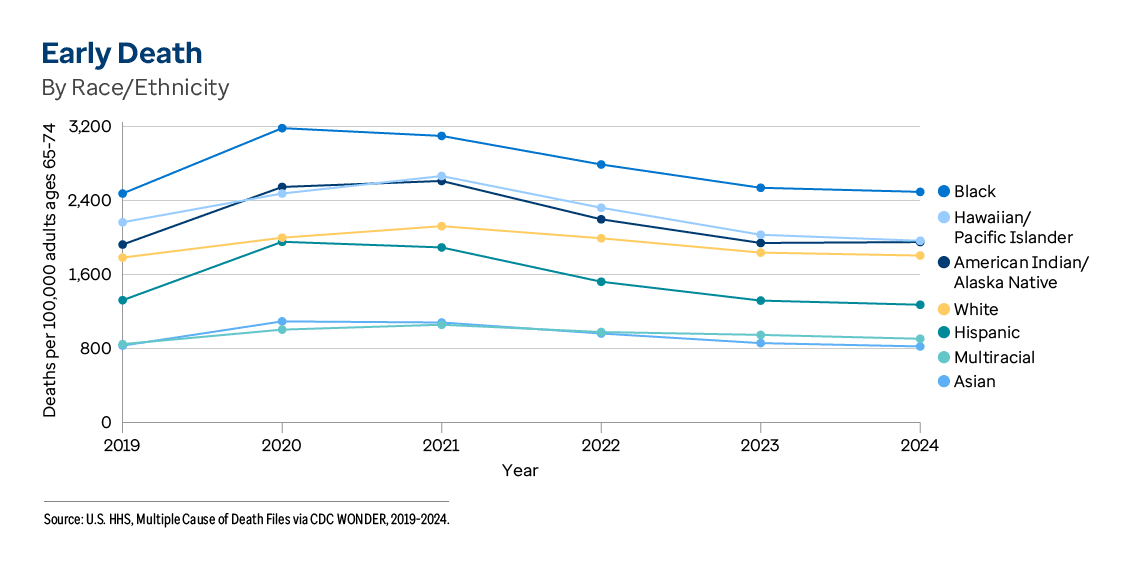
early death rate decreased 2% from 1,810 to 1,773 deaths per 100,000 adults ages 65-74 between 2023 and 2024, nearly back to the 2019 rate (1,765). In 2024, there were approximately 628,400 deaths among adults ages 65-74, 740 fewer than in 2023.
Between 2023 and 2024, the early death rate among adults ages 65-74 significantly decreased:
- 4% among Asian (859 to 823 deaths per 100,000 adults ages 65-74), 3% among Hispanic (1,319 to 1,274) and 2% among both Black (2,539 to 2,495) and white (1,838 to 1,806) older adults.
- 2% among both women (1,452 to 1,425) and men (2,212 to 2,164).
During the same time, the early death rate significantly decreased in seven states: 4% in both
California (1,520 to 1,462 deaths per 100,000 adults ages 65-74) and
Massachusetts (1,474 to 1,413); 3% in
Florida (1,674 to 1,629),
Georgia (2,049 to 1,992),
New York (1,479 to 1,440) and
Pennsylvania (1,827 to 1,772); and 2% in
Texas (1,907 to 1,861).
Differences. In 2024, the early death rate significantly varied by race/ethnicity, geography and gender. The rate among adults ages 65-74 was:
- 3.0 times higher among Black (2,495 deaths per 100,000) compared with Asian (823) adults.
- 1.9 times higher in Mississippi (2,613) than in New Jersey (1,389).
- 1.5 times higher among men (2,164) than women (1,425).
America’s Health Rankings data indicate that older adults were the only population that experienced a significant increase in drug-related deaths between 2022 and 2023, while rates decreased among younger populations.
8 According to
The Journals of Gerontology, drug abuse can be particularly hazardous for older adults because age-related changes in the liver reduce the ability to
metabolize medications.
9 Additionally, many older adults take
one or more prescription medications, which can increase the risk of dangerous interactions.
10 Changes over time. Despite staying below the United States Department of Health and Human Services’
Healthy People 2030 target of 20.7 drug overdose deaths per 100,000 population, the national
drug death rate increased 38% from 9.9 to 13.7 deaths due to drug injury (unintentional, suicide, homicide or undetermined) per 100,000 adults age 65 and older between 2019-2021 and 2022-2024.
11 This represents approximately 24,500 drug deaths among older adults in 2022-2024, 8,100 more than in 2019-2021.
Between 2019-2021 and 2022-2024, the drug death rate among adults age 65 and older significantly increased:
During this time frame, the drug death rate significantly increased in 35 states. The largest increases were: 116% in
Alaska (9.8 to 21.2 deaths per 100,000 adults age 65 and older), 87% in
Washington (11.7 to 21.9) and 78% in
Maine (6.7 to 11.9).
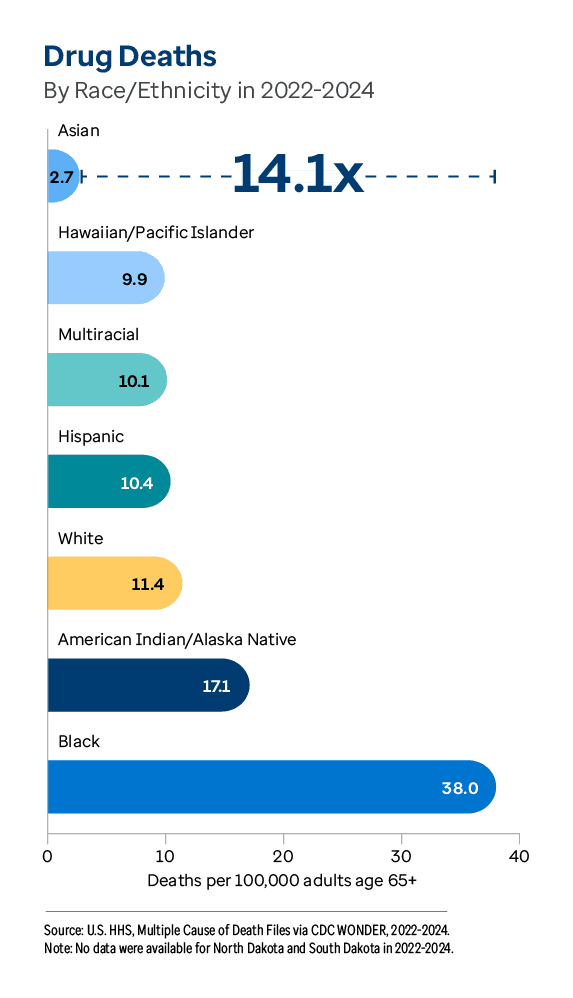
Differences. In 2022-2024, the drug death rate varied significantly by geography, race/ethnicity and gender. The rate among adults age 65 and older was:
- 16.0 times higher in the District of Columbia (86.5 deaths per 100,000) and 4.6 times higher in Nevada (24.9) than in Nebraska (5.4).
- 14.1 times higher among Black (38.0) compared with Asian (2.7) adults.
- 2.6 times higher among men (20.8) compared with women (8.0).
Note: No data were available for North Dakota and South Dakota in 2019-2021 and 2022-2024.
Changes over time. Nationally,
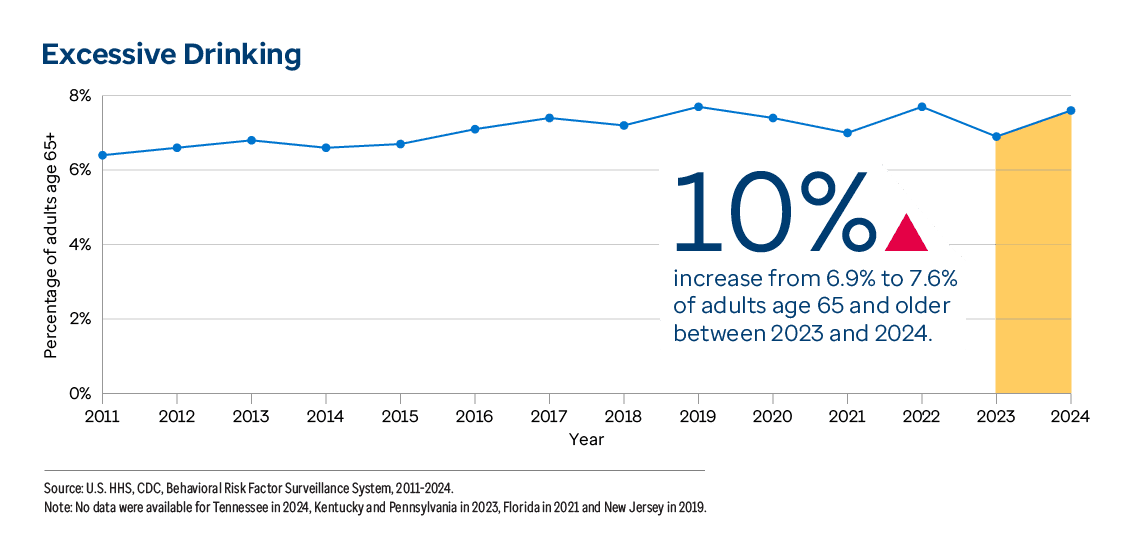
excessive drinking — the percentage of adults age 65 and older who reported binge drinking (four or more drinks on one occasion in the past 30 days for females or five or more for males) or heavy drinking (eight or more drinks per week for females or 15 or more for males) — increased 10% from 6.9% to 7.6% between 2023 and 2024.
Between 2023 and 2024, the prevalence of excessive drinking among adults age 65 and older significantly increased:
- 50% among Black (4.6% to 6.9%) and 10% among white (7.3% to 8.0%) adults.
- 12% among straight adults (6.8% to 7.6%).
During the same time period, the prevalence significantly increased 76% in
Missouri (5.1% to 9.0%) and 50% in
Kansas (4.8% to 7.2%).
Differences. Excessive drinking significantly varied by geography, race/ethnicity, gender, income and disability status. In 2024, the prevalence among adults age 65 and older was:
Note: No data were available for Tennessee in 2024 or for Kentucky and Pennsylvania in 2023. Differences highlighted the groups with the highest and lowest values. However, the values for certain race/ethnicity, income and disability groups may not differ significantly based on overlapping 95% confidence intervals. For more information, view excessive drinking data for older adults. Suicide is a troubling public health issue that can leave a
lasting impact on families and communities.
15 Suicide attempts by older adults are
more likely to be fatal than suicide attempts by younger people.
16 Between 2019-2021 and 2022-2024, the suicide rate among adults age 65 and older significantly increased:
- 5% among white adults (20.3 to 21.4 deaths per 100,000).
- 3% among men (31.5 to 32.4).
- 3% among adults ages 65-74 (15.1 to 15.6).
The suicide rate among older adults significantly increased 21% in
Missouri (18.0 to 21.8 deaths per 100,000 adults age 65 and older) between 2019-2021 and 2022-2024.
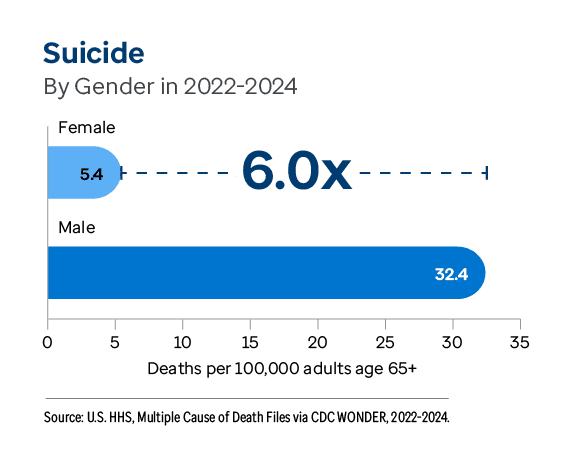
Differences. In 2022-2024, the suicide rate significantly varied by gender, race/ethnicity, geography and age group. The rate among adults age 65 and older was:
- 6.0 times higher among men (32.4 deaths per 100,000) compared with women (5.4).
- 4.5 times higher among white (21.4) compared with Black (4.8) adults.
- 4.2 times higher in Montana (31.6) than in the District of Columbia (7.5), and 3.2 times higher in Montana than in New York (9.8).
- 1.4 times higher among adults age 85 and older (22.4) than those ages 65-74 (15.6).
Note: Differences highlighted the groups with the highest and lowest values. However, the values for certain race/ethnicity groups may not differ significantly based on overlapping 95% confidence intervals. For more information, view suicide data for older adults. 
 US Summary
 Alabama
 Alaska
 Arizona
 Arkansas
 California
 Colorado
 Connecticut
 Delaware
 District of Columbia
 Florida
 Georgia
 Hawaii
 Idaho
Idaho Illinois
 Indiana
 Iowa
Iowa Kansas
 Kentucky
 Louisiana
 Maine
Maine Maryland
 Massachusetts
 Michigan
 Minnesota
 Mississippi
 Missouri
 Montana
 Nebraska
 Nevada
 New Hampshire
 New Jersey
 New Mexico
 New York
 North Carolina
 North Dakota
 Ohio
Ohio Oklahoma
 Oregon
 Pennsylvania
 Rhode Island
 South Carolina
 South Dakota
 Tennessee
 Texas
Texas Utah
Utah Vermont
 Virginia
 Washington
 West Virginia
 Wisconsin
 Wyoming