Behavioral health measures among older adults have worsened over the past decade.
There are a variety of reasons why older adults are particularly
at risk for drug overdoses. They may unintentionally misuse prescription medications like
opioids, are more likely to be taking prescription medications
than other populations and face
other risk factors including social isolation. Drug abuse is particularly dangerous for this population: Older adults face a
reduced ability to metabolize medications due to age-related changes in the liver.
Between 2008-2010 and 2018-2020
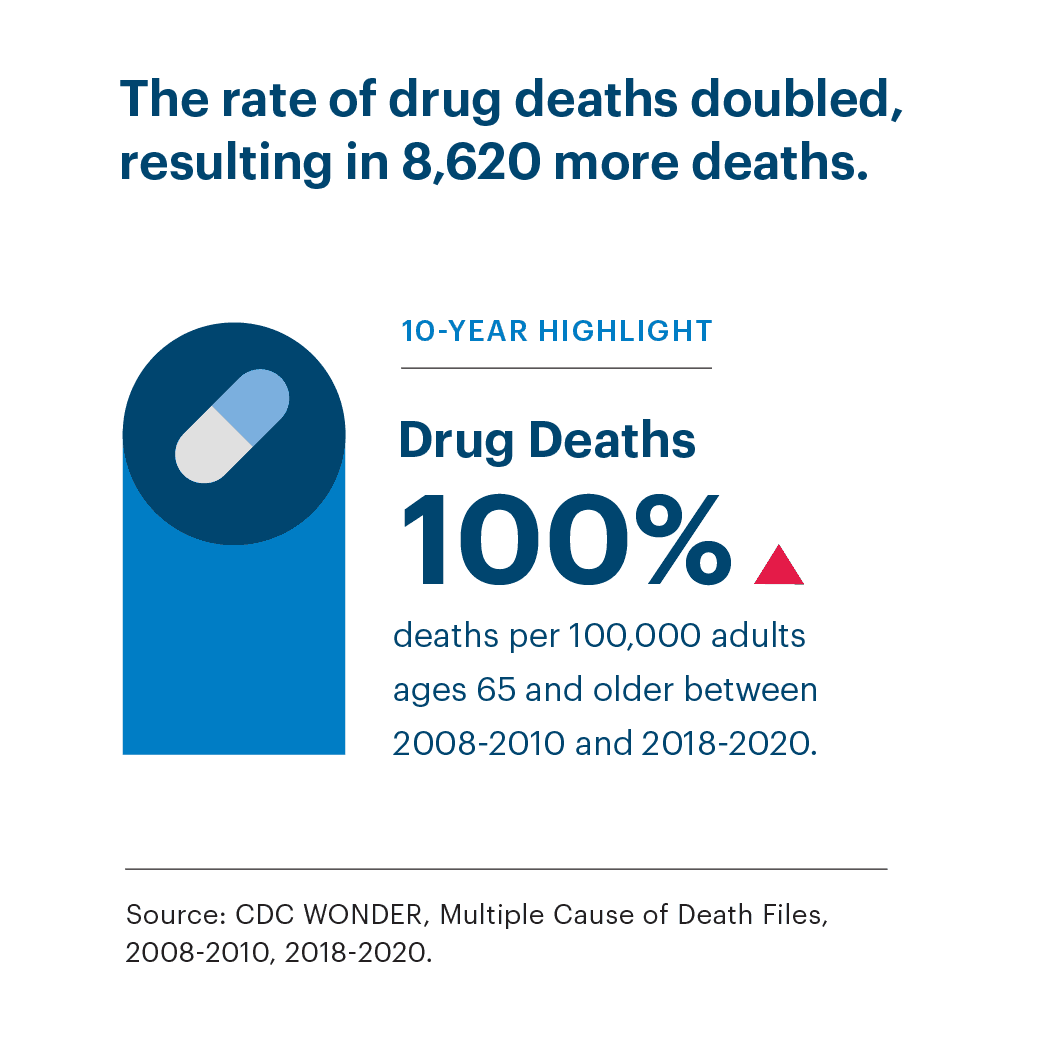
Nationally, the number of deaths due to drug injury (unintentional, suicide, homicide or undetermined) per 100,000 adults ages 65 and older significantly increased 100% from 4.2 to 8.4, corresponding to an increase of 8,620 deaths over this period. The
drug death rate significantly increased in 35 states, led by: 352% in
Connecticut (2.3 to 10.4 deaths per 100,000 adults ages 65 and older), 323% in
Maryland (3.5 to 14.8) and 222% in
New Jersey (2.7 to 8.7).
Among adults ages 65-74, drug deaths increased 147% from 4.7 to 11.6 deaths per 100,000 — the largest increase compared with all other age groups 15 and older. Both
males and
females experienced significant increases in the drug death rate: 172% for males (4.3 to 11.7 deaths per 100,000 adults ages 65 and older) and 38% for females (4.2 to 5.8).
Disparities in 2018-2020
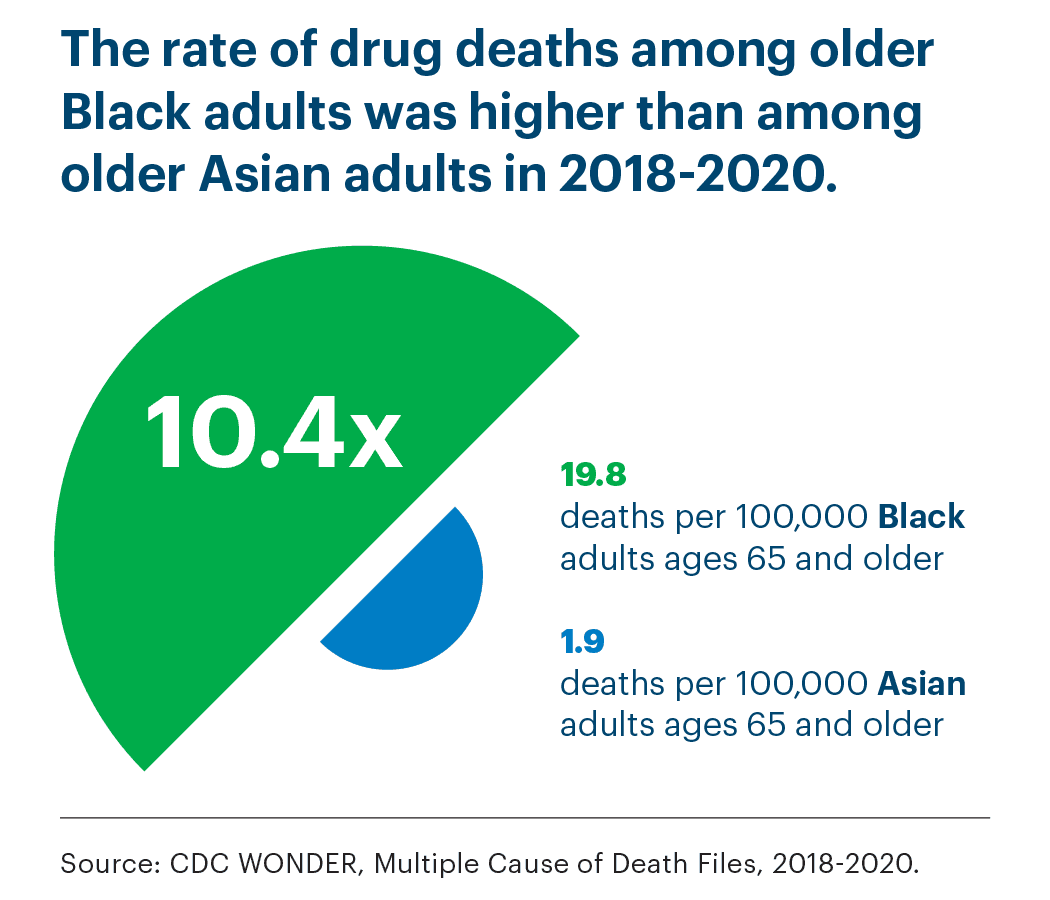
The drug death rate significantly varied by race/ethnicity and gender. The rate was 10.4 times higher among
Black adults (19.8 deaths per 100,000 adults ages 65 and older) than among
Asian adults (1.9) and 2.0 times higher among males (11.7) than among females (5.8).
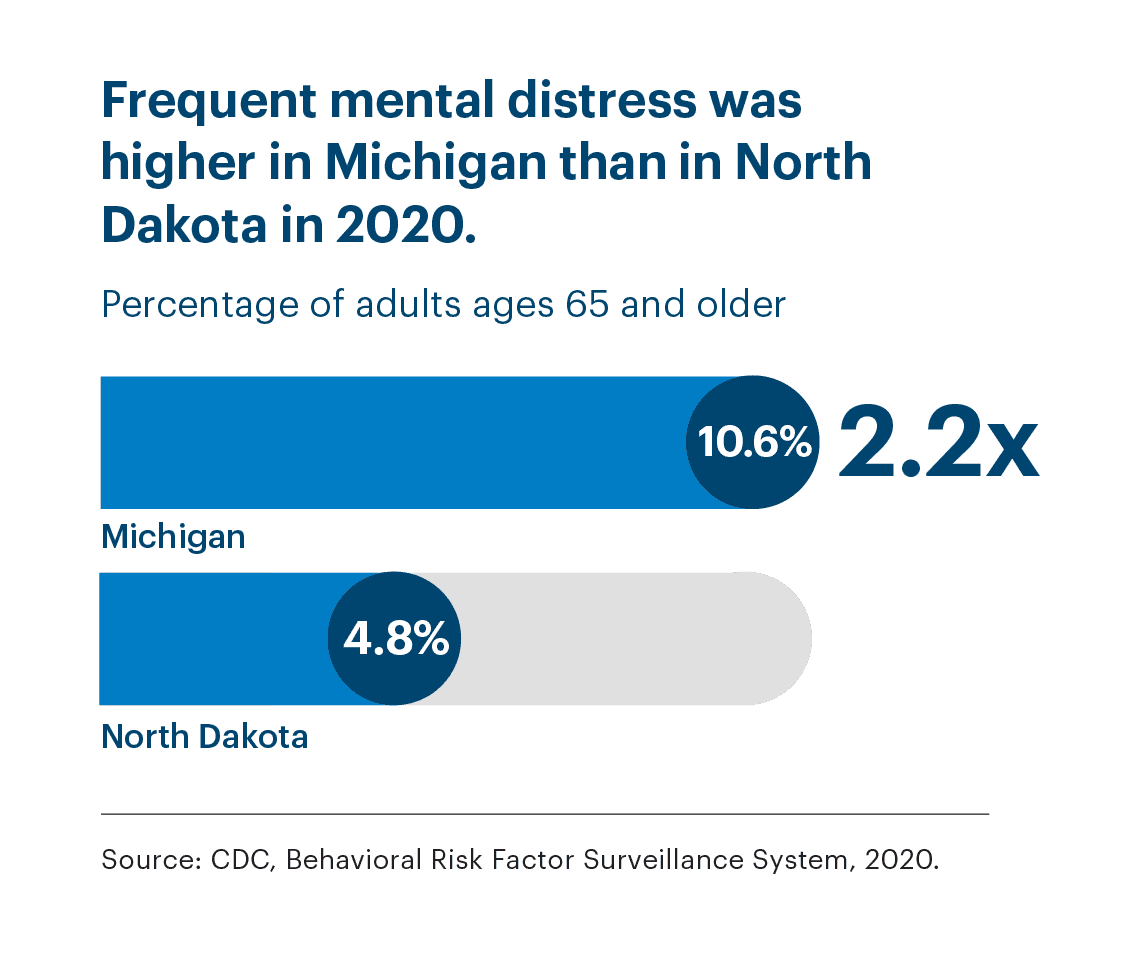
Frequent mental distress is an indicator of health-related quality of life and the burden of mental illness in a population. Frequent mental distress is
characterized by 14 or more days of self-reported poor mental health in the past month and is
associated with risk factors for poor health.
Between 2011 and 2020
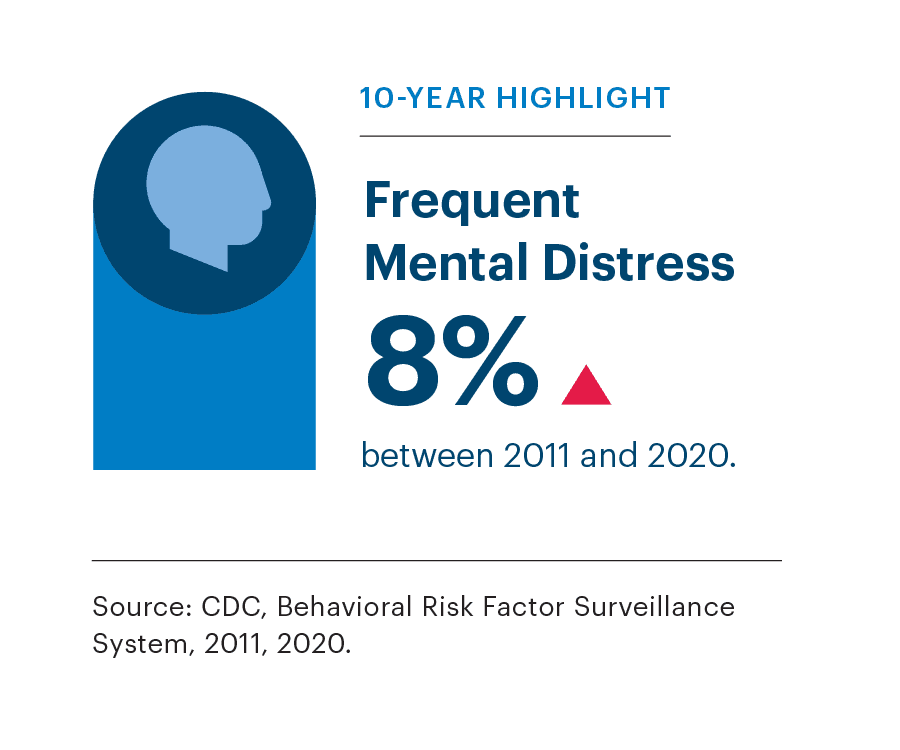
Nationally, the percentage of adults ages 65 and older who reported their mental health was not good 14 or more days in the past 30 days significantly increased 8% from 7.5% to 8.1%. Frequent mental distress among older adults significantly increased 81% in
Hawaii (4.2% to 7.6%), 61% in
Michigan (6.6% to 10.6%) and 57% in
Washington (5.3% to 8.3%).
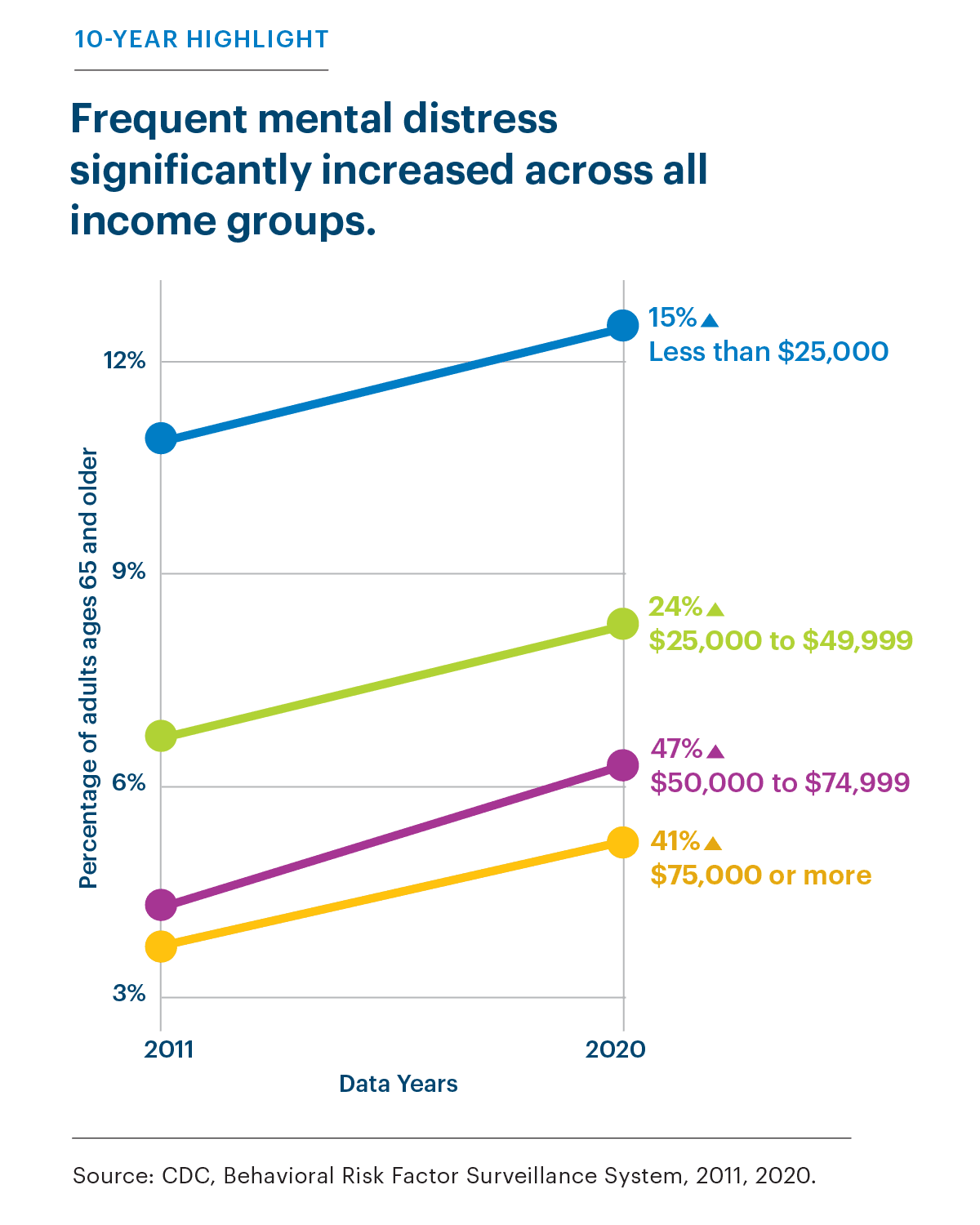
Some income, education, gender and racial/ethnic subpopulations experienced significant increases in frequent mental distress. Among adults ages 65 and older, increases greater than the national change included:
Disparities in 2020
Frequent mental distress significantly varied by race/ethnicity, income, education and gender; differences by metropolitan status were not notable. The prevalence among adults ages 65 and older was higher among:
- American Indian/Alaska Native adults (15.6%), 4.0 times higher than among Asian adults (3.9%). The prevalence was also significantly higher among American Indian/Alaska Native adults than among Black (6.8%) and white (7.8%) adults.
- Those with an annual household income below $25,000 (12.5%), 2.4 times higher than among those with an income of $75,000 or more (5.2%); the prevalence was significantly lower among those with incomes of $75,000 or more and $50,000 to $74,999 (6.3%) compared with all other income levels.
- Those with less than a high school education (12.0%), 2.2 times higher than among college graduates (5.4%).
- Females (9.4%) than among males (6.5%).
Between 2011 and 2020
Nationally, the percentage of adults ages 65 and older who reported being told by a health professional that they have a depressive disorder significantly increased 9% from 13.0% to 14.2%.
Depression significantly increased in seven states, led by
Washington (12.6% to 20.0%),
Hawaii (7.1% to 10.9%) and
West Virginia (12.4% to 19.0%). During the same period, depression significantly decreased in
Alaska (19.2% to 10.4%) and
Illinois (13.4% to 8.2%). All income and some education, racial/ethnic and gender subpopulations experienced significant increases in depression.
Disparities in 2020
Depression among older adults was lowest in Illinois (8.2%) and highest in Washington (20.0%). The prevalence significantly varied by race/ethnicity, gender, income and education; differences by metropolitan status were not notable.
Between 2011 and 2020
Nationally, the percentage of adults ages 65 and older who reported binge drinking (four or more drinks for females or five or more drinks for males on one occasion in the past 30 days) or heavy drinking (eight or more drinks for females or 15 or more drinks for males per week) significantly increased 16% from 6.4% to 7.4%, affecting 3.8 million older adults in 2020.
Some racial/ethnic, gender and education subpopulations experienced significant increases in
excessive drinking; changes by income were not notable. Excessive drinking significantly increased in
Kansas (4.0% to 5.9%),
Nebraska (5.4% to 7.2%),
North Carolina (4.0% to 6.4%),
Ohio (4.6% to 7.8%) and
West Virginia (2.1% to 4.3%).
Disparities in 2020
Excessive drinking among older adults was lowest in
Utah (2.7%) and highest in
Wisconsin (11.8%). The prevalence significantly varied by income, education, race/ethnicity, gender and metropolitan status.
Suicide is a tragic public health issue that leaves a lasting impact on families and communities. Recorded suicide attempts among older adults are usually
more lethal than those among younger age groups. Older adults may also exhibit passive
self-harm behaviors that can result in death, such as refusing food, medications or liquids; these are rarely recorded as suicide attempts or deaths by suicide.
Between 2009-2011 and 2018-2020
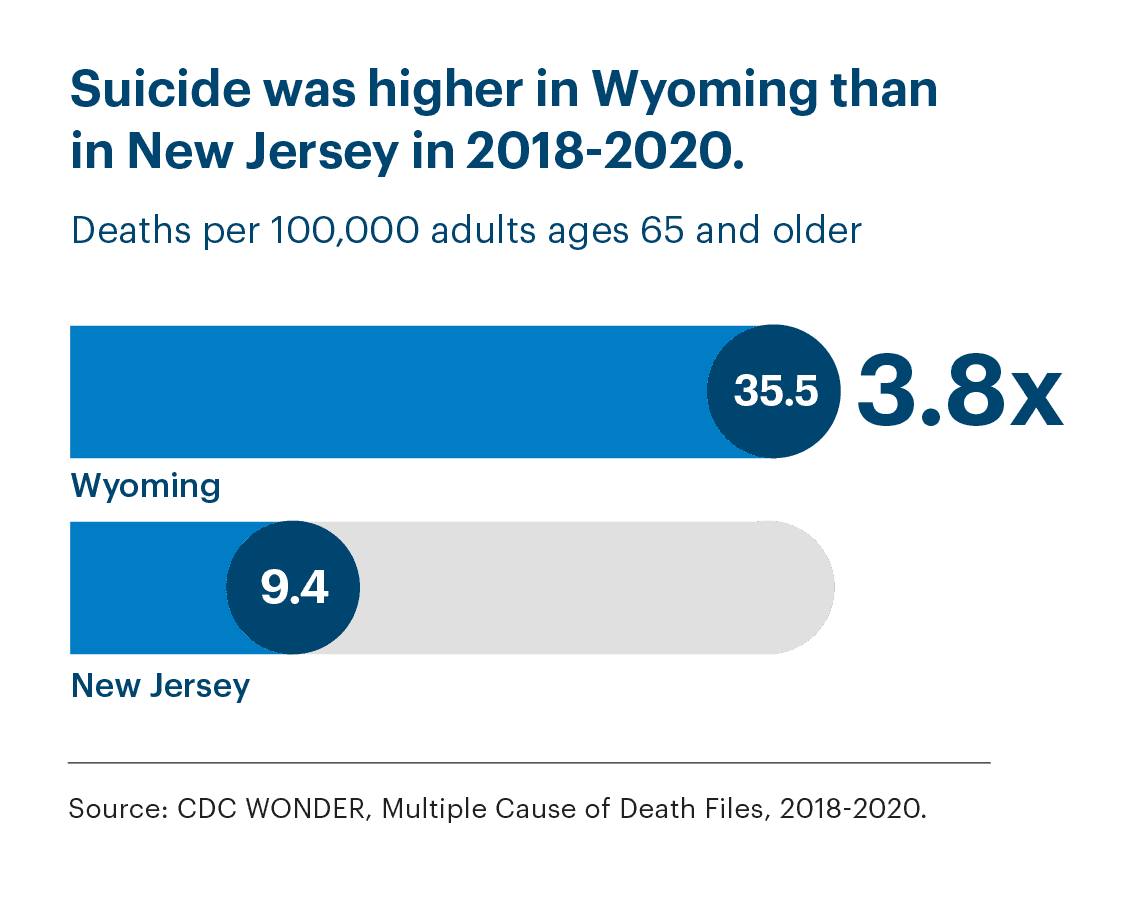
Nationally, the number of deaths due to intentional self-harm per 100,000 adults ages 65 and older significantly increased 13% from 15.0 to 16.9, corresponding to an increase of 9,239 deaths over this period. In 2018-2020, 27,412 older adults died by suicide. The suicide rate significantly increased in nine states, led by: 40% in
Connecticut (9.6 to 13.4 deaths per 100,000 adults ages 65 and older), 37% in
Ohio (11.9 to 16.3) and 34% in
Oklahoma (16.3 to 21.8).
Disparities in 2018-2020
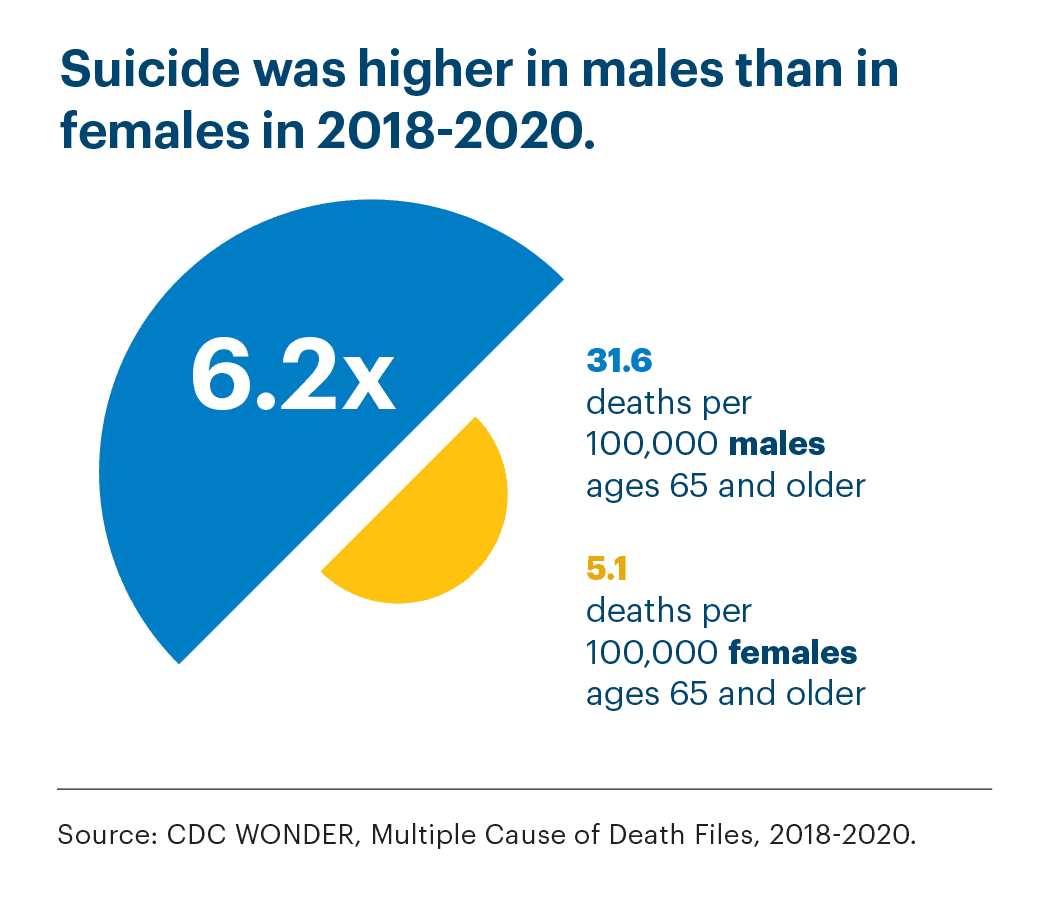
The suicide rate varied by gender, race/ethnicity and age. The rate was higher among:
- Males (31.6 deaths per 100,000 adults ages 65 and older), 6.2 times higher than among females (5.1).
- White adults (20.2), 4.7 times higher than among Black adults (4.3). The rate was significantly higher among white adults compared with all other racial/ethnic groups.
- Adults ages 85 and older (20.0) than among adults ages 65-74 (15.4). The rate was significantly higher with each increase in age group.

 Alabama
 Alaska
 Arizona
 Arkansas
 California
 Colorado
 Connecticut
 Delaware
 District of Columbia
 Florida
 Georgia
 Hawaii
 Idaho
Idaho Illinois
 Indiana
 Iowa
Iowa Kansas
 Kentucky
 Louisiana
 Maine
Maine Maryland
 Massachusetts
 Michigan
 Minnesota
 Mississippi
 Missouri
 Montana
 Nebraska
 Nevada
 New Hampshire
 New Jersey
 New Mexico
 New York
 North Carolina
 North Dakota
 Ohio
Ohio Oklahoma
 Oregon
 Pennsylvania
 Rhode Island
 South Carolina
 South Dakota
 Tennessee
 Texas
Texas Utah
Utah Vermont
 Virginia
 Washington
 West Virginia
 Wisconsin
 Wyoming
 US SummaryAppendixMeasures TableData Source DescriptionsMethodology