After almost a decade of improvement, the early death rate among adults ages 65-74 increased dramatically during the first year of the COVID-19 pandemic, disproportionately affecting older Americans of color.
Those who are 65 should expect to live another
18.5 years, down 1.1 years from 2019, according to 2020 life expectancy estimates. Yet while the death rate among adults ages 65-74 — considered an
early death — decreased steadily over the last decade, there was a sudden, significant increase between 2019 and 2020, and much of this increase was attributed to the COVID-19 pandemic. COVID-19 became a new top-10 cause of death in 2020 and the third-leading cause of death among older adults, causing
76,277 deaths. There were also more deaths from cancer, heart disease, diabetes, stroke, unintentional injury, liver disease, kidney disease and influenza/pneumonia in this age group in 2020 compared with 2019. The early death rate may continue to grow, as provisional death data revealed that
more deaths due to COVID-19 occurred in 2021 than in 2020.
Between 2019 and 2020
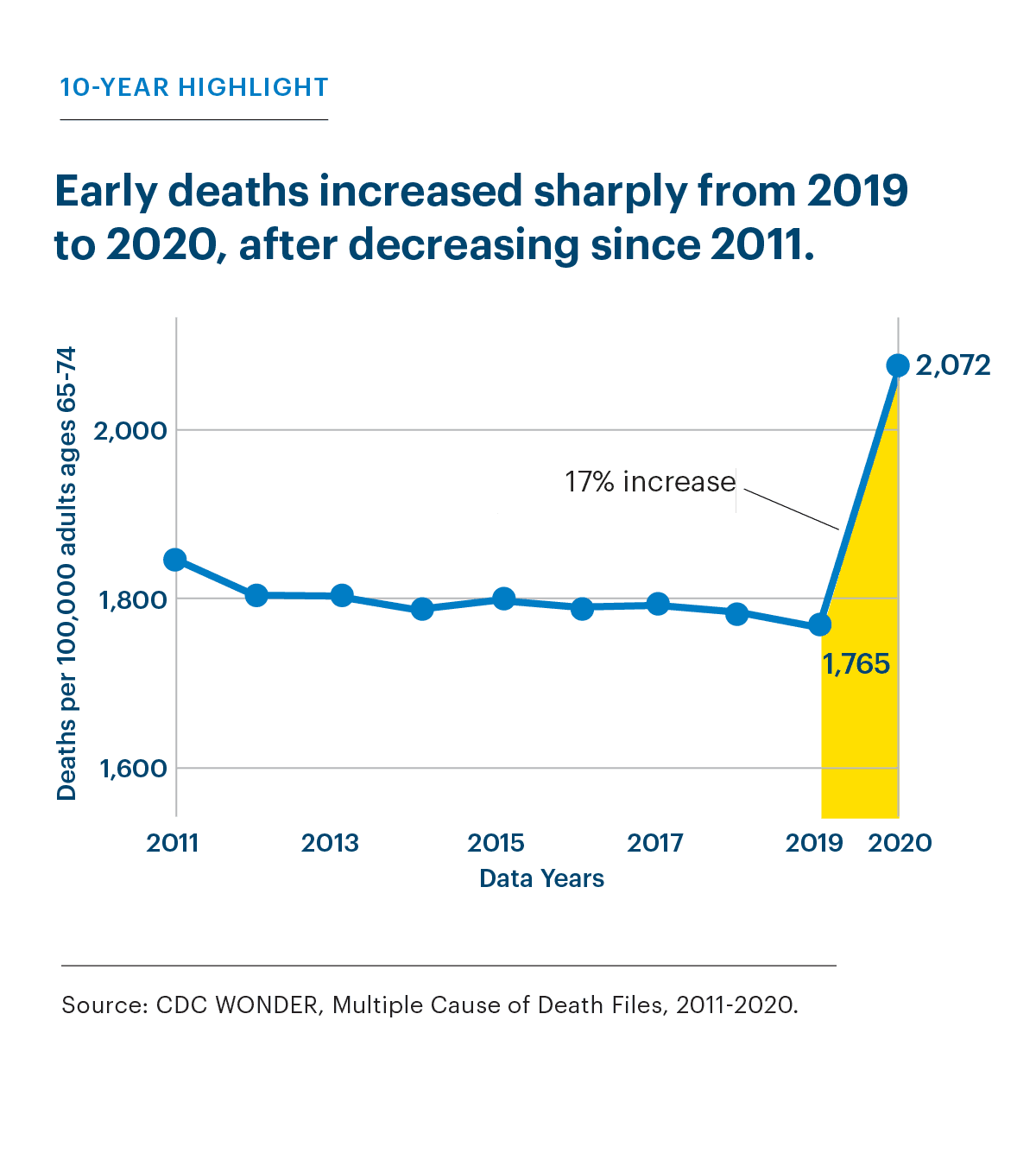
Nationally, the number of deaths per 100,000 adults ages 65-74 significantly increased 17% from 1,765 to 2,072, corresponding to an increase of 118,948 deaths over this time. This followed a 4% decrease between 2011 and 2019. The early death rate significantly increased in 45 states and the
District of Columbia, led by: 34% in the District of Columbia (1,932 to 2,593 deaths per 100,000 adults ages 65-74), 33% in
New York (1,528 to 2,026), 30% in
New Jersey (1,562 to 2,036) and 23% in both
Arizona (1,591 to 1,962) and
Louisiana (2,184 to 2,691).
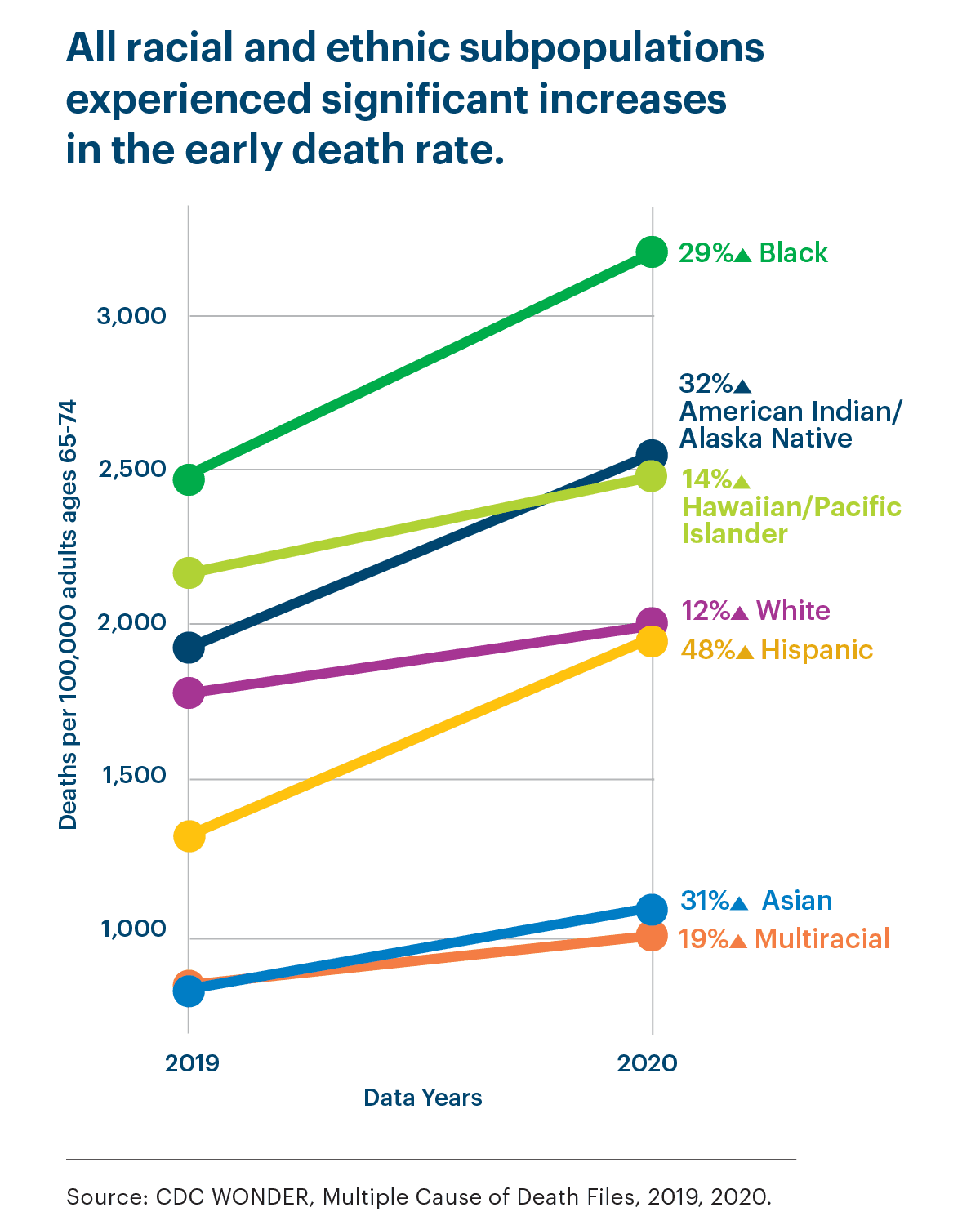
All racial/ethnic and gender subpopulations experienced significant increases in the early death rate. Increases greater than the national change included: 48% among
Hispanic (1,323 to 1,955 deaths per 100,000 adults ages 65-74), 32% among
American Indian/Alaska Native (1,925 to 2,548), 31% among
Asian (832 to 1,094), 29% among
Black (2,477 to 3,184) and 19% among
multiracial (848 to 1,005) adults, as well as 18% among
males (2,179 to 2,582).
Disparities in 2020
The COVID-19 pandemic disproportionately affected some
people of color, with American Indian/Alaska Native and Black populations experiencing much higher COVID-19 mortality rates compared with non-Hispanic white and Asian populations. According to the CDC, inequities in the social determinants of health are
driven by the negative effects of interpersonal and structural racism, placing communities of color at risk for poor health outcomes.
The early death rate significantly varied by race/ethnicity and gender. The rate was 3.2 times higher among Black adults (3,184 deaths per 100,000 adults ages 65-74) than among multiracial adults (1,005) and 1.6 times higher among males (2,582) than among
females (1,627).
Early Death Racial Disparity
Between 2019 and 2020
Nationally, the ratio of the early death rate among Black adults (3,184 deaths per 100,000 adults ages 65-74) compared with the rate among white adults (1,999) increased 14% from 1.4 to 1.6 between 2019 and 2020.
Disparities in 2020
Arkansas had the largest
early death racial disparity ratio at 4.4, followed by the
District of Columbia (3.8),
South Dakota (3.6) and
North Dakota (3.5). In Arkansas,
Hawaiian/Pacific Islander adults had the highest early death rate at 11,504 deaths per 100,000 adults ages 65-74, compared with 2,630 among
white adults.
New Hampshire had the smallest early death racial disparity ratio at 1.0, followed by
Kentucky and
Rhode Island (both 1.2). In New Hampshire, there was no relative difference in the early death rate between white (1,664) and
Hispanic (1,109) adults. In Kentucky and Rhode Island,
Black adults (3,229 and 2,228, respectively) had similar early death rates compared with white adults (2,622 and 1,845, respectively).

 Alabama
 Alaska
 Arizona
 Arkansas
 California
 Colorado
 Connecticut
 Delaware
 District of Columbia
 Florida
 Georgia
 Hawaii
 Idaho
Idaho Illinois
 Indiana
 Iowa
Iowa Kansas
 Kentucky
 Louisiana
 Maine
Maine Maryland
 Massachusetts
 Michigan
 Minnesota
 Mississippi
 Missouri
 Montana
 Nebraska
 Nevada
 New Hampshire
 New Jersey
 New Mexico
 New York
 North Carolina
 North Dakota
 Ohio
Ohio Oklahoma
 Oregon
 Pennsylvania
 Rhode Island
 South Carolina
 South Dakota
 Tennessee
 Texas
Texas Utah
Utah Vermont
 Virginia
 Washington
 West Virginia
 Wisconsin
 Wyoming
 US SummaryAppendixMeasures TableData Source DescriptionsMethodology