Social and Economic Factors | Community and Family Safety
Injury deaths, an indicator of community and family safety, have been increasing among women of reproductive age and children. During the COVID-19 pandemic, early childhood education enrollment declined substantially.
Injuries are the leading cause of death among women ages 20-44. In 2021, the top causes of injury death among women of reproductive age were poisoning (including drug deaths), motor vehicle traffic accidents and firearms. Firearm violence is a serious and deadly public health issue, especially for women. Women in the U.S. are 21 times more
likely to die by firearm than women in comparable countries. Most injury deaths were accidents (unintentional), followed by suicide and homicide.
Significant changes over time. Nationally,
injury deaths among women increased 17% from 41.0 to 48.1 deaths per 100,000 females ages 20-44 between 2016-2018 and 2019-2021. In 2019-2021, approximately 78,200 women died because of injury in the U.S., an increase of 12,400 women compared with 2016-2018. Injury deaths among women increased in 27 states and the District of Columbia, led by 64% in the
District of Columbia (21.0 to 34.4 deaths per 100,000 females ages 20-44), 46% in
Mississippi (48.1 to 70.0) and 42% in
Delaware (55.8 to 79.0). The rate increased among all age groups: 20% among women
ages 35-44 (44.3 to 53.2), 16% among women
ages 25-34 (41.6 to 48.4) and 11% among women
ages 20-24 (33.2 to 36.9).
Disparities. The injury death rate among women significantly varied by race/ethnicity, geography and age in 2019-2021. The rate was:
Related Measure: Firearm Deaths - Women
Nationally,
firearm deaths among women significantly increased 14% from 4.9 to 5.6 deaths due to firearm injury of any intent (unintentional, suicide, homicide or undetermined) per 100,000 females ages 20-44 between 2016-2018 and 2019-2021. This increase is larger than the increase in the
2022 Health of Women and Children Report. In 2019-2021, 9,100 women died from firearms, an increase of approximately 1,300 women compared with 2016-2018. Between 2016-2018 and 2019-2021, the rate significantly increased 47% in
Maryland (3.6 to 5.3 deaths per 100,000 females ages 20-44), 39% in
Mississippi (10.8 to 15.0), 33% in
Tennessee (7.5 to 10.0) and 25% in
Georgia (6.8 to 8.5). The rate of firearm deaths among women varied significantly by geography, race/ethnicity and age in 2019-2021. It was 13.6 times higher in Mississippi (15.0) than
Massachusetts (1.1), 10.1 times higher among
Black (13.1) than
Asian (1.3) women and higher among women
ages 20-24 (5.9) and
25-34 (5.8) compared with women
ages 35-44 (5.2).
Note: Data for Hawaii, Rhode Island and Vermont were suppressed because 20 or fewer deaths were recorded. The estimates for women ages 20-24 and women ages 25-34 were not significantly different from each other based on non-overlapping 95% confidence intervals.
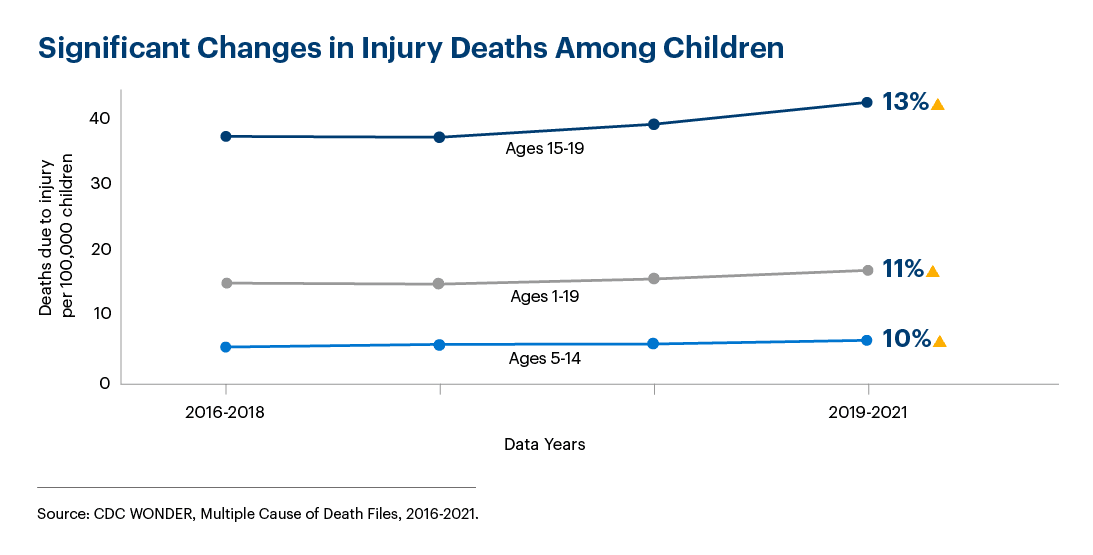
Accidents (unintentional injuries) are the leading cause of death among U.S. children ages 1-19, followed by homicide and suicide, all of which are considered injury deaths. In 2019-2021, the leading cause of injury deaths was firearms, followed by motor vehicle accidents and poisoning. The U.S. is the
only nation among its peers where firearms are the leading cause of child mortality.
Significant changes over time. Nationally,
injury deaths among children increased 11% from 15.7 to 17.4 deaths due to injury per 100,000 children ages 1-19 between 2016-2018 and 2019-2021. In 2019-2021, approximately 40,600 U.S. children died because of injury, an increase of 3,800 children compared with 2016-2018. Injury deaths among children increased in nine states and the District of Columbia, led by 71% in the
District of Columbia (15.0 to 25.6 deaths per 100,000 children ages 1-19), 25% in
Arizona (18.7 to 23.4) and 23% in both
Mississippi (25.6 to 31.6) and
Minnesota (12.1 to 14.9) between 2016-2018 and 2019-2021. The rate also increased among the following age groups and by gender: 13% among children
ages 15-19 (38.7 to 43.7), 10% among children
ages 5-14 (5.9 to 6.5), 12% among
boys (21.7 to 24.4) and 5% among
girls (9.5 to 10.0).
Disparities. Injury deaths among children significantly varied by age, race/ethnicity, geography and gender in 2019-2021. The rate was:
- 6.7 times higher among children ages 15-19 (43.7 deaths per 100,000 children ages 1-19) than children ages 5-14 (6.5).
- 5.9 times higher among American Indian/Alaska Native (40.8) than Asian (6.9) children.
- 4.4 times higher in Alaska (32.9) than Massachusetts (7.5).
- 2.4 times higher among boys (24.4) than girls (10.0).
Related Measure: Firearm Deaths - Children
Nationally,
firearm deaths among children significantly increased 26% from 4.2 to 5.3 deaths due to firearm injury per 100,000 children ages 1-19 between 2016-2018 and 2019-2021. This is a larger increase than the increase in last year’s report
. In 2019-2021, approximately 12,500 U.S. children died by firearm, about 2,600 more deaths than in 2016-2018. Between 2016-2018 and 2019-2021, the rate significantly increased in 14 states, led by 61% in
Kansas (4.9 to 7.9 per 100,000 children ages 1-19) and 55% in both
North Carolina (4.4 to 6.8) and
Louisiana (8.6 to 13.3). The rate of firearm deaths among children varied significantly by age, race/ethnicity and geography in 2019-2021. It was 23.4 times higher among children
ages 15-19 (16.4) than children
ages 1-4 (0.7), 15.0 times higher among
Black (18.0) than
Asian (1.2) children and 12.1 times higher in Louisiana (13.3) than
Massachusetts (1.1).
Related Measure: Teen Suicide
Nationally, the
teen suicide rate was 10.6 deaths per 100,000 adolescents ages 15-19 in 2019-2021, or approximately 6,800 deaths. The rate did not significantly differ from the 2016-2018 rate. However, the teen suicide rate significantly decreased 27% in
Missouri (17.2 to 12.5 deaths per 100,000 adolescents ages 15-19) between 2016-2018 and 2019-2021. In 2019-2021, the teen suicide rate was 8.6 times higher in
Alaska (41.3) than in
Massachusetts (4.8) and 5.0 times higher among
American Indian/Alaska Native (39.9) than
Hispanic (8.0) teens.
Note: Teen suicide data for Delaware, Rhode Island and Vermont were suppressed because 20 or fewer deaths were recorded.
Social and Economic Factors | Education
Early Childhood Education
The
COVID-19 pandemic severely disrupted early childhood education and exacerbated already present disparities. For many, the path to higher educational attainment starts with early childhood education. There is
sound evidence that early childhood education leads not only to higher educational attainment but also contributes to better health and promotes health equity.
Significant changes over time. Nationally, the percentage of children ages 3-4 who are enrolled in nursery school, preschool or kindergarten decreased 18% from 48.9% to 40.2% between 2019 and 2021. In 2021, approximately 3,150,000 U.S. children were enrolled in early childhood education, a decrease of 838,000 compared with 2019.
Early childhood education enrollment decreased in 28 states, led by 44% in
New Mexico (46.1% to 25.6%), 34% in
Mississippi (60.4% to 39.9%) and 31% in
New Hampshire (58.2% to 40.1%).
Disparities. Early childhood education was 2.4 times higher in Connecticut (55.5%) than West Virginia (23.5%) in 2021.

 US Summary
 Alabama
 Alaska
 Arizona
 Arkansas
 California
 Colorado
 Connecticut
 Delaware
 District of Columbia
 Florida
 Georgia
 Hawaii
 Idaho
Idaho Illinois
 Indiana
 Iowa
Iowa Kansas
 Kentucky
 Louisiana
 Maine
Maine Maryland
 Massachusetts
 Michigan
 Minnesota
 Mississippi
 Missouri
 Montana
 Nebraska
 Nevada
 New Hampshire
 New Jersey
 New Mexico
 New York
 North Carolina
 North Dakota
 Ohio
Ohio Oklahoma
 Oregon
 Pennsylvania
 Rhode Island
 South Carolina
 South Dakota
 Tennessee
 Texas
Texas Utah
Utah Vermont
 Virginia
 Washington
 West Virginia
 Wisconsin
 Wyoming

