Data show concerning trends and disparities in mortality, rising mental health challenges among women — with gains in some other health measures.
Health Outcomes | Mortality
Mortality rates, including maternal mortality, continued to increase among women of reproductive age and children, while the infant mortality rate declined. All mortality measures had distressing disparities by race/ethnicity and geography.
The death rate among women of reproductive age has
risen since 2011 after declining between 2003 and 2011. Between 2020 and 2021, the number of deaths from accidents and COVID-19 increased, and COVID-19 moved from the fifth to the second leading cause of death. In 2021, the leading causes of death among women ages 20-44 were accidents (unintentional injuries), COVID-19, cancer, heart disease and suicide. In addition, the maternal mortality rate in the U.S.
has risen steadily since 1990, and the U.S. had the
highest rate among high-income countries.
Significant changes over time. Nationally, the
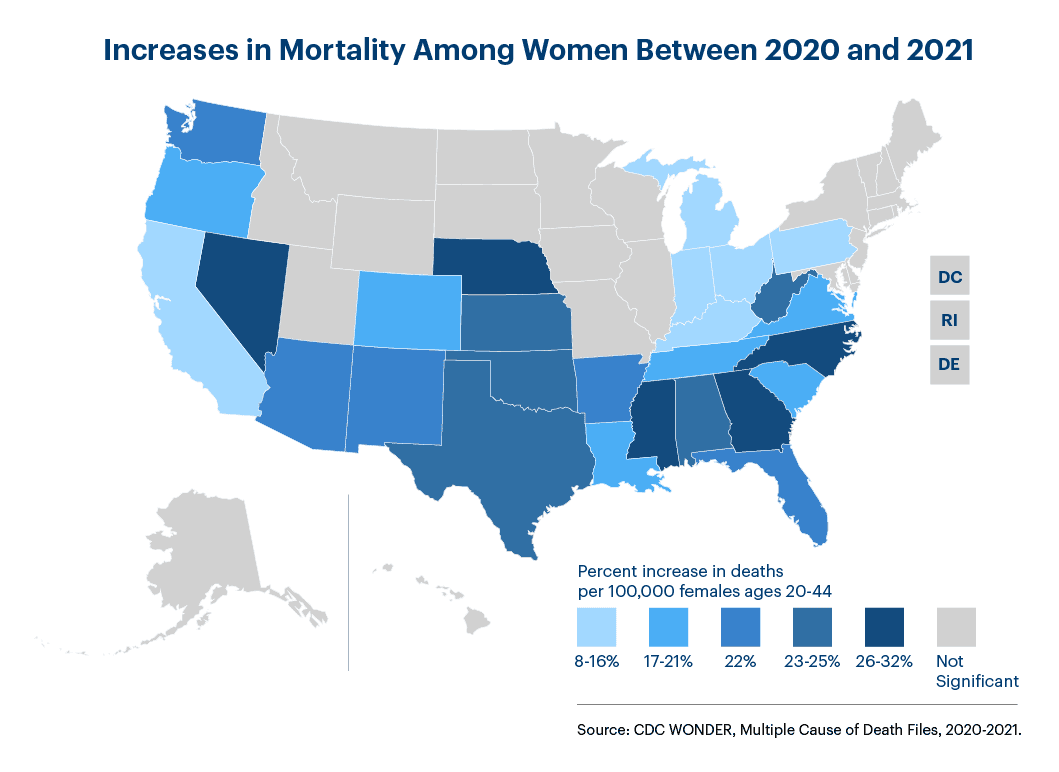
mortality rate increased 16% from 117.3 to 136.4 deaths per 100,000 women ages 20-44 between 2020 and 2021, a smaller increase than the 21% increase between 2019 and 2020. In 2021, about 74,400 U.S. women died, an increase of nearly 10,800 women compared with 2020. The mortality rate increased in 27 states, led by 32% in
Georgia (126.7 to 167.1), 29% in
Nevada (117.7 to 152.0) and 28% in
Nebraska (86.7 to 111.0). The rate increased among every racial/ethnic group, led by 43% among
Hawaiian/Pacific Islander (168.9 to 240.9), 21% among
Hispanic (80.5 to 97.3) and 18% among
American Indian/Alaska Native (357.6 to 423.4) women.
Disparities. The mortality rate significantly varied by race/ethnicity and geography in 2021. The rate was:
- 9.9 times higher among American Indian/Alaska Native (423.4 deaths per 100,000 women ages 20-44) than Asian (42.6) women.
- 3.0 times higher in West Virginia (266.3) than Hawaii (87.5).
Related Measure: Maternal Mortality
Nationally, the
maternal mortality rate increased 29% from 17.3 to 22.4 deaths related to or aggravated by pregnancy (excluding accidental or incidental causes) occurring within 42 days of the end of a pregnancy per 100,000 live births between 2014-2018 and 2017-2021. The rate exceeded the Healthy People 2030 national
target of 15.7 per 100,000. During this period, the maternal mortality rate increased in eight states, led by 148% in
Mississippi (15.3 to 38.0 deaths per 100,000 live births), 136% in
Nevada (9.5 to 22.4) and 70% in
California (5.6 to 9.5). The rate varied by race/ethnicity, geography, age and educational attainment in 2017-2021. The rate was:
Note: The 2014-2018 and 2017-2021 comparison contains overlapping 5-year estimates. Because of the overlapping data years, the comparison is largely between the non-overlapping years (2014-2016 and 2019-2021). The estimates for women ages 20-24 and women less than 20 years (14.3) and the estimates for high school graduates and women with less than a high school education (31.7) were not significantly different based on non-overlapping 95% confidence intervals.
Most deaths among children are preventable. Among children ages 1-19, the top causes of death in 2019-2020 were accidents (unintentional injury), homicide, suicide, cancer and congenital abnormalities. Since 2016-2018, homicide has surpassed suicide as the second-leading cause of death among children.
Significant changes over time. Nationally, the
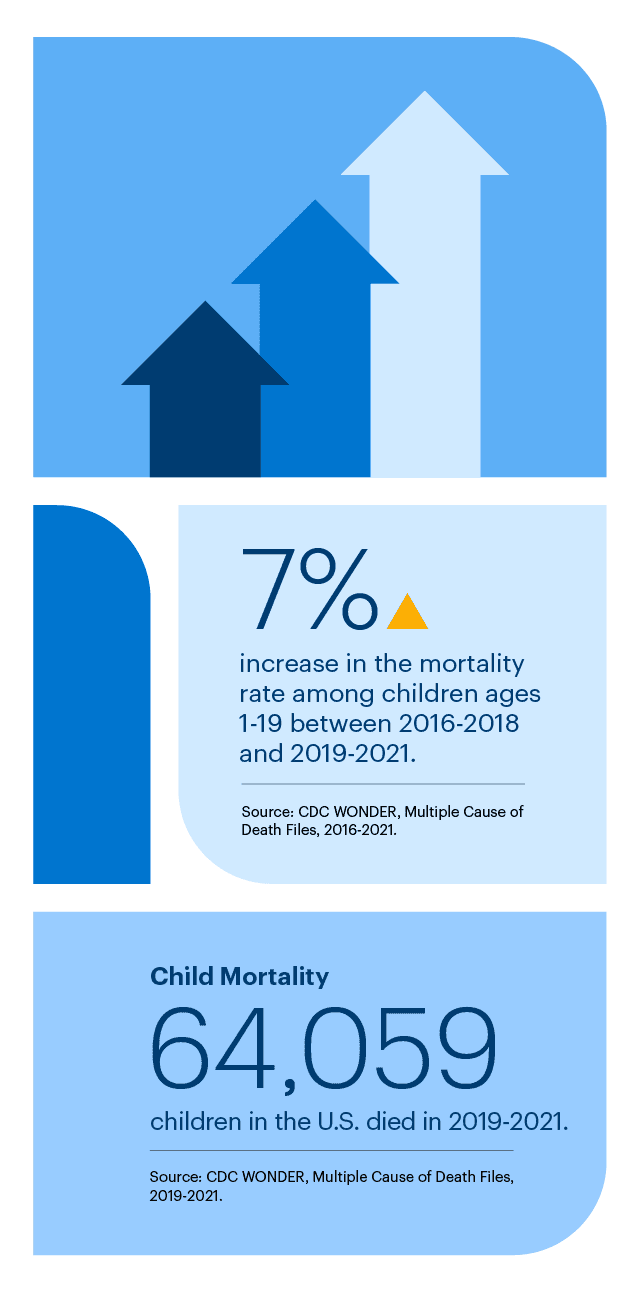
mortality rate increased 7% from 25.7 to 27.4 deaths per 100,000 children ages 1-19 between 2016-2018 and 2019-2021. That rate exceeded the Healthy People 2030
target of 18.4 deaths per 100,000. In 2019-2021, nearly 64,100 U.S. children died, an increase of 3,700 children compared with 2016-2018. The mortality rate increased in seven states, led by 19% in
Arizona (28.8 to 34.3 deaths per 100,000 children ages 1-19), 18% in
Mississippi (40.6 to 48.0) and 16% in
Louisiana (37.7 to 43.7). Significant increases occurred among the oldest age group and by gender. The mortality rate increased 12% among children
ages 15-19 (50.6 to 56.5), 8% among
boys (32.7 to 35.3) and 3% among
girls (18.5 to 19.1).
Disparities. The mortality rate significantly varied by age, race/ethnicity, geography and gender in 2019-2021. The rate was:
- 4.1 times higher among children ages 15-19 (56.5 deaths per 100,000 children ages 1-19) than children ages 5-14 (13.8).
- 4.0 times higher among American Indian/Alaska Native (55.5) than Asian (14.0) children.
- 3.3 times higher in Mississippi (48.0) than Massachusetts (14.7).
- 1.8 times higher among boys (35.3) than girls (19.1).
Note: The estimates for American Indian/Alaska Native and Black (51.5) children were not significantly different from each other based on non-overlapping 95% confidence intervals.
The
infant mortality rate is consistently
higher in the U.S. than in other developed countries. Around
two-thirds of infant deaths occur during the neonatal period, birth to 27 days old. Research shows that
socioeconomic inequality in the U.S. is a primary contributor to its higher infant mortality rate.
Significant changes over time. Nationally, the
infant mortality rate decreased 4% from 5.7 to 5.5 deaths before age 1 per 1,000 live births between 2017-2018 and 2019-2020, moving closer to the Healthy People 2030
target of 5.0 per 1,000. In 2019-2020, approximately 40,500 U.S. infants died, a decrease of about 3,300 infants compared with 2017-2018. The infant mortality rate decreased in 33 states and the District of Columbia, led by 35% in the
District of Columbia (7.8 to 5.1 deaths per 1,000 live births), 18% in
Hawaii (6.1 to 5.0) and 13% in both
Nevada (6.0 to 5.2) and
Rhode Island (5.6 to 4.9). During the same period, the infant mortality rate increased in seven states, led by 30% in
North Dakota (5.0 to 6.5), 5% in
Louisiana (7.4 to 7.8) and 4% in both
South Dakota (6.8 to 7.1) and
Colorado (4.6 to 4.8). The rate decreased among every racial/ethnic and age group. By group, the largest decreases were 11% among infants born to
Hawaiian/Pacific Islander women (8.5 to 7.6) and
Asian women (3.7 to 3.3) and 6% among infants born to women
ages 35-39 (5.2 to 4.9).
Disparities. The infant mortality rate varied significantly by race/ethnicity, geography, age and metropolitan status in 2019-2020. The rate was:
Related Measure: Neonatal Mortality
Nationally, between 2017-2018 and 2019-2020 the
neonatal mortality rate significantly decreased 5% from 3.8 to 3.6 deaths during the first 28 days of life per 1,000 live births. During this timeframe, the rate significantly decreased in 30 states and the District of Columbia, led by 41% in the
District of Columbia (5.1 to 3.0), 21% in
Hawaii (3.9 to 3.1) and 17% in both
Indiana (4.7 to 3.9) and
Oklahoma (4.7 to 3.9). During the same period, the rate significantly increased in
Louisiana,
Washington,
Michigan,
North Carolina,
West Virginia and
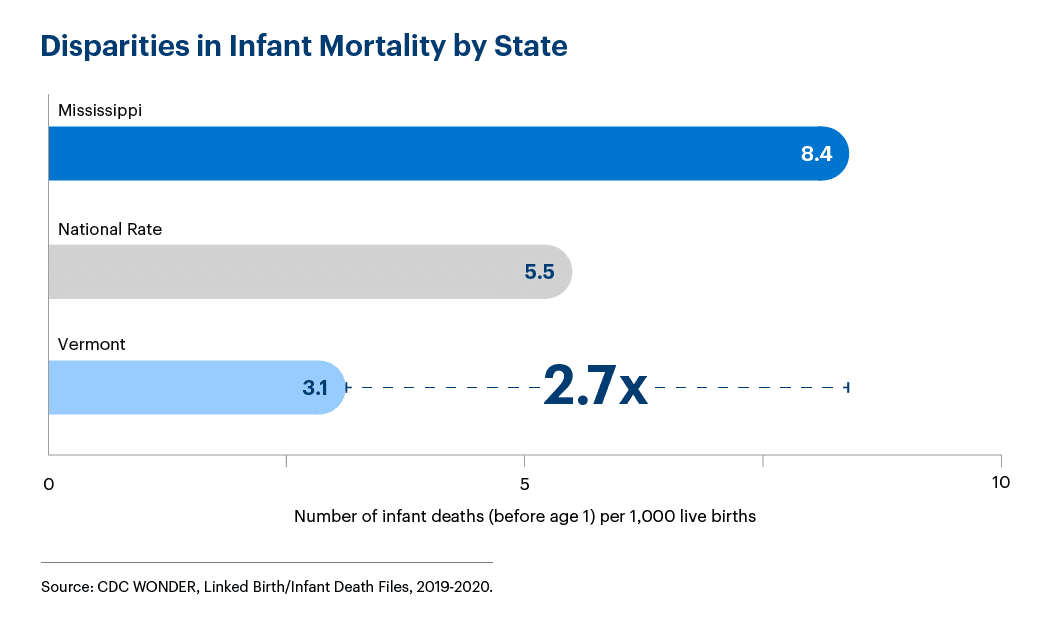
Wisconsin. The rate of neonatal mortality was 2.6 times higher in
Mississippi (5.0) than
Vermont (1.9) and higher among
male (3.9) than
female (3.3) neonates.
Health Outcomes | Behavioral Health
Women’s mental and behavioral health challenges continued to grow, with increases in drug deaths, frequent mental distress and depression, all with disparities by age, race/ethnicity and geography.
Drug overdose deaths
have risen steadily in the U.S. over the past two decades, becoming a leading cause of injury death and contributing to the decline in life expectancy.
Significant changes over time. Nationally, the
drug death rate – deaths due to drug injury (unintentional, suicide, homicide or undetermined) per 100,000 females ages 20-44 – increased 27% from 20.3 to 25.7 between 2016-2018 and 2019-2021. This increase was larger than the 19% increase in the
2022 Health of Women and Children Report. The rate exceeded the Healthy People 2030
target of 20.7 deaths per 100,000. In 2019-2021, nearly 41,900 women in the U.S. died from a drug overdose, an increase of slightly more than 9,200 women since 2016-2018. The drug death rate increased in 30 states and the District of Columbia, led by 90% in
North Dakota (10.7 to 20.3 deaths per 100,000 females ages 20-44), 89% in
Mississippi (12.0 to 22.7), 82% in the
District of Columbia (9.2 to 16.7) and 77% in
Louisiana (24.2 to 42.8).
Disparities. The drug death rate significantly varied by race/ethnicity, geography and age in 2019-2021; all disparities were larger than those in the 2022 Health of Women and Children Report. The rate was:
Frequent mental distress is a self-reported measure that captures the population experiencing persistent and severe mental health issues.
Significant changes over time. Nationally, the percentage of women ages 18-44 who reported their mental health was not good 14 or more days in the past 30 days increased 16% from 18.1% to 21.0% between 2018-2019 and 2020-2021, a larger increase than seen in last year’s report. During this timeframe, the prevalence of
frequent mental distress increased in 12 states, led by 38% in
Colorado (16.0% to 22.1%), 32% in
Iowa (18.0% to 23.7%) and 30% in
Connecticut (15.1% to 19.6%). The prevalence increased across all income and age groups and among some educational attainment and racial/ethnic groups during this timeframe. By group, the largest increases were 42% among women with a household income of
$75,000 or more (9.9% to 14.1%), 40% among
college graduates (11.1% to 15.5%), 21% among women
ages 35-44 (14.6% to 17.6%) and 19% among
white women (20.7% to 24.7%).
Disparities. Frequent mental distress significantly varied by race/ethnicity, geography, income, educational attainment, age and metropolitan status in 2019-2021. The prevalence among women ages 18-44 was:
Note: The estimates for multiracial women, women who identify their race as other (28.2%) and American Indian/Alaska Native women (25.4%) were not significantly different from each other based on non-overlapping 95% confidence intervals, the same was true for estimates for Asian, Hispanic (15.5%) and Hawaiian/Pacific Islander (16.4%) women.

Related Measures: Depression and Postpartum Depression
Nationally, the percentage of women ages 18-44 who reported being told by a health professional that they had a
depressive disorder – including depression, major depression, minor depression or dysthymia – significantly increased 8% from 25.3% to 27.4% between 2018-2019 and 2020-2021; this exceeded the 5% increase in the
2022 Health of Women and Children Report. During this timeframe, the prevalence significantly increased 36% in
Connecticut (20.9% to 28.4%), 30% in
Colorado (23.1% to 30.1%), 26% in
Indiana (28.5% to 35.9%) and 17% in
Virginia (23.8% to 27.9%). The prevalence increased among some income, age, racial/ethnic and educational attainment groups. It was 2.4 times higher in
New Hampshire (38.7%) than
Hawaii (15.9%) and significantly varied by race/ethnicity, income, educational attainment, age and metropolitan status.
Nationally, the prevalence of
postpartum depression among women with a recent live birth was 12.7% in 2021. Evaluating the 34 states with data, the prevalence was 2.9 times higher in
Idaho (25.4%) than
Vermont (8.7%).
Health Outcomes | Physical Health
The percentage of women who reported their own health was very good or excellent improved, along with the percentage who reported frequent physical distress. However, severe maternal morbidity and the percentage of infants born with a low birth weight significantly worsened.
Self-reported health status is a measure of how individuals
perceive their health. It is a subjective measure of
health-related quality of life that is not limited to specific health conditions or outcomes but also factors in social support, ability and ease of functioning and other socioeconomic, environmental and cultural aspects.
Significant changes over time. Nationally, the percentage of women ages 18-44 who reported their health is very good or excellent increased 10% from 53.8% to 59.0% between 2018-2019 and 2020-2021. During this timeframe, the prevalence of
high health status increased in 20 states, led by 22% in both
New Mexico (46.0% to 56.3%) and
Hawaii (53.5% to 65.1%) and 21% in
Nevada (47.8% to 57.7%). The prevalence increased among most racial/ethnic, all educational attainment, some income and all age groups. By group, the largest increases were 29% among
Hawaiian/Pacific Islander women (46.9% to 60.5%), 27% among women with
less than a high school education (25.9% to 32.9%), 18% among women with an annual income
less than $25,000 (32.5% to 38.5%) and 12% among women ages
18-24 (56.7% to 63.4%).
Disparities. The prevalence of high health status among women significantly varied by educational attainment, income, race/ethnicity, geography, age and metropolitan status in 2020-2021. It was:
Note: The estimates for white, Asian (62.3%) and Hawaiian/Pacific Islander women were not significantly different from each other based on non-overlapping 95% confidence intervals, the same was true for American Indian/Alaska Native and Hispanic (47.9%) women.
Related Measure: Frequent Physical Distress - Women
Nationally, the percentage of women ages 18-44 who reported their physical health was not good 14 or more days in the past 30 days significantly decreased 15% from 8.4% to 7.1% between 2018-2019 and 2020-2021.
Frequent physical distress significantly decreased 40% in
Oregon (12.3% to 7.4%), 32% in
Arizona (10.7% to 7.3%), 28% in
Virginia (8.1% to 5.8%) and 24% in
New York (7.5% to 5.7%). The prevalence significantly decreased among some racial/ethnic, age and educational attainment groups. It was 2.1 times higher in
Kentucky (11.0%) than
Hawaii (5.2%) and varied significantly by income, race/ethnicity, educational attainment, age and metropolitan status.
Severe Maternal Morbidity
Significant changes over time. Nationally,
severe maternal morbidity — life-threatening maternal complications during delivery — increased 9% from 81.0 to 88.3 complications per 10,000 delivery hospitalizations between 2019 and 2020. This is larger than the increase between 2018 and 2019 and exceeded the Healthy People 2030
target of 64.4 per 10,000. In 2020, approximately 29,600 women experienced significant life-threatening complications during delivery, an increase of about 1,400 women compared with 2019. Severe maternal morbidity increased 22% in
New York (92.2 to 112.1 complications during delivery per 10,000 delivery hospitalizations), 21% in
Tennessee (73.1 to 88.6), 15% in both
Michigan (78.3 to 89.9) and
Florida (81.8 to 94.1) and 10% in
Texas (72.4 to 79.5). The rate increased among some racial/ethnic groups and all age and income groups. By group, the largest increases were 15% among
Hispanic women (82.2 to 94.6), 12% among both women
younger than 20 (77.8 to 86.9) and women in the
poorest income quartile (89.6 to 100.6) and 10% among women in
metropolitan (87.0 to 96.0) areas.
Disparities. Severe maternal morbidity varied significantly by geography, race/ethnicity, age, income and metropolitan status in 2020. The rate was:
Note: Data are missing for Alabama and Idaho. The estimates for women ages 20-24 and women ages 25-29 (75.7) were not significantly different from each other based on non-overlapping 95% confidence intervals.

Significant changes over time. Nationally, the percentage of infants weighing less than 2,500 grams (5 pounds, 8 ounces) at birth increased 4% from 8.2% to 8.5% between 2020 and 2021. In 2021, approximately 311,900 infants were born with a low birth weight, an increase of about 14,300 infants compared with 2020. The
low birth weight rate increased in eight states, led by 8% in
Nevada (9.0% to 9.7%) and 7% in
Minnesota (6.7% to 7.2%),
Kentucky (8.5% to 9.1%),
Georgia (9.9% to 10.6%) and
Arizona (7.4% to 7.9%). The prevalence increased among some racial/ethnic, all age and some educational attainment groups. By group, the largest increases were 8% among infants born to
Asian women (8.5% to 9.2%), 5% among infants born to both women
ages 20-24 (8.6% to 9.0%) and women
ages 40-44 (10.5% to 11.0%) and 4% among infants born to women with a
high school diploma or GED (9.4% to 9.8%).
Disparities. Low birth weight varied significantly by race/ethnicity, geography, educational attainment and age in 2021. It was:
Note: The estimates for women ages 30-34 and women ages 25-29 (8.0%) were not significantly different from each other based on non-overlapping 95% confidence intervals.

 US Summary
 Alabama
 Alaska
 Arizona
 Arkansas
 California
 Colorado
 Connecticut
 Delaware
 District of Columbia
 Florida
 Georgia
 Hawaii
 Idaho
Idaho Illinois
 Indiana
 Iowa
Iowa Kansas
 Kentucky
 Louisiana
 Maine
Maine Maryland
 Massachusetts
 Michigan
 Minnesota
 Mississippi
 Missouri
 Montana
 Nebraska
 Nevada
 New Hampshire
 New Jersey
 New Mexico
 New York
 North Carolina
 North Dakota
 Ohio
Ohio Oklahoma
 Oregon
 Pennsylvania
 Rhode Island
 South Carolina
 South Dakota
 Tennessee
 Texas
Texas Utah
Utah Vermont
 Virginia
 Washington
 West Virginia
 Wisconsin
 Wyoming