Behaviors | Nutrition and Physical Activity
Among women of reproductive age, fruit and vegetable intake decreased and the percentage of physically inactive women declined. The long-term successes in reducing smoking and teen birth rates have continued.
Fruit and Vegetable Consumption
Significant changes over time. Nationally, the percentage of women ages 18-44 who reported consuming two or more fruits and three or more vegetables daily decreased 20% from 12.2% to 9.8% between 2017 and 2021.
Fruit and vegetable consumption decreased in nine states, led by 60% in
Mississippi (9.5% to 3.8%), 59% in
Oregon (15.7% to 6.5%) and 56% in
Idaho (16.0% to 7.0%). The prevalence decreased among some income, educational attainment, racial/ethnic and age groups. By group, the largest decreases were 39% among women with an income of
$50,000-$74,999 (14.5% to 8.8%), 31% among
college graduates (15.7% to 10.9%), 23% among
white women (12.8% to 9.9%) and 21% among women
ages 35-44 (13.5% to 10.7%).
Disparities. Fruit and vegetable consumption varied significantly by geography, age and income in 2021. The prevalence was:
- 4.4 times higher in Vermont (16.8%) than Mississippi (3.8%). Higher among women ages 35-44 (10.7%) than women ages 18-24 (8.1%) and higher among women with an income of $75,000 or more (11.7%) than women with an income of $50,000-$74,999 (8.8%).
Note: Data were not available for Florida. The estimates for women ages 25-34 (10.1%) were not significantly different from the other age groups based on non-overlapping 95% confidence intervals; the same was true for the three lowest annual household income groups.
Significant changes over time. Nationally, the percentage of women ages 18-44 who reported doing no physical activity or exercise other than their regular job in the past 30 days decreased 7% from 22.6% to 21.1% between 2018-2019 and 2020-2021. The prevalence decreased among some educational attainment, racial/ethnic and age groups. By group, the largest decreases were 14% among
college graduates (13.2% to 11.4%), 12% among
white women (17.8% to 15.7%) and 8% among women
ages 35-44 (24.2% to 22.2%).
Disparities. Physical inactivity varied by educational attainment, income, geography, race/ethnicity and age group in 2020-2021. The prevalence was:
Note: The estimates for Hispanic and Black (28.2%) women were not significantly different from each other based on non-overlapping 95% confidence intervals, the same was true for white, multiracial (16.4%) and Hawaiian/Pacific Islander (21.5%) women. The estimates for women ages 25-34 (21.2%) were not significantly different from the estimates for women ages 18-24 or ages 35-44.
Behaviors | Smoking and Tobacco Use
Despite large declines in smoking among women of reproductive age, the 12.1% prevalence is still nearly double Healthy People 2030’s goal to reduce current smoking among adults to 6.1%.
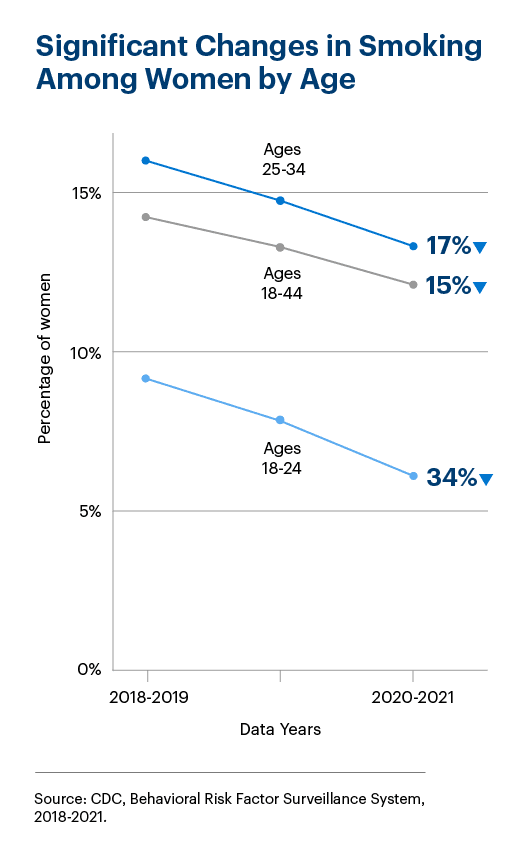
Significant changes over time. Nationally, the percentage of women ages 18-44 who reported
smoking at least 100 cigarettes in their lifetime and currently smoke daily or some days decreased 15% from 14.3% to 12.1% between 2018-2019 and 2020-2021, exceeding the decrease in last year’s report. Despite this progress, the current prevalence remains higher than the Healthy People 2030
target of 6.1%. The prevalence of smoking decreased in six states, led by 32% in
Maryland (11.6% to 7.9%) and 31% in both
Delaware (17.8% to 12.2%) and
Oregon (16.6% to 11.5%). The prevalence decreased among some age, educational attainment and one racial/ethnic group. By group the largest decreases were 34% among women
ages 18-24 (9.2% to 6.1%), 19% among
college graduates (5.9% to 4.8%) and 14% among
white women (18.0% to 15.4%).
Disparities. The prevalence of smoking varied significantly by race/ethnicity, educational attainment, geography, income, age and metropolitan status in 2020-2021. The prevalence was:
Note: The estimates for women with less than a high school education and high school graduates (22.3%) were not significantly different from each other based on non-overlapping 95% confidence intervals.
Related Measure: Smoking During Pregnancy
Nationally, the percentage of women who reported smoking cigarettes during pregnancy decreased 16% from 5.5% to 4.6% between 2020 and 2021, exceeding the decrease in the
2022 Health of Women and Children Report. In 2021, approximately 168,100 U.S. women reported
smoking during pregnancy, a decrease of 31,500 women compared with 2020. Smoking during pregnancy decreased at a rate greater than or equal to the nation in 33 states and the District of Columbia, led by 28% in
Vermont (13.1% to 9.4%), 27% in
Connecticut (3.3% to 2.4%) and 26% in
Delaware (7.0% to 5.2%). Smoking during pregnancy was 22.8 times higher in
West Virginia (18.2%) than
California (0.8%).
Related Measure: E-Cigarette Use
Nationally, 8.8% of women ages 18-44 reported that they had used
e-cigarettes or other electronic vaping products at least once in their lifetime and currently use daily or some days in 2020-2021. The prevalence was 2.7 times higher in
Kentucky (15.5%) than
California and
Maryland (both 5.8%). The
District of Columbia (4.0%) had the lowest prevalence. It also varied significantly by age, educational attainment, race/ethnicity, income, and metropolitan status.

Related Measure: Electronic Vapor Product Use - Youth
Nationally, the percentage of high school students who reported using an
electronic vapor product in the past 30 days significantly decreased 45% from 32.7% to 18.0% between 2019 and 2021. In 2021, approximately 16,100 high school students reported using an electronic vapor product, a decrease of 3,300 students compared with before the COVID-19 pandemic in 2019. Electronic vapor use decreased significantly in 16 states, led by 61% in
Connecticut (27.0% to 10.6%) and 52% in both
Hawaii (30.6% to 14.8%) and
New Hampshire (33.8% to 16.2%). Assessing the 43 states with data, electronic vapor use was 2.8 times higher in
West Virginia (27.5%) than
Utah (9.7%).
Note: Minnesota, Oregon, Washington, Wyoming and D.C. did not participate in the 2019 or 2021 Youth Risk Behavior Surveillance System. In addition, data were missing for Alaska, California and Florida in 2021 and Delaware, Florida and Indiana in 2019.
Behaviors | Sexual Health
Substantial social, economic and health
costs are associated with teen pregnancy and childrearing. Teen mothers are
more likely to drop out of high school and experience unemployment.
Changes over time. Nationally, the
teen birth rate decreased 10% from 15.4 to 13.9 births per 1,000 females ages 15-19 between 2020 and 2021, continuing a long-term downward trend and exceeding the decrease between 2019 and 2020. In 2021, there were approximately 147,000 births among U.S. teens, a decrease of 11,100 births compared with 2020. The teen birth rate decreased 10% or more in 19 states and the District of Columbia, led by 26% in
Maine (10.6 to 7.8 births per 1,000 females ages 15-19) and 18% in
Idaho (14.6 to 12.0),
Illinois (13.6 to 11.1) and
New Hampshire (6.6 to 5.4). During the same period, the rate decreased 15% among
Asian teens (2.0 to 1.7) and 10% among
Black (24.2 to 21.7),
Hispanic (23.5 to 21.1) and
white (10.3 to 9.3) teens.
Disparities. The teen birth rate varied by race/ethnicity and geography in 2021. The rate was:

 US Summary
 Alabama
 Alaska
 Arizona
 Arkansas
 California
 Colorado
 Connecticut
 Delaware
 District of Columbia
 Florida
 Georgia
 Hawaii
 Idaho
Idaho Illinois
 Indiana
 Iowa
Iowa Kansas
 Kentucky
 Louisiana
 Maine
Maine Maryland
 Massachusetts
 Michigan
 Minnesota
 Mississippi
 Missouri
 Montana
 Nebraska
 Nevada
 New Hampshire
 New Jersey
 New Mexico
 New York
 North Carolina
 North Dakota
 Ohio
Ohio Oklahoma
 Oregon
 Pennsylvania
 Rhode Island
 South Carolina
 South Dakota
 Tennessee
 Texas
Texas Utah
Utah Vermont
 Virginia
 Washington
 West Virginia
 Wisconsin
 Wyoming


