The United Health Foundation is proud to release the America’s Health Rankings® 2026 Health of Women and Children Report, which provides a comprehensive look at the health of women of reproductive age and children nationwide and on a state-by-state basis.
A decade of progress in behaviors, care and socioeconomic conditions did not consistently translate into better health outcomes for women and children.
This edition marks the 10th anniversary of the America’s Health Rankings Health of Women and Children Report, providing a decade of insights into the health and well-being of women and children across the United States. By analyzing trends over the past 10 years, the report features long-term data to provide a holistic view of key factors shaping health and well-being.
Between 2014 and 2024, the number of women ages 18-44 in the United States grew 6%, from 57.2 million to 60.9 million, while the number of children younger than 18 decreased 1%, from 73.6 million to 73.1 million. Together, children and women of reproductive age made up nearly 40% of the U.S. population in 2024.
The findings reveal a complex landscape for women and children, where significant advancements in economic resources and educational attainment are contrasted by urgent and persistent challenges in mental and physical health — and uneven access to clinical care. In the past decade:
- The prevalence of frequent mental distress and depression among women increased, while measures of children’s mental health worsened, marked by a decline in flourishing and rising rates of teen suicide. Overall, the prevalence of diagnosed mental health conditions among children has risen.
- Rates of maternal mortality, severe maternal morbidity and low birth weight worsened, while teen births decreased and infant well-being measures such as infant mortality and breastfeeding improved.
- Substance use trends were also mixed. While drug deaths among women increased, rates of neonatal abstinence syndrome improved.
- Several measures of physical health among women worsened, including the prevalence of obesity and diabetes; overall, self-perceived high health status declined. Levels of physical inactivity among women remained unchanged, while physical activity decreased among children.
- Injury and firearm death rates increased among both women and children over the past decade.
- Poverty rates among both women and children improved, as did high school and college graduation rates. Additional improvements included a reduced housing cost burden among households with children and long-term decreases in household food insecurity, though these trends have begun to reverse in recent years.
- Several clinical care measures of access and prevention improved for women but have moved in the opposite direction for children. The rate of uninsured women and prevalence of well-woman visits improved, but the rate of uninsured children and prevalence of well-child visits worsened, despite an increase in the supply of pediatricians. Fewer children also had adequate insurance coverage or a medical home.
- Smoking patterns have shifted. Cigarette smoking among women, cigarette smoking during pregnancy and household smoke exposure among children decreased, while e-cigarette use among women rose.
Ten years of America’s Health Rankings analysis shows that meaningful progress in women’s and children’s health requires sustained focus. Long-term improvements in health behaviors, access to care and socioeconomic conditions reflect public health and clinical efforts, while persistent and emerging challenges reinforce the need for purposeful collaboration in a changing landscape. Leaders can use state data to target action where it is most needed, maintain momentum in areas showing improvement and help foster better health and well-being for women and children across their lifespan.
America’s Health Rankings aims to inform and drive action by offering credible, trusted data that can guide efforts to improve population health and health care. To achieve this, America’s Health Rankings collaborates with an advisory committee to determine the selection of a comprehensive set of measures. The 2026 Health of Women and Children Report is based on:
- One hundred and twenty-five measures. These include 83 ranking and 42 unweighted measures (not included in a state’s overall rank). For a complete list of measures, definitions and source details, see Measures Table - Women, Measures Table - Children and Data Source Descriptions.
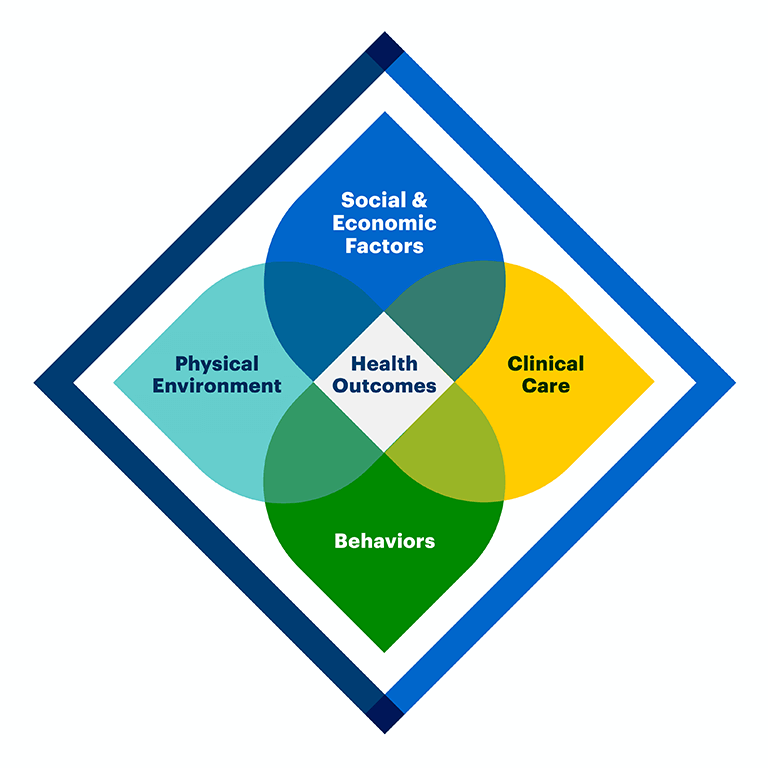
- Five categories of health. These comprise Health Outcomes and four categories of health determinants: Social and Economic Factors, Physical Environment, Behaviors, and Clinical Care.
- Thirty-four sources. Data are from multiple sources, including the Centers for Disease Control and Prevention’s Behavioral Risk Factor Surveillance System, March of Dimes, the National Survey of Children’s Health and the U.S. Census Bureau’s American Community Survey.
The America’s Health Rankings 2026 Health of Women and Children Report aims to improve population health by:
- Presenting a holistic view of health. This report goes beyond measures of clinical care and health behaviors by considering social, economic and physical environment measures, reflecting the impact of social determinants of health.
- Providing a benchmark for states. Since 2016, the report has presented strengths, challenges and key findings for every state and the District of Columbia. Public health leaders can monitor health trends over time and compare their state’s health measures with those of other states and the nation. State Summaries are available on the America’s Health Rankings website as separate downloads.
- Highlighting differences. The report shows differences in health between states and among demographic groups at state and national levels where data are available, with groupings based on race/ethnicity, gender, age, education, income, metropolitan status, disability status, special health care needs status among children, sexual orientation and veteran status.
- Stimulating action. The report aims to drive change and improve health by drawing attention to trends and promoting data-driven discussions among individuals, community leaders, public health workers, policymakers and the media. States can incorporate population insights into their annual review of programs, and many organizations use the report as a reference when assigning goals for health improvement plans.
Model for Measuring America’s Health
The model was developed under the guidance of the
America’s Health Rankings Advisory Council and Committees, with insights from other rankings and health models, particularly
County Health Rankings & Roadmaps and
Healthy People. The model serves as a framework across all
America’s Health Rankings reports for identifying and quantifying the drivers and outcomes that impact state and national population health.

 US Summary
 Alabama
 Alaska
 Arizona
 Arkansas
 California
 Colorado
 Connecticut
 Delaware
 District of Columbia
 Florida
 Georgia
 Hawaii
 Idaho
Idaho Illinois
 Indiana
 Iowa
Iowa Kansas
 Kentucky
 Louisiana
 Maine
Maine Maryland
 Massachusetts
 Michigan
 Minnesota
 Mississippi
 Missouri
 Montana
 Nebraska
 Nevada
 New Hampshire
 New Jersey
 New Mexico
 New York
 North Carolina
 North Dakota
 Ohio
Ohio Oklahoma
 Oregon
 Pennsylvania
 Rhode Island
 South Carolina
 South Dakota
 Tennessee
 Texas
Texas Utah
Utah Vermont
 Virginia
 Washington
 West Virginia
 Wisconsin
 Wyoming