Avoided Care Due to Cost Among Women
In a 2022 survey,
59% of women in the U.S. reported that they would not be able to pay an unexpected $500 medical bill in full without going into debt, and among those, 19% would be unable to pay it at all.
60 Widespread lack of access to affordable, timely and high-quality primary care is associated with increased
preventable hospitalizations, excess strain on
emergency services and missed opportunities to
prevent disease and
manage chronic conditions, all of which can lead to worse and more expensive health outcomes.
61–64 Changes over time. Nationally, the percentage of women ages 18-44 who reported a time in the past 12 months when they
needed to see a doctor but could not because of cost increased 19%, from 14.6% to 17.4% between 2021 and 2022-2023. In 2022-2023, more than 10 million women were unable to afford care due to cost, representing an increase of 1.9 million women from 2021.
Between 2021 and 2022-2023, the percentage of women who could not afford care due to cost increased:
Differences. The prevalence of avoiding care due to cost varied significantly by household income, geography, disability status, educational attainment, race/ethnicity, sexual orientation and age in 2022-2023. The prevalence was:
- 3.6 times higher among women with an annual household income less than $25,000 (29.9%) compared with those with incomes of $75,000 or more (8.4%).
- 3.4 times higher in Texas (27.6%) than in Hawaii (8.1%).
- 3.0 times higher among women who have difficulty with self-care (38.5%) compared with women without a disability (12.7%).
- 2.8 times higher among women with less than a high school education (30.1%) compared with college graduates (10.8%).
- 2.6 times higher among Hispanic (24.0%) compared with Asian (9.3%) women.
- 1.6 times higher among LGBQ+ (24.7%) compared with straight (15.2%) women.
- 1.2 times higher among women ages 25-34 (19.4%) compared with those ages 35-44 (15.7%).
Note: Data for Kentucky, Pennsylvania and all sexual orientation groups in Colorado are from 2022 only. Data for all racial and ethnic groups and all sexual orientation groups in Alabama, Arizona, California, Idaho, New Jersey and Wyoming are from 2023 only. The values for women who have difficulty with self-care (38.5%), those with independent living difficulty (38.0%), those who have difficulty seeing (35.0%), those who have difficulty with mobility (34.3%), those who have difficulty with cognition (33.5%) and those who have difficulty hearing (31.7%) may not differ significantly based on overlapping 95% confidence intervals. The same is true for Hispanic (24.0%), Hawaiian/Pacific Islander (22.3%), American Indian/Alaska Native (22.2%) and other race (20.7%) women; and women ages 35-44 (15.7%) and 18-24 (17.2%). 2020 data excluded due to methodological differences.
ADD/ADHD Treatment Among Children
Attention-deficit/hyperactivity disorder (ADHD) is one of the most common neurobehavioral disorders in childhood.
65 (The term ADD is no longer an official diagnosis and is part of ADHD.) It is important to diagnose and treat ADHD
early.
66 ADHD cannot be cured, but it can be managed and symptoms may improve as children age. If left untreated, ADHD can lead to
significant problems in education, employment and personal relationships.
67 Changes over time. Nationally, the percentage of children ages 3-17 who had ADD or ADHD, were taking medication and had received behavioral treatment increased 21%, from 2.8% to 3.4% between 2021-2022 and 2023-2024. In 2023-2024, nearly 2.1 million children had ADD/ADHD, were taking medication and had received behavioral treatment, an increase of 340,900 compared with 2021-2022.
During the same time period, ADD/ADHD treatment increased 129% in
Oregon (2.4% to 5.5%) and 90% in
Illinois (2.1% to 4.0%).
Differences. ADD/ADHD treatment among children significantly varied by race/ethnicity, geography, caregiver educational attainment and gender in 2023-2024. The prevalence was:
Note: The values for American Indian/Alaska Native (7.9%), Black (4.3%), white (4.0%), multiracial (3.8%) and Hispanic (2.2%) children may not differ significantly based on overlapping 95% confidence intervals. The same is true for Asian (0.7%) and Hawaiian/Pacific Islander (0.9%) children; and children with a caregiver who had some post-high school education (3.7%), children with a caregiver who graduated from high school (3.6%) and children with a caregiver who graduated from college (3.5%).
Changes over time. Nationally, the percentage of children younger than 19 years not covered by private or public health insurance increased 6%, from 5.1% to 5.4% between 2022 and 2023.
Differences. The prevalence of uninsured children was 7.9 times higher in Texas (11.9%) than in
Massachusetts (1.5%) in 2023.
Preventive Clinical Services
Early childhood immunizations are a safe and cost-effective way to protect children from potentially life-threatening
preventable diseases during their most vulnerable years.
72 Changes over time. Nationally, the percentage of children who received all recommended doses of the combined seven-vaccine series by age 24 months decreased 4%, from 70.0% to 66.9% between the 2017-2018 and 2020-2021 birth cohorts.
Differences. The childhood immunization rate was 1.4 times higher in
Massachusetts (83.1%) than in
Montana (57.8%) in 2020-2021 birth cohorts.
Flu Vaccination Among Women
The
flu vaccine helps protect people against seasonal influenza viruses (known as the flu) that may lead to severe complications.
73 Estimates suggest that during the 2022-2023 flu season, vaccines
prevented 6 million flu-related illnesses and 65,000 hospitalizations associated with influenza in the U.S.
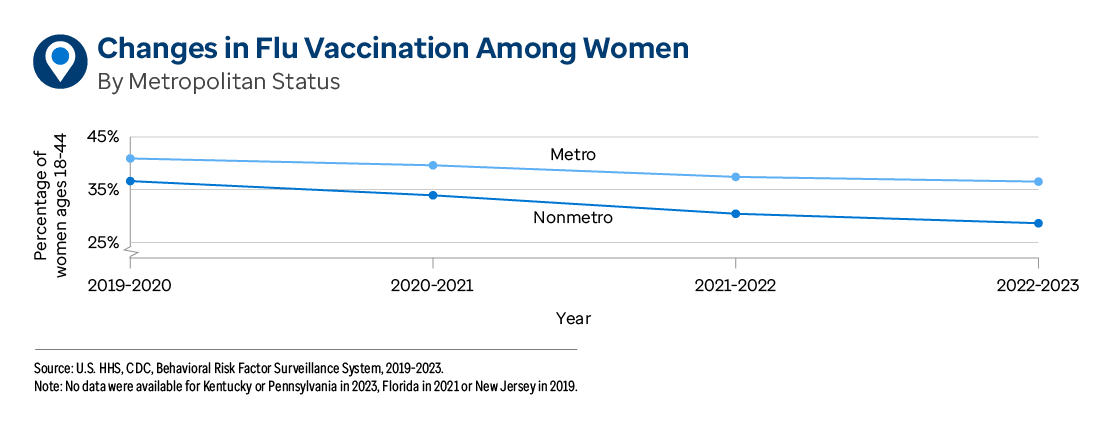
74 Changes over time. Nationally, the percentage of women ages 18-44 who reported
receiving a seasonal flu vaccine in the past 12 months decreased 9%, from 38.9% to 35.5% between 2020-2021 and 2022-2023. This remains below the
Healthy People 2030 target of 70.0% of people age 6 months and older.
75 In 2022-2023, nearly 18.2 million women received a flu vaccine.
Between 2020-2021 and 2022-2023, the prevalence of flu vaccination significantly decreased:
During this time frame, flu vaccination significantly decreased in 15 states. The largest decreases were: 27% in
South Dakota (54.7% to 40.0%), 25% in
Florida (30.3% to 22.7%) and 22% in
Montana (41.5% to 32.2%).
Differences. Flu vaccination rates varied significantly by geography, educational attainment, race/ethnicity, household income, disability status, veteran status, age and sexual orientation. In 2022-2023, the prevalence was:
Note: Data for Kentucky, Pennsylvania and all sexual orientation groups in Colorado are from 2022 only. Data for all racial and ethnic groups and all sexual orientation groups in Alabama, Arizona, California, Idaho, New Jersey and Wyoming are from 2023 only. The values for women with less than a high school education (23.4%) and high school graduates (24.8%) may not differ significantly based on overlapping 95% confidence intervals. The same is true for American Indian/Alaska Native (26.8%), Black (28.4%), other race (29.2%), Hawaiian/Pacific Islander (30.1%) and Hispanic (30.7%) women; women with incomes less than $25,000 (25.6%) and incomes of $25,000-$49,999 (28.2%); women without a disability (37.2%) and those who have difficulty with self-care (34.9%); women with difficulty seeing (27.0%), those with independent living difficulty (29.5%), those with difficulty hearing (30.1%) and those who have difficulty with mobility (30.8%); and women ages 18-24 (33.0%) and 25-34 (35.0%).
Annual health exams provide an opportunity for women to access preventive services such as vaccines and
screening tests, which can help identify cancers and other conditions at an earlier stage when they are easier to treat.
76,77 Well-woman visits are also a great opportunity to
discuss strategies for minimizing health risks and achieving a healthy lifestyle.
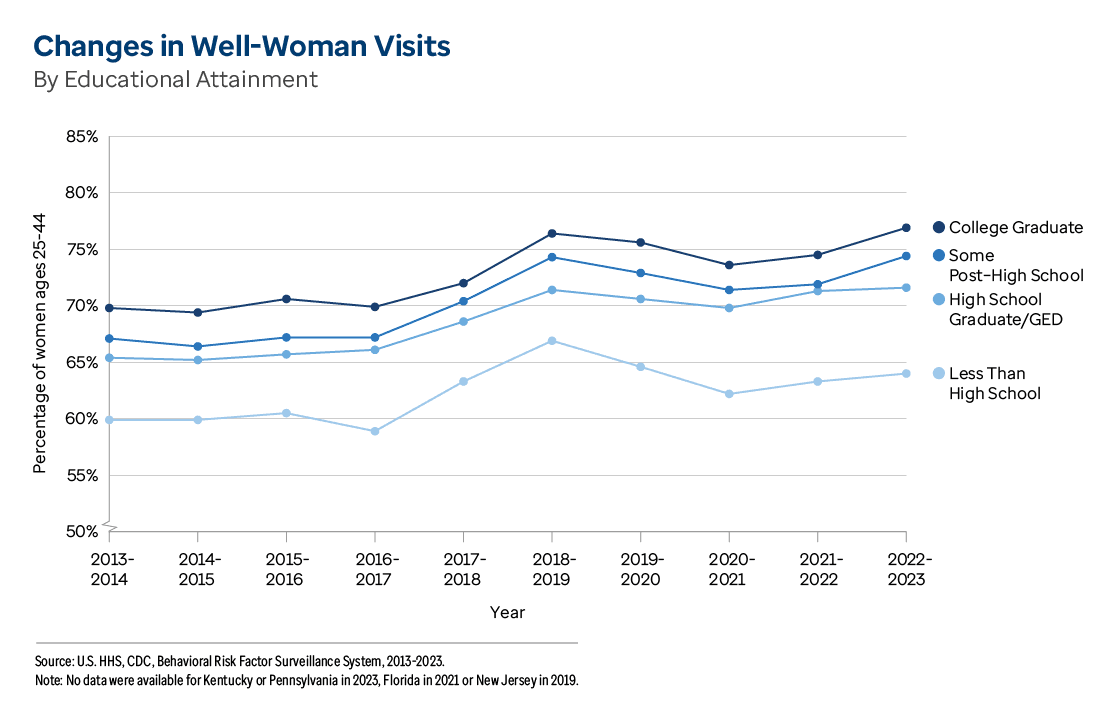
78 Changes over time. Nationally, the percentage of women ages 18-44 who had a
preventive medical visit in the past year increased 3%, from 70.5% to 72.7% between 2020-2021 and 2022-2023. In 2022-2023, 41.2 million women received a preventive visit.
Between 2020-2021 and 2022-2023, the prevalence of well-woman visits significantly increased:
During this time frame, well-woman visits significantly increased in seven states. The largest increases were: 16% in
Vermont (64.7% to 74.9%), 14% in
California (62.4% to 71.3%) and 11% in
Alaska (63.9% to 70.7%).
Differences. Well-woman visits varied significantly by geography, race/ethnicity, educational attainment, disability status, age, household income, sexual orientation and veteran status in 2022-2023. The prevalence was:
Note: Data for Kentucky, Pennsylvania and all sexual orientation groups in Colorado are from 2022 only. Data for all racial and ethnic groups and all sexual orientation groups in Alabama, Arizona, California, Idaho, New Jersey and Wyoming are from 2023 only. The values for Hawaiian/Pacific Islander (61.4%), Hispanic (69.9%), multiracial (71.0%), white (72.1%), other race (72.7%), American Indian/Alaska Native (73.7%) and Asian (75.3%) women may not differ significantly based on overlapping 95% confidence intervals. The same is true for women who have difficulty with self-care (78.8%) and those with difficulty with mobility (77.1%); women with independent living difficulty (67.2%), those with difficulty with cognition (69.0%), those with difficulty seeing (70.2%) and those with difficulty hearing (71.5%); women ages 18-24 (70.2%) and 25-34 (71.9%); and women with incomes less than $25,000 (69.7%), incomes of $25,000-$49,999 (71.4%) and incomes of $50,000-$74,999 (72.6%).
Related Measure: Dedicated Health Care Provider Among Women
Nationally, the percentage of women ages 18-44 who reported having a
personal doctor or health care provider decreased 2%, from 79.2% to 77.4% between 2021 and 2022-2023. This means roughly 403,800 fewer women had a personal doctor. During this period, the prevalence significantly decreased 8% in
Nebraska (83.7% to 77.3%),
South Carolina (79.2% to 72.8%) and
Wisconsin (89.3% to 81.8%); and 7% in
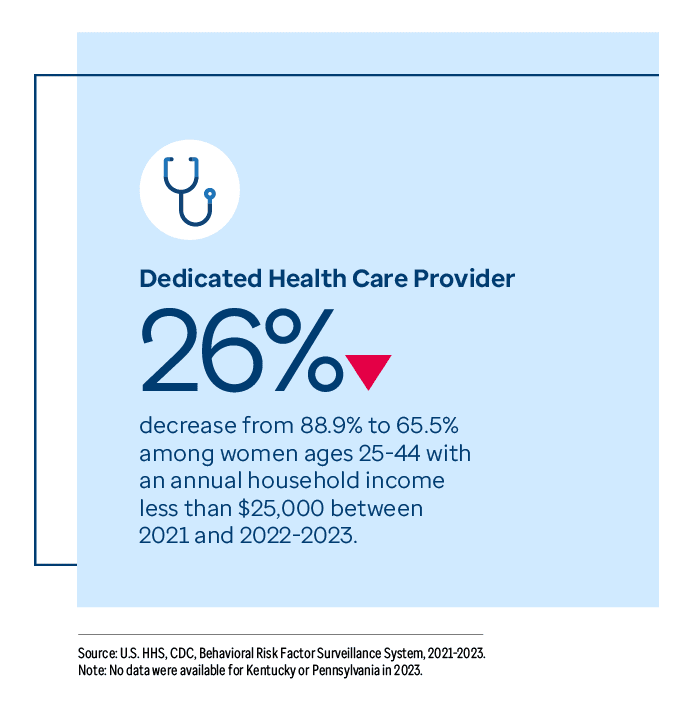
Iowa (86.5% to 80.3%). It also decreased 26% among women with an annual household income less than $25,000 (88.9% to 65.5%), 7% among
Hispanic women (68.2% to 63.7%) and 5% among women
ages 18-24 (75.4% to 71.6%). In contrast, the prevalence significantly increased 10% in
Oregon (74.6% to 82.2%), 9% among women with incomes of $50,000-$74,999 (75.9% to 82.9%), 8% among women with incomes of
$25,000-$49,999 (71.3% to 77.1%) and 4% among women with incomes of
$75,000 or more (84.9% to 88.4%). Roughly 1.3 times more women in the highest income group (household incomes of $75,000 or more) had dedicated healthcare providers compared with the lowest income group (household income
less than $25,000).
Note: Data for Kentucky and Pennsylvania are from 2022 only. Data for all racial and ethnic groups are from 2023 only. 2020 data excluded due to methodological differences.
The American Academy of Pediatrics
recommends that all infants, toddlers and children receive routine preventive visits, known as well-child visits.
79 Younger children require
more frequent visits due to their rapid development.
80 As they enter adolescence, they experience several transitions that may require unique health care solutions and conversations. Social factors and behaviors that lead to morbidity and mortality are often
initiated in adolescence, which makes it a critical time for education, prevention and early intervention.
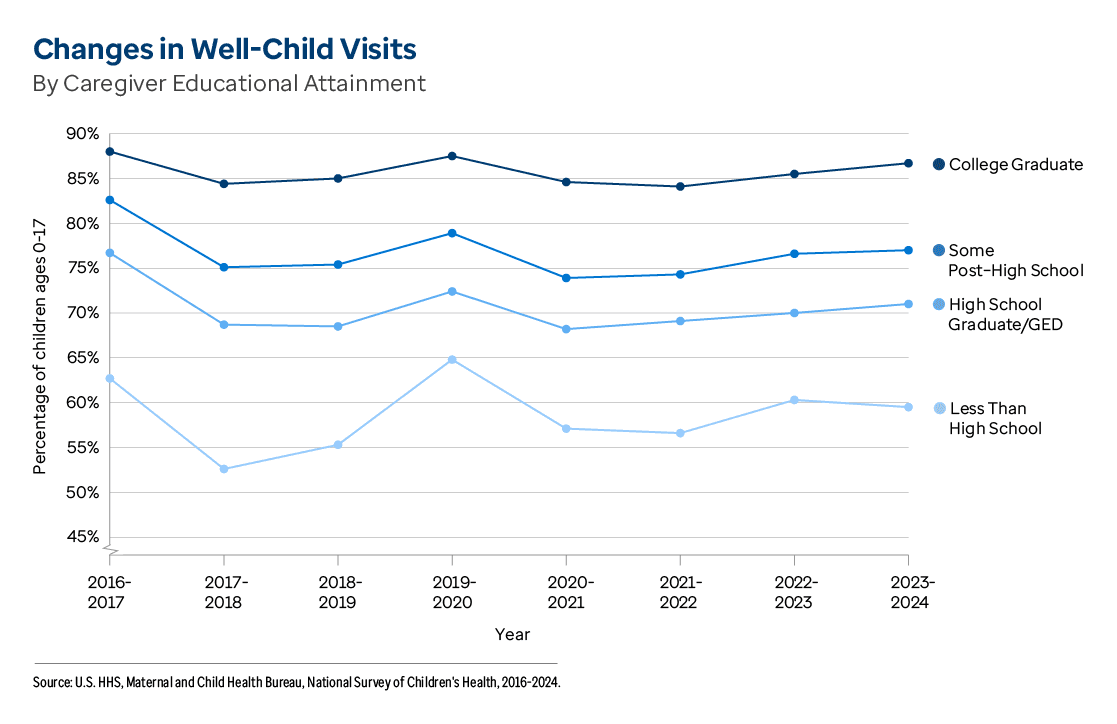
81 Changes over time. Nationally, the percentage of children ages 0-17 who received one or more
preventive visits in the past 12 months increased 4%, from 76.8% to 79.6% between 2021-2022 and 2023-2024. In 2023-2024, 57.1 million children received a preventive visit, nearly 1.5 million more than in 2021-2022.
Between 2021-2022 and 2023-2024, the prevalence of well-child visits significantly increased:
During this time frame, well-child visits significantly increased in six states. The largest increases were: 11% in
New Mexico (69.8% to 77.5%), 10% in
Vermont (83.8% to 92.0%) and 9% in
California (68.4% to 74.8%).
Differences. Well-child visits varied significantly by educational attainment, race/ethnicity, geography, age and special health care needs status in 2023-2024. The prevalence was:
Note: The values for multiracial (84.2%) and white (83.6%) children may not differ significantly based on overlapping 95% confidence intervals. The same is true for Hawaiian/Pacific Islander (64.9%), American Indian/Alaska Native (71.8%), Hispanic (73.8%), Asian (74.7%) and Black (77.4%) children.
Clinical Care Measures Continue to Fall Short of Healthy People 2030 Targets
Low-risk cesarean delivery and adequate prenatal care continued to fall short of national public health goals. Low-risk cesarean delivery — the percentage of singleton, head-first, term (37 or more weeks) first births that were cesarean deliveries — slightly increased from 26.3% in 2022 to 26.6% in 2023, exceeding the
Healthy People 2030 target of 23.6%.
82 Meanwhile, adequate prenatal care — the percentage of live births in which the mother received appropriate prenatal care in the first four months of pregnancy — was 75.2% in 2023, short of the
Healthy People 2030 target of 80.5% of pregnant females who received early and adequate prenatal care.
83 
 US Summary
 Alabama
 Alaska
 Arizona
 Arkansas
 California
 Colorado
 Connecticut
 Delaware
 District of Columbia
 Florida
 Georgia
 Hawaii
 Idaho
Idaho Illinois
 Indiana
 Iowa
Iowa Kansas
 Kentucky
 Louisiana
 Maine
Maine Maryland
 Massachusetts
 Michigan
 Minnesota
 Mississippi
 Missouri
 Montana
 Nebraska
 Nevada
 New Hampshire
 New Jersey
 New Mexico
 New York
 North Carolina
 North Dakota
 Ohio
Ohio Oklahoma
 Oregon
 Pennsylvania
 Rhode Island
 South Carolina
 South Dakota
 Tennessee
 Texas
Texas Utah
Utah Vermont
 Virginia
 Washington
 West Virginia
 Wisconsin
 Wyoming