Most childhood deaths are preventable. In 2021-2023, the
leading causes of death among children ages 1-19 in the United States were accidents (unintentional injuries), homicide, suicide, cancer and congenital abnormalities.
1 The
leading mechanisms of injury deaths (intentional and unintentional) in 2021-2023 were firearms, followed by motor vehicle traffic accidents and poisoning.
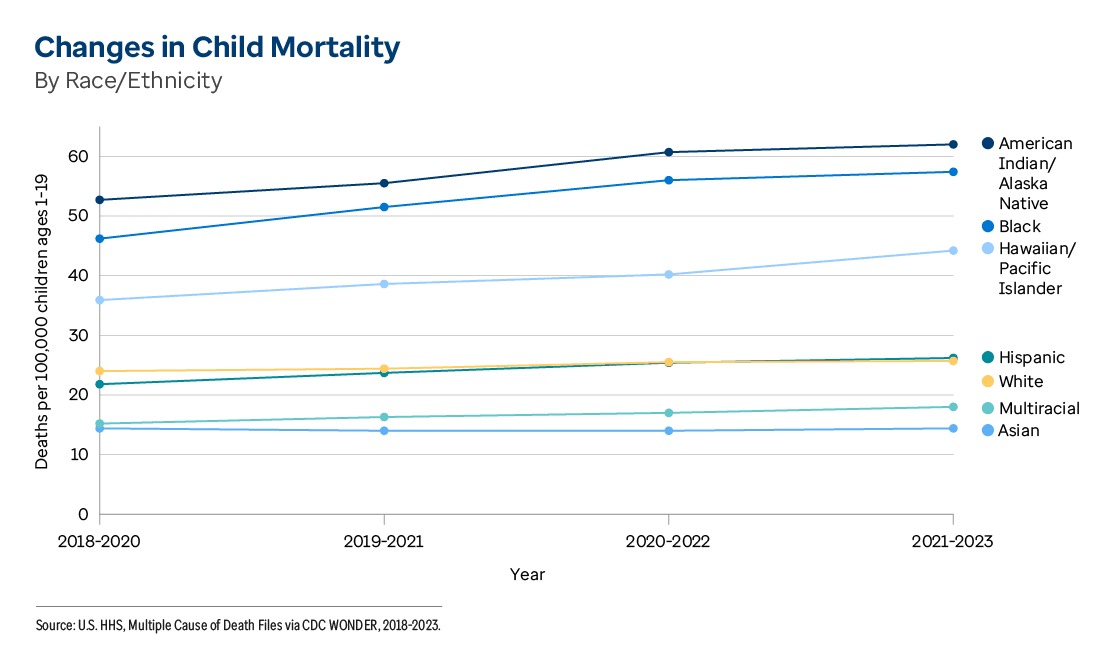
2 Between 2018-2020 and 2021-2023, the child mortality rate significantly increased:
During the same period, the child mortality rate increased in 28 states. The largest increases were: 38% in
Wyoming (30.1 to 41.5 deaths per 100,000 children ages 1-19), 30% in
North Carolina (27.3 to 35.5) and 28% in
Louisiana (38.1 to 48.9).
Differences. The child mortality rate varied significantly by race/ethnicity, age, geography and gender in 2021-2023. The rate was:
- 4.3 times higher among American Indian/Alaska Native (62.0 deaths per 100,000 children ages 1-19) compared with Asian (14.4) children.
- 4.1 times higher among children ages 15-19 (59.6) compared with those ages 5-14 (14.7).
- 3.1 times higher in Mississippi (51.6) than in Massachusetts (16.7).
- 1.8 times higher among boys (38.1) compared with girls (20.7).
Losing an infant is devastating for parents, families and communities. In 2023, the
leading causes of infant death in the U.S. were congenital abnormalities, low birth weight, sudden infant death syndrome (SIDS), unintentional injuries and maternal complications.
4 The U.S. has a consistently and considerably
higher infant mortality rate than other developed countries.
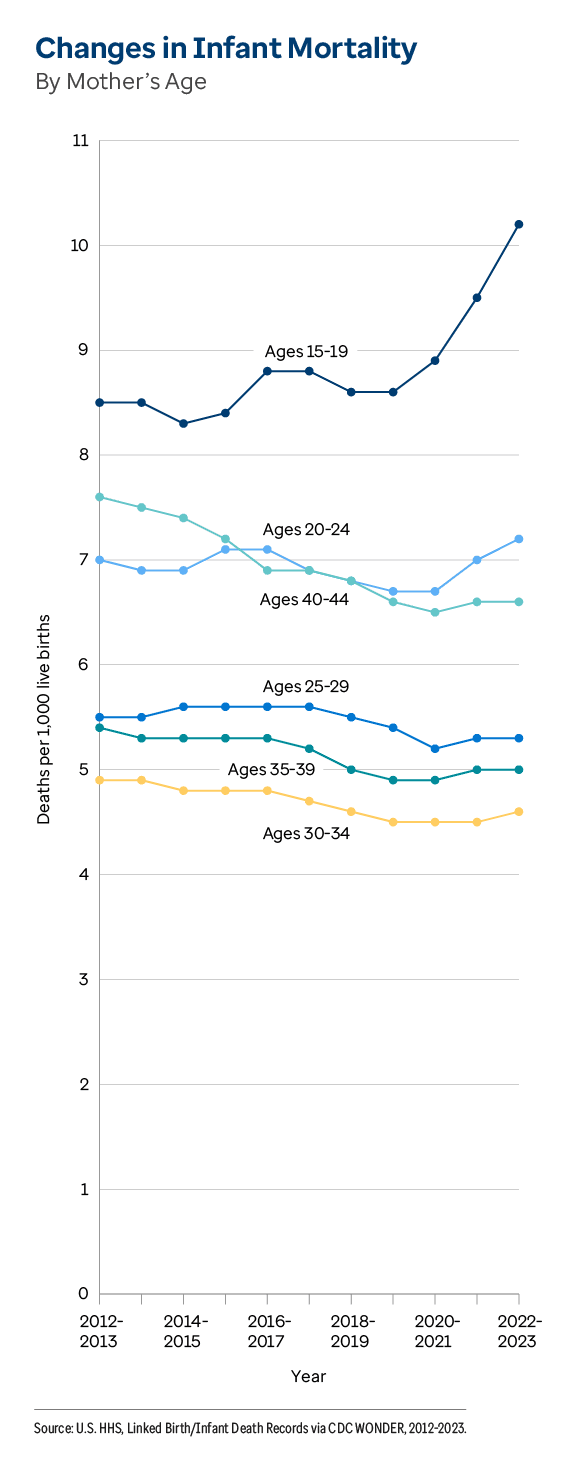
5 Between 2020-2021 and 2022-2023, the infant mortality rate significantly increased:
During the same period, the infant mortality rate significantly changed in 40 states. Among the 26 states where it rose, the largest increases were: 39% in
Delaware (4.9 to 6.8 deaths per 1,000 live births), 24% in
Iowa (4.2 to 5.2) and 15% in
Oregon (4.0 to 4.6). The rate also decreased in 14 states, led by: 24% in
New Hampshire (4.2 to 3.2); and 8% in
Colorado (4.9 to 4.5),
Kansas (6.0 to 5.5),
Massachusetts (3.6 to 3.3) and
West Virginia (7.1 to 6.5).
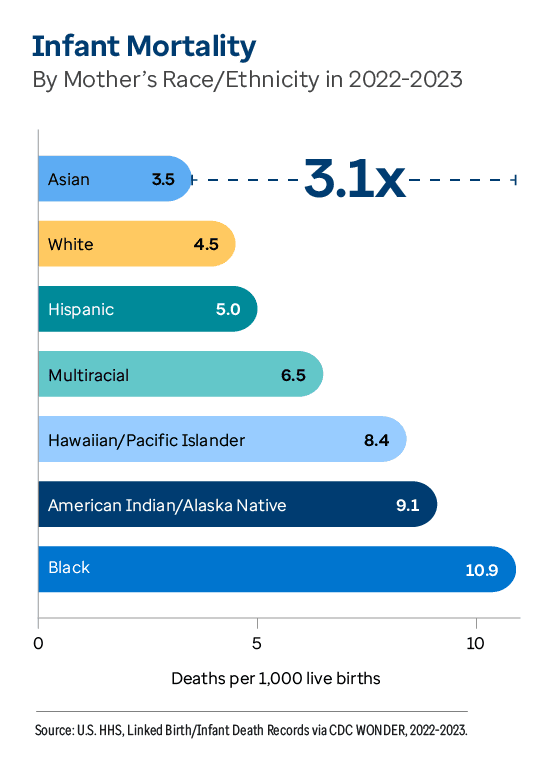
Differences. The infant mortality rate significantly varied by mother’s race/ethnicity, geography, mother’s age and infant gender. The rate was:
- 3.1 times higher among infants born to Black (10.9 deaths per 1,000 live births) compared with Asian (3.5) mothers.
- 2.8 times higher in Mississippi (9.0) than in New Hampshire (3.2).
- 2.2 times higher among infants born to mothers ages 15-19 (10.2) compared with mothers ages 30-34 (4.6).
- 1.2 times higher among male (6.1) compared with female (5.1) infants.
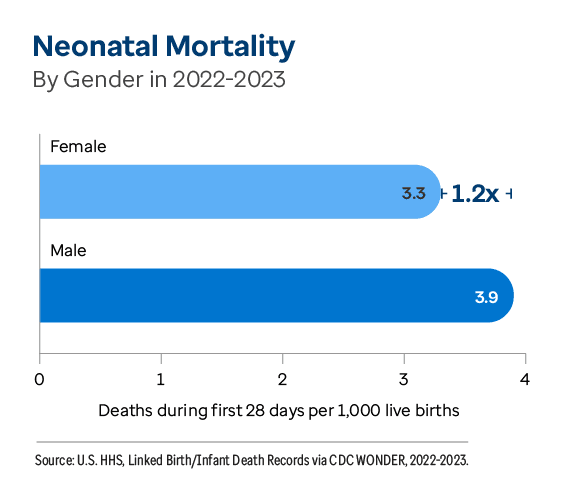
Related Measure: Neonatal MortalityNationally, the
neonatal mortality rate increased 3% between 2020-2021 and 2022-2023, from 3.5 to 3.6 deaths during the first 28 days of life (0-27 days) per 1,000 live births. Approximately 26,300 neonatal deaths occurred in 2022-2023, about 600 more deaths than in 2020-2021. In 2022-2023, the rate was:
The majority of maternal deaths resulting from pregnancy-related complications are
preventable.
8 Despite this, the U.S. consistently has the
highest rate of maternal mortality among high-income countries.
9 Changes over time. Nationally, the maternal mortality rate increased 36% between 2014-2018 and 2019-2023, from 17.3 to 23.5 deaths related to or aggravated by pregnancy (excluding accidental or incidental causes) occurring within 42 days of the end of a pregnancy per 100,000 live births. This rate exceeds the
Healthy People 2030 target of 15.7 maternal deaths per 100,000 live births.
10 Reducing maternal deaths is a Healthy People 2030
Leading Health Indicator.
7 In 2019-2023, nearly 4,310 women died of pregnancy-related causes, an increase of more than 920 maternal deaths from 2014-2018.
Between 2014-2018 and 2019-2023, the
maternal mortality rate significantly increased in 11 states. The largest increases were: 159% in
Mississippi (15.3 to 39.7 deaths per 100,000 live births), 139% in
Nevada (9.5 to 22.7) and 95% in
Virginia (17.1 to 33.4).
Differences. The maternal mortality rate varied significantly by race/ethnicity, geography, age, educational attainment and metropolitan status in 2019-2023. The rate was:
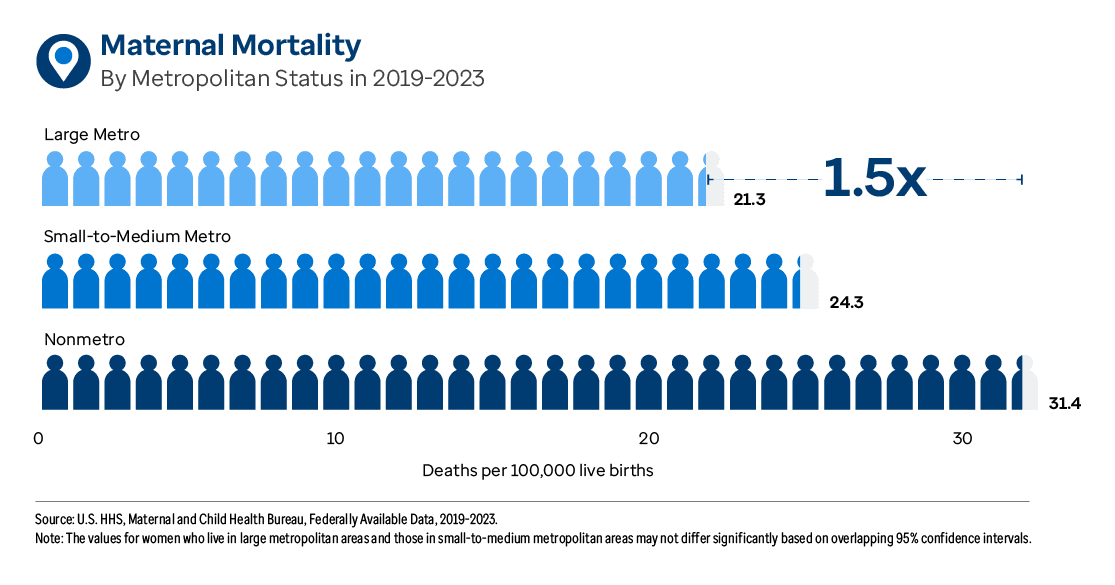
Note: The values for American Indian/Alaska Native (60.8 deaths per 100,000 live births), Black (53.7) and Hawaiian/Pacific Islander (40.7) women may not differ significantly based on overlapping 95% confidence intervals. The same is true for multiracial (12.7), Asian (13.4) and Hispanic (17.5) women; women who are high school graduates (35.9) and women with less than a high school education (33.8); and women who live in large metropolitan areas (21.3) and small-to-medium metropolitan areas (24.3).
Changes over time. Nationally, the
mortality rate among women decreased 8% between 2022 and 2023, from 120.0 to 109.9 deaths per 100,000 women ages 20-44. Approximately 60,700 women ages 20-44 died in 2023, 5,300 fewer deaths than in 2022. Between 2022 and 2023, unintentional injuries decreased, and COVID-19 dropped out of the 10 leading causes of death among women for this age group.
Between 2022 and 2023, the mortality rate among women significantly decreased 10% among
white (124.8 to 112.9 deaths per 100,000 women ages 20-44), 7% among
Hispanic (81.0 to 75.1) and 6% among
Black (192.3 to 179.9) women.
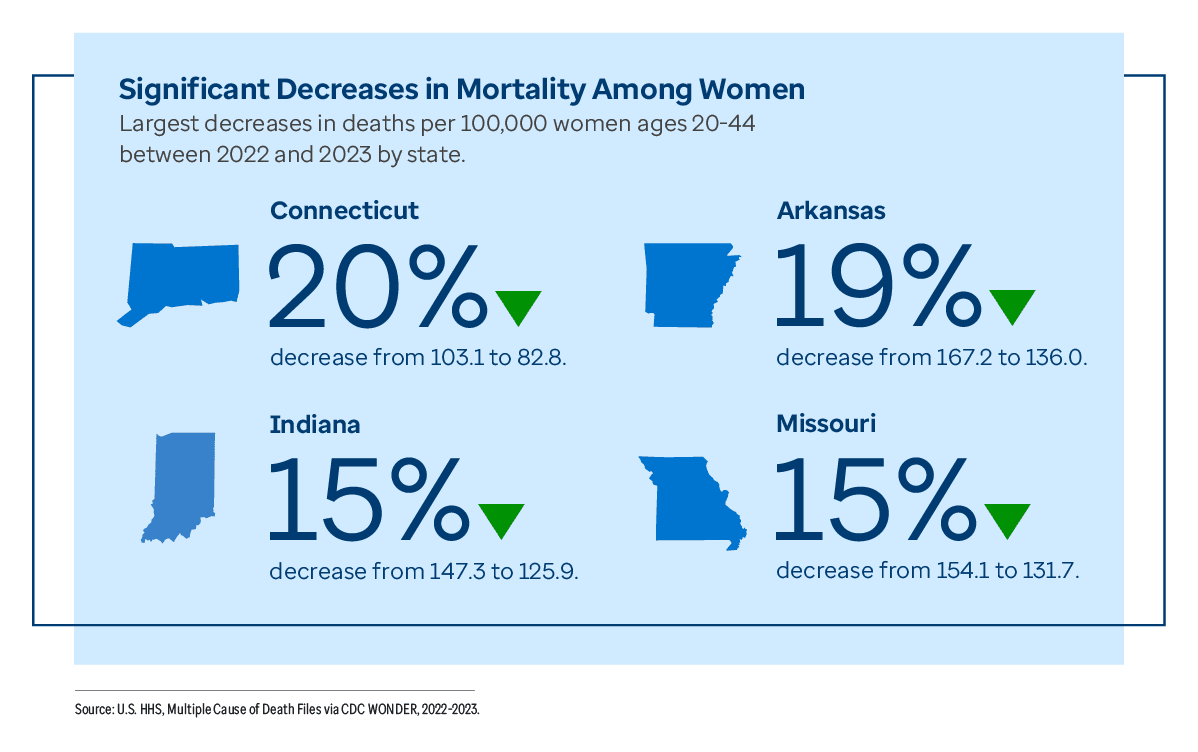
During this time, the mortality rate among women significantly decreased in 17 states, led by: 20% in
Connecticut (103.1 to 82.8 deaths per 100,000 women ages 20-44), 19% in
Arkansas (167.2 to 136.0), and 15% in both
Indiana (147.3 to 125.9) and
Missouri (154.1 to 131.7).
Differences. In 2023, the mortality rate among women was
9.4 times higher among
American Indian/Alaska Native (343.2 deaths per 100,000 women ages 20-44) compared with
Asian (36.4) women.
Related Measure: Drug Deaths Among WomenFor the first time in the history of the
Health of Women and Children Report, the
drug death rate plateaued. In 2021-2023, the number of deaths due to drug injury (unintentional, suicide, homicide or undetermined) per 100,000 women ages 20-44 remained at 28.6, the same as the period before. Racial/ethnic differences persisted; the drug death rate was 20.8 times higher among
American Indian/Alaska Native (76.8) compared with
Asian (3.7) women in 2021-2023.
Provisional data from the CDC WONDER indicate that the drug death rate among women ages 20-44 continued to decrease between 2021-2023 and 2022-2024.
14 Changes over time. Nationally, the percentage of women ages 18-44 who reported being told by a health professional that they had a
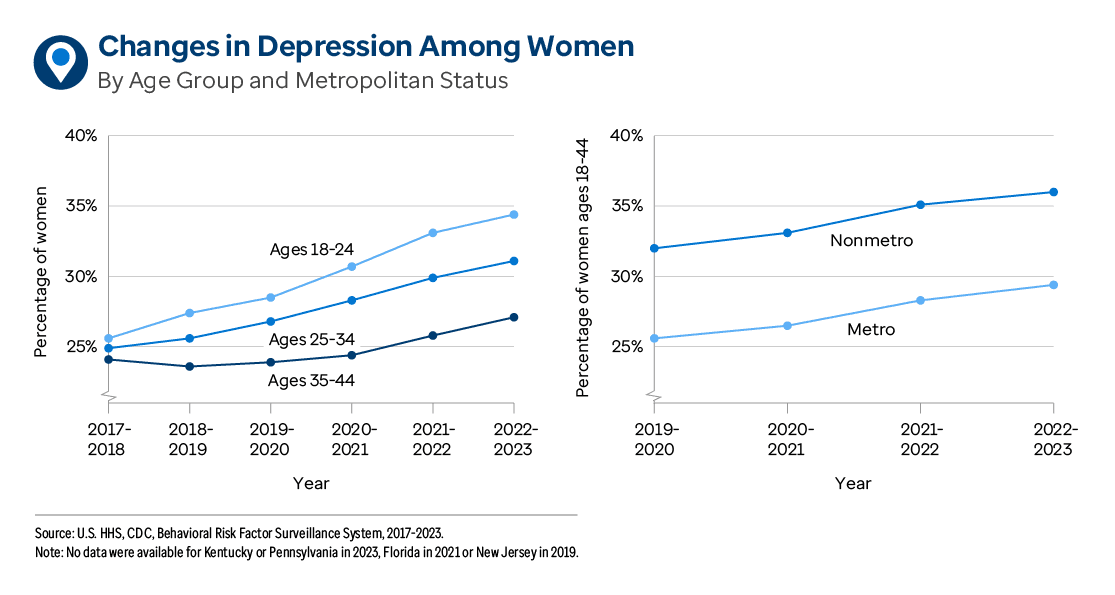
depressive disorder — including depression, major depression, minor depression or dysthymia — increased 11%, from 27.4% to 30.3% between 2020-2021 and 2022-2023. The prevalence has increased 22% (from 24.8%) since 2017-2018. In 2022-2023, more than 17.3 million women ages 18-44 in the U.S. had depression.
Between 2020-2021 and 2022-2023, the prevalence of depression significantly increased:
During this time, the prevalence of depression also significantly increased in 11 states. The largest increases were: 30% in
Hawaii (15.9% to 20.7%) and 22% in both
Tennessee (34.8% to 42.4%) and
California (19.6% to 23.9%).
Differences. The prevalence of depression varied significantly by disability status, race/ethnicity, geography, sexual orientation, educational attainment, veteran status, age, household income and metropolitan status in 2022-2023. The prevalence was:
- 3.5 times higher among women with independent living difficulty (74.2%) than those without a disability (21.0%).
- 3.4 times higher among multiracial (45.3%) than Asian (13.3%) women.
- 2.1 times higher in Maine (43.3%) than in New Jersey (20.5%).
- 2.1 times higher among LGBQ+ (55.5%) than straight (26.2%) women.
- 1.5 times higher among women with some post-high school education (35.5%) than those with less than a high school education (23.0%).
- 1.4 times higher among women who have served in the U.S. armed forces (41.3%) than those who have not served (30.1%).
- 1.3 times higher among women ages 18-24 (34.4%) than those ages 35-44 (27.1%).
- 1.3 times higher among women with an annual household income less than $25,000 (34.5%) than those with incomes of $75,000 or more (26.0%).
- 1.2 times higher among women living in nonmetropolitan areas (36.0%) than those in metropolitan areas (29.4%).
Note: Data for Kentucky, Pennsylvania and all sexual orientation groups in Colorado are from 2022 only. Data for all racial and ethnic groups and all sexual orientation groups in Alabama, Arizona, California, Idaho, New Jersey and Wyoming are from 2023 only. The value for women with independent living difficulty (74.2%) may not differ significantly from that of women who have difficulty with self-care (68.4%) based on overlapping 95% confidence intervals. The same is true for multiracial (45.3%) and American Indian/Alaska Native (38.8%) women; women with less than a high school education (23.0%) and women who are college graduates (25.0%); and women with incomes less than $25,000 (34.5%), incomes of $25,000-$49,999 (32.8%) and incomes of $50,000-$74,999 (32.6%).
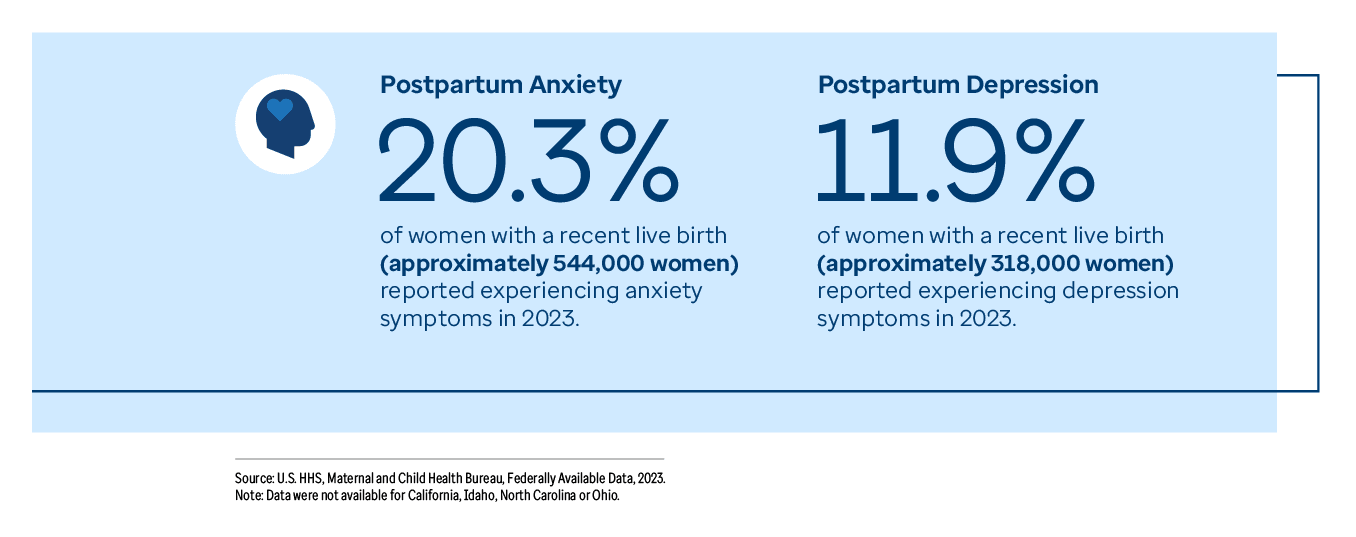
Related Measures: Postpartum Depression and AnxietyIn 2023, 11.9% of women with a recent live birth (more than 318,000 women) reported experiencing depression symptoms. The prevalence of
postpartum depression was highest in
Mississippi (17.1%),
Kansas (16.3%) and
Alaska (15.9%). It was lowest in
Louisiana (7.2%),
New Jersey (8.3%) and
Vermont (8.4%).
Note: Data were not available for California, Idaho, North Carolina or Ohio.
During this time, the prevalence of frequent mental distress significantly increased in six states. The largest increases were: 41% in
Alaska (17.4% to 24.6%), 36% in
Tennessee (24.3% to 33.0%) and 27% in
Texas (18.1% to 23.0%).
Frequent mental distress significantly varied by disability status, race/ethnicity, sexual orientation, household income, geography, age, educational attainment, veteran status and metropolitan status in 2022-2023.
Mental Health Conditions Among Children
While higher rates of diagnosis may reflect improved awareness and engagement with care, they could also indicate a
growing burden of mental health challenges for youth.
19 Early diagnosis and treatment of mental health conditions in children is vital to preventing problems at home, in school or forming friendships.
20 Changes over time. Nationally, the percentage of children ages 3-17 with a
mental health condition increased 9%, from 18.8% to 20.5% between 2021-2022 and 2023-2024. This includes children who were told by a health care provider that they had ADHD, depression or anxiety problems; or were told by a doctor or educator that they had behavior or conduct problems. There were increases in the prevalence of
ADHD (10%, from 10.1% to 11.1%) and
anxiety (13%, from 9.9% to 11.2%). The prevalence of
depression (4.2%) and
behavioral problems (7.7%) did not significantly change.
Between 2021-2022 and 2023-2024, the prevalence of mental health conditions significantly increased:
During this period, mental health conditions increased 32% in
Iowa (18.6% to 24.5%), and 28% in both
Oregon (20.3% to 26.0%) and
California (12.7% to 16.2%).
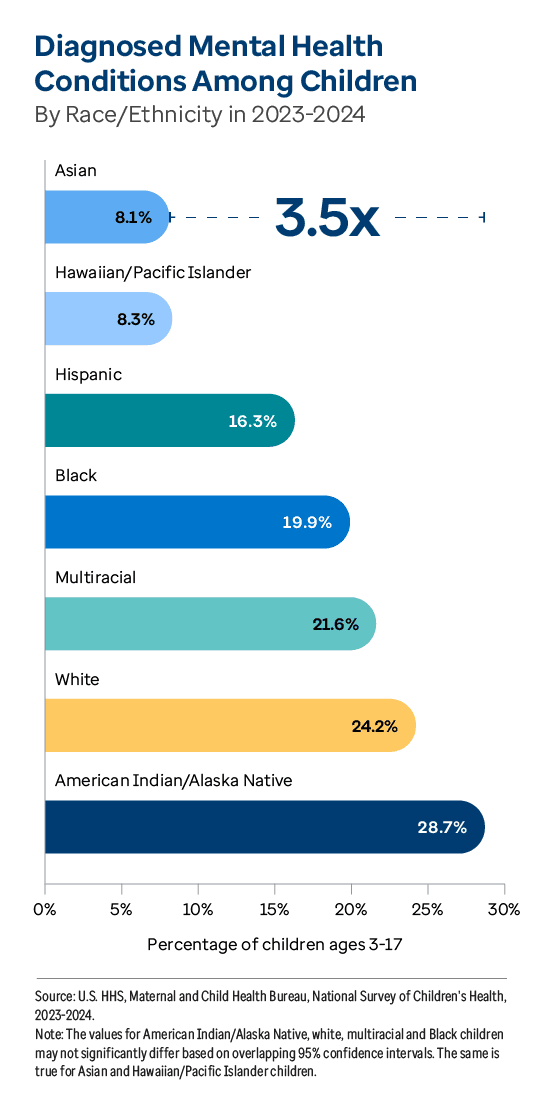
Differences. Mental health conditions among children significantly varied by race/ethnicity, geography, caregiver educational attainment and gender in 2023-2024. The prevalence was:
Note: The values for American Indian/Alaska Native (28.7%), white (24.2%), multiracial (21.6%) and Black (19.9%) children may not differ significantly based on overlapping 95% confidence intervals. The same is true for Asian (8.1%) and Hawaiian/Pacific Islander (8.3%) children.
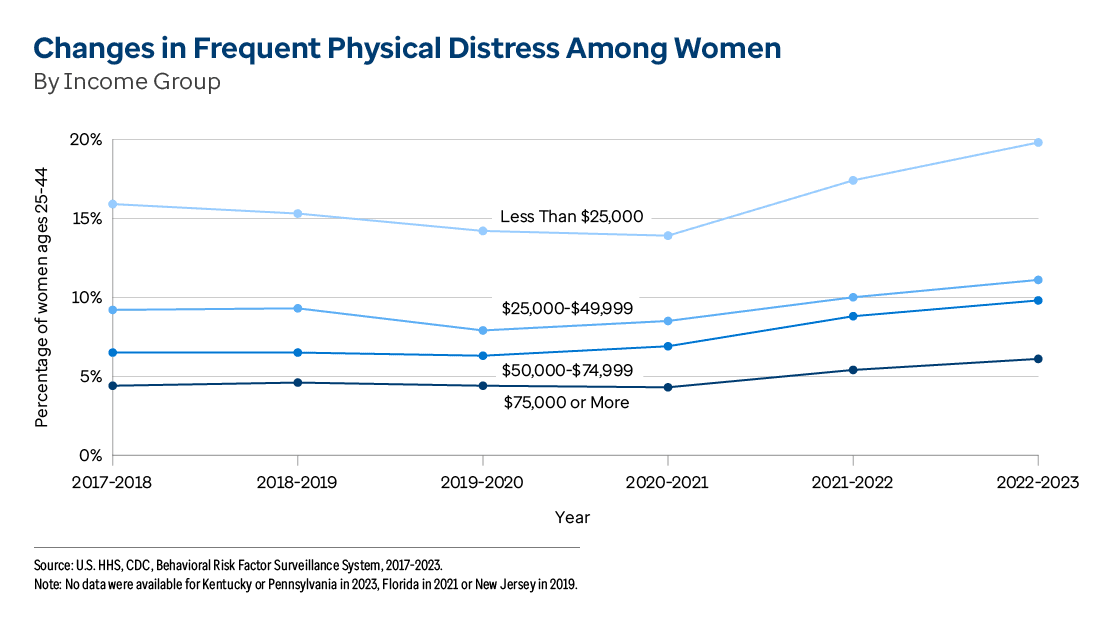
Frequent Physical Distress Among Women
Frequent physical distress measures the population experiencing persistent and
likely severe physical health problems, which can significantly impact health-related quality of life and overall wellness.
21 Changes over time. Nationally, the percentage of women ages 18-44 who reported their physical health was not good 14 or more days in the past 30 days increased 37%, from 7.1% to 9.7% between 2020-2021 and 2022-2023. In 2022-2023, more than 5.4 million women reported
frequent physical distress. Between 2020-2021 and 2022-2023, the prevalence significantly increased:
- 133% among American Indian/Alaska Native (8.0% to 18.6%), and 42% among both Hispanic (6.6% to 9.4%) and white (7.7% to 10.9%) women.
- 63% among women ages 18-24 (5.1% to 8.3%), 31% among those ages 25-34 (7.0% to 9.2%) and 30% among those ages 35-44 (8.7% to 11.3%).
- 47% among college graduates (4.3% to 6.3%), 35% among high school graduates (8.9% to 12.0%), 33% among women with less than a high school education (11.9% to 15.8%) and 22% among those with some post-high school education (9.9% to 12.1%).
- 42% among women with an annual household income less than $25,000 (13.9% to 19.8%), those with incomes of $50,000-$74,999 (6.9% to 9.8%) and those with incomes of $75,000 or more (4.3% to 6.1%); and 31% among women with incomes of $25,000-$49,999 (8.5% to 11.1%).
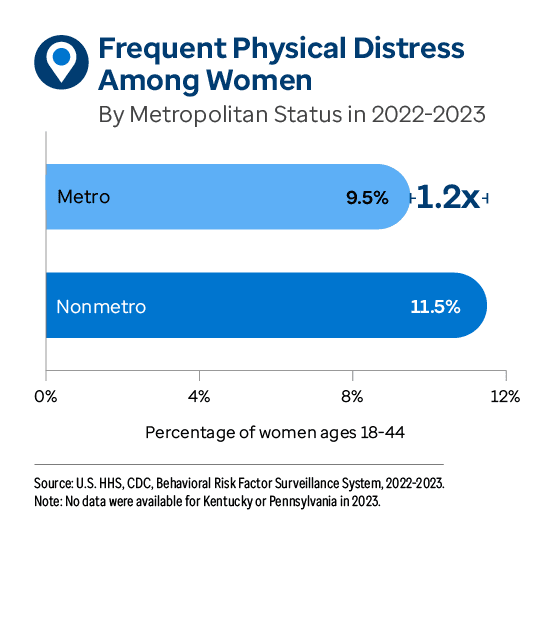
- 39% among women living in nonmetropolitan areas (8.3% to 11.5%) and 38% among those in metropolitan areas (6.9% to 9.5%).
During the same period, the prevalence of frequent physical distress significantly increased in 18 states and the District of Columbia. The largest increases were: 81% in the
District of Columbia (4.2% to 7.6%), 68% in
New York (5.7% to 9.6%), 64% in
Oregon (7.4% to 12.1%) and 62% in both
Virginia (5.8% to 9.4%) and
Vermont (6.5% to 10.5%).
Differences. Frequent physical distress significantly varied by disability status, household income, race/ethnicity, educational attainment, geography, sexual orientation, veteran status, age and metropolitan status in 2022-2023. The prevalence was:
- 12.6 times higher among women who have difficulty with self-care (64.1%) than those without a disability (5.1%).
- 3.2 times higher among women with an annual household income less than $25,000 (19.8%) than those with incomes of $75,000 or more (6.1%).
- 2.7 times higher among American Indian/Alaska Native (18.6%) than Asian (6.8%) women.
- 2.5 times higher among women with less than a high school education (15.8%) than college graduates (6.3%).
- 2.1 times higher in Nevada (13.0%) than in Hawaii (6.3%).
- 1.8 times higher among LGBQ+ (15.3%) than straight (8.4%) women.
- 1.5 times higher among women who have served in the U.S. armed forces (14.0%) than those who have not served (9.6%).
- 1.4 times higher among women ages 35-44 (11.3%) than those ages 18-24 (8.3%).
- 1.2 times higher among women living in nonmetropolitan areas (11.5%) than those in metropolitan areas (9.5%).
Note: Data for Kentucky, Pennsylvania and all sexual orientation groups in Colorado are from 2022 only. Data for all racial and ethnic groups and all sexual orientation groups in Alabama, Arizona, California, Idaho, New Jersey and Wyoming are from 2023 only. The values for American Indian/Alaska Native (18.6%), other race (14.2%), multiracial (12.6%) and white (10.9%) women may not differ significantly based on overlapping 95% confidence intervals. The same is true for Asian (6.8%), Black (7.4%), Hispanic (9.4%), multiracial and other race women.
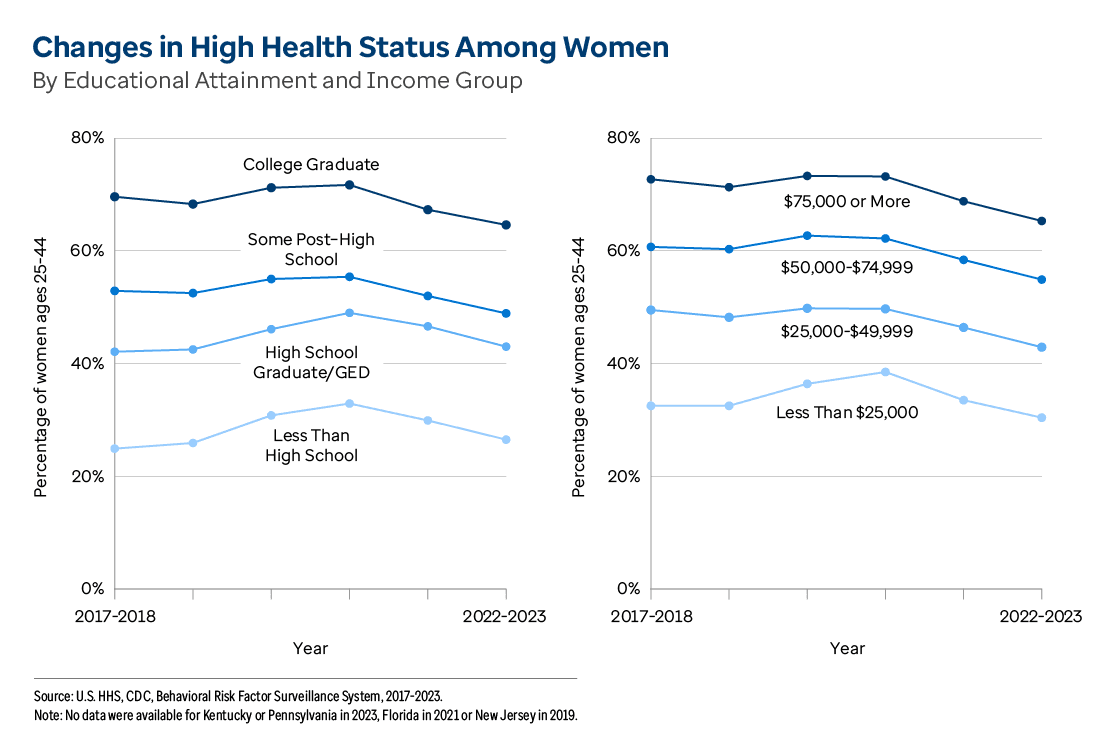
High Health Status Among Women
Self-reported health status is a subjective measure of
health-related quality of life that encompasses not only specific health conditions or outcomes, but also factors such as social support, ability and ease of functioning, and other socioeconomic, environmental and cultural components.
22 Research shows that those with “poor” self-reported health status have a
mortality risk double that of those with ”excellent” self-reported health status.
23 Changes over time. Nationally, the percentage of women ages 18-44 who reported their
health was very good or excellent decreased 13%, from 59.0% to 51.6% between 2020-2021 and 2022-2023. In 2022-2023, around 30 million women reported having very good or excellent health. Between 2020-2021 and 2022-2023, the prevalence significantly decreased:
- 21% among women with an annual household income less than $25,000 (38.5% to 30.4%), 14% among those with incomes of $25,000-$49,999 (49.7% to 42.9%), 12% among those with incomes of $50,000-$74,999 (62.2% to 54.9%) and 11% among those with incomes of $75,000 or more (73.2% to 65.3%).
- 19% among women with less than a high school education (32.9% to 26.5%), 12% among both high school graduates (49.0% to 43.0%) and women with some post-high school education (55.4% to 48.9%), and 10% among college graduates (71.7% to 64.6%).
- 18% among Hispanic (47.9% to 39.2%), 17% among multiracial (59.2% to 49.1%), 16% among Black (54.9% to 46.0%) and 14% among white (64.7% to 55.9%) women.
- 16% among women ages 18-24 (63.4% to 53.3%), 12% among those ages 25-34 (59.3% to 52.1%) and 10% among those ages 35-44 (55.6% to 50.2%).
- 13% among women living in metropolitan areas (59.3% to 51.8%) and 11% among those in nonmetropolitan areas (56.7% to 50.3%).
During this time, the prevalence of high health status significantly decreased in 37 states. The largest decreases were: 20% in both
Oregon (59.0% to 47.3%) and
Rhode Island (61.4% to 48.9%), 19% in both
Hawaii (65.1% to 52.5%) and
Tennessee (61.0% to 49.3%), and 18% in
Maryland (62.3% to 51.3%).
Differences. The prevalence of high health status varied significantly by disability status, educational attainment, household income, race/ethnicity, sexual orientation, geography and age in 2022-2023. The prevalence was:
- 4.9 times higher among women without a disability (58.8%) compared with women who have difficulty with self-care (11.9%).
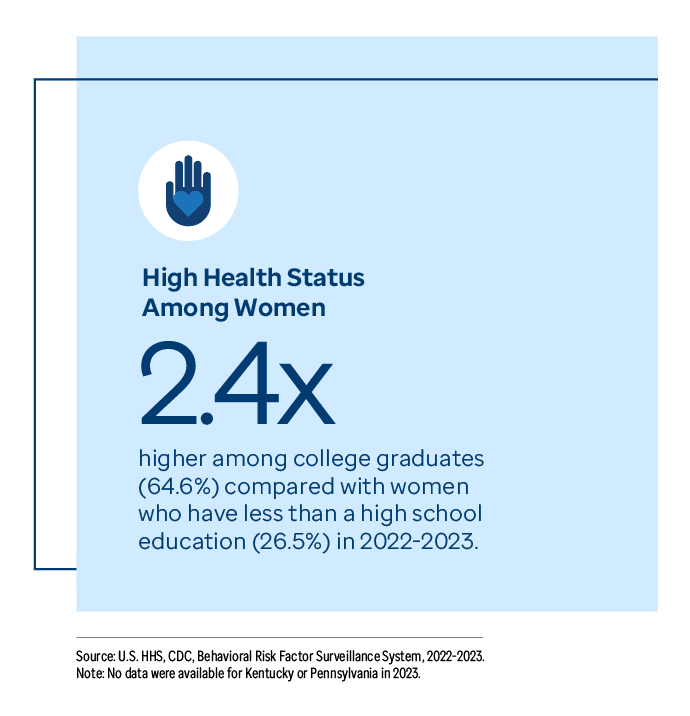
- 2.4 times higher among college graduates (64.6%) compared with women who have less than a high school education (26.5%).
- 2.1 times higher among women with an annual household income of $75,000 or more (65.3%) compared with those who have incomes less than $25,000 (30.4%).
- 1.4 times higher among Asian (56.6%) compared with Hispanic (39.2%) women.
- 1.3 times higher among straight (53.5%) compared with LGBQ+ (41.1%) women.
- 1.2 times higher in South Dakota (57.8%) than in Oregon and Texas (both 47.3%).
- 1.1 times higher among women ages 18-24 (53.3%) compared with those ages 35-44 (50.2%).
Note: Data for Kentucky, Pennsylvania and all sexual orientation groups in Colorado are from 2022 only. Data for all racial and ethnic groups and all sexual orientation groups in Alabama, Arizona, California, Idaho, New Jersey and Wyoming are from 2023 only. The values for women who have difficulty with self-care (11.9%) and those who have difficulty with mobility (14.1%) may not significantly differ based on overlapping 95% confidence intervals. The same is true for Asian (56.6%), white (55.9%), other race (50.7%), Hawaiian/Pacific Islander (50.2%) and multiracial (49.1%) women; Hispanic (39.2%), American Indian/Alaska Native (40.9%) and Hawaiian/Pacific Islander women; and women ages 18-24 (53.3%) and 25-34 (52.1%).
Severe Maternal Morbidity
Severe maternal morbidity is a
critical indicator for identifying preventable, severe complications in maternal health care.
24 As a population-level metric, it helps uncover the underlying causes of maternal health disparities, guides improvement efforts and supports the prevention of maternal mortality.
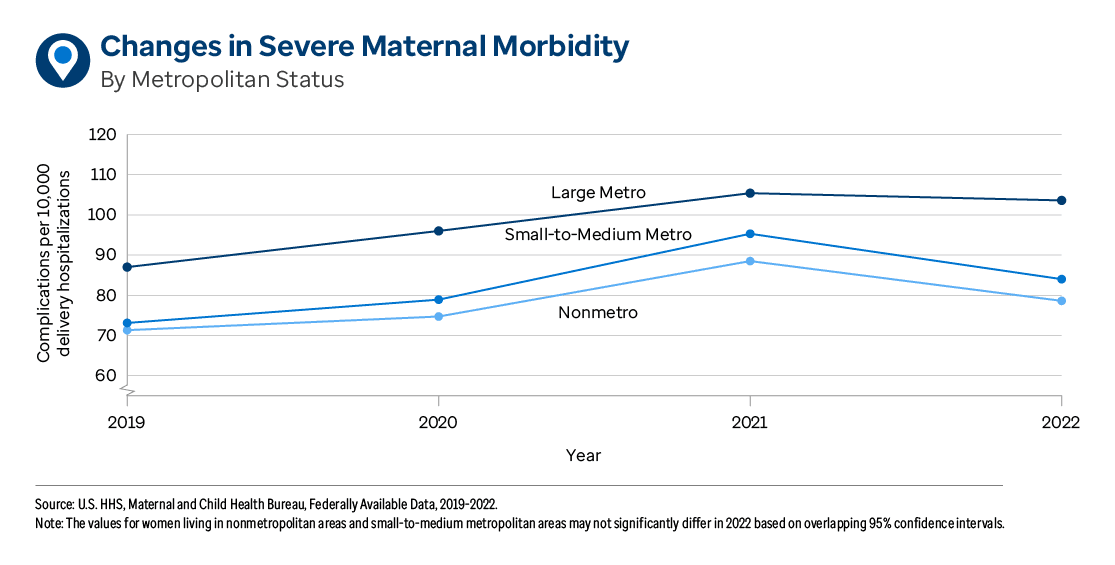
Changes over time. Nationally, the
severe maternal morbidity rate decreased 6% between 2021 and 2022, from 100.3 to 94.7 significant life-threatening maternal complications during delivery per 10,000 delivery hospitalizations. In 2022, approximately 32,000 women experienced severe maternal morbidity, about 2,000 fewer than in 2021. Between 2020 and 2021, severe maternal morbidity significantly decreased:
During this time, the severe maternal morbidity rate significantly decreased 24% in
Arizona (105.6 to 80.5 complications per 10,000 delivery hospitalizations), 22% in
Mississippi (94.2 to 73.7), 14% in
Texas (92.5 to 79.8) and 10% in
Florida (114.7 to 102.7).
Differences. The prevalence of severe maternal morbidity significantly varied by geography, race/ethnicity, age, metropolitan status and household income. The prevalence was:
- 3.3 times higher in Vermont (144.2 complications per 10,000 delivery hospitalizations) than in South Dakota (43.6).
- 1.9 times higher among Black (150.3) compared with white (77.4) women.
- 1.8 times higher among women age 35 and older (136.3) compared with women ages 20-24 (76.9).
- 1.3 times higher among women living in large metropolitan areas (103.6) than those in nonmetropolitan areas (78.6).
- 1.1 times higher among women living in the least-wealthy ZIP code quartile (103.1) compared with those in the wealthiest ZIP code quartile (90.4).
Note: The values for women ages 20-24 (76.9) and women ages 25-29 (78.2) may not differ significantly based on overlapping 95% confidence intervals. The same is true for women living in the wealthiest (90.4), second least-wealthy (91.9) and second-wealthiest ZIP code quartiles (92.0).
Neonatal Abstinence Syndrome
Changes over time. Nationally, the rate of
NAS decreased 10% between 2021 and 2022, from 5.9 to 5.3 birth hospitalizations with a diagnosis code of withdrawal symptoms due to prenatal exposure to illicit drugs per 1,000 birth hospitalizations. In 2022, there were approximately 18,000 NAS hospitalizations in the U.S., nearly 2,000 fewer hospitalizations than in 2021. Between 2021 and 2022, NAS hospitalization rates significantly decreased:
During this time, the rate significantly decreased in nine states. The largest decreases were: 26% in
Maine (18.2 to 13.5 NAS hospitalizations per 1,000 birth hospitalizations), 25% in
Kentucky (16.8 to 12.6), 21% in
Massachusetts (7.8 to 6.2) and 20% in
Pennsylvania (11.1 to 8.9). At the same time, the rate significantly increased in one state: 26% in
Minnesota (5.0 to 6.3).
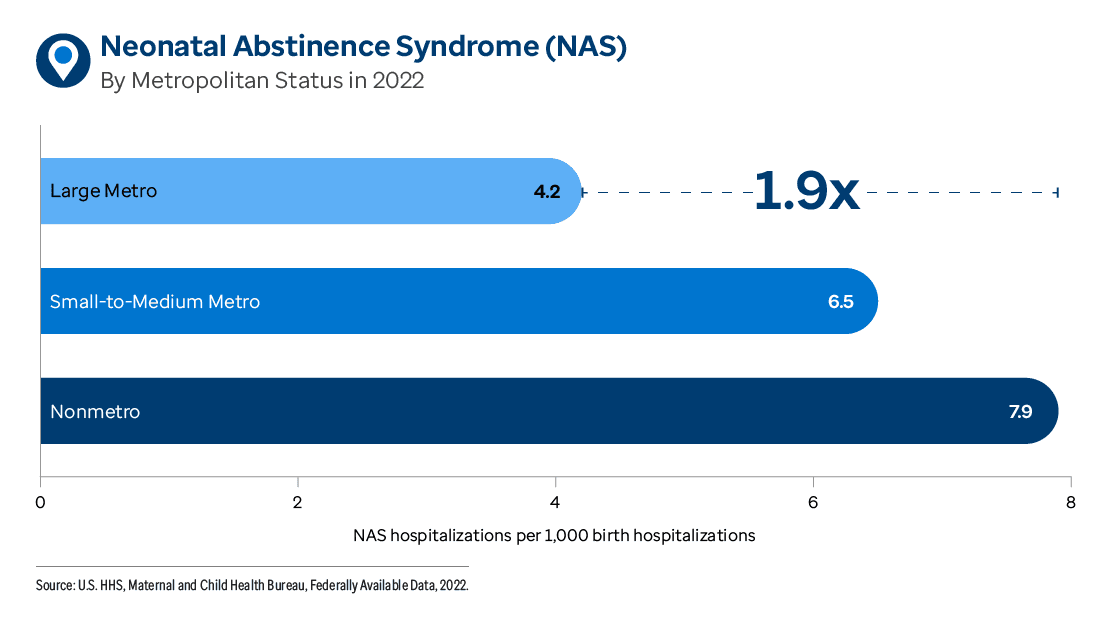
Differences. The prevalence of NAS hospitalizations significantly varied by geography, race/ethnicity, household income and metropolitan status in 2022. The rate was:
- 31.9 times higher in West Virginia (31.9 NAS hospitalizations per 1,000 birth hospitalizations) than in Hawaii (1.0).
- 23.5 times higher among American Indian/Alaska Native (14.1) compared with Asian/Pacific Islander (0.6) infants.
- 2.8 times higher among infants living in the least wealthy ZIP code quartile (7.6) compared with infants living in the wealthiest ZIP code quartile (2.7).
- 1.9 times higher among infants living in nonmetropolitan areas (7.9) than those in large metropolitan areas (4.2).
Overweight or Obesity Among Children
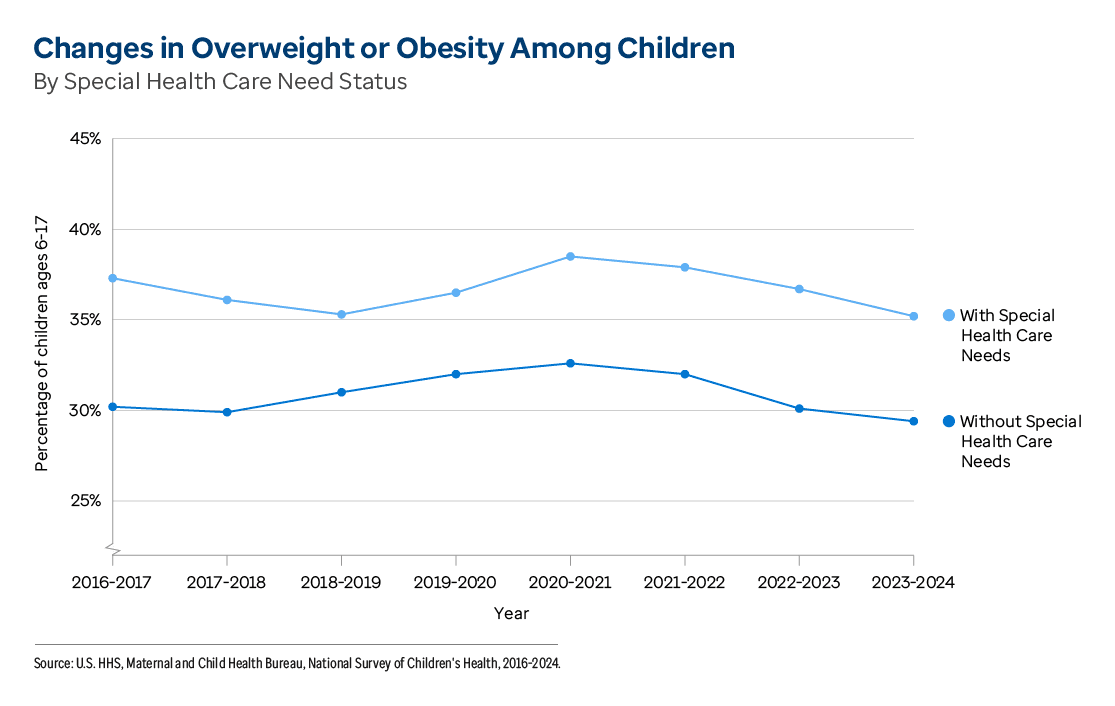
Changes over time. Nationally, the percentage of children ages 6-17 who had
overweight or obesity for their age based on reported height and weight decreased 7%, from 33.8% to 31.3% between 2021-2022 and 2023-2024. In 2023-2024, approximately 14.7 million children had overweight or obesity, 1.1 million fewer than in 2021-2022. The prevalence of overweight and obesity significantly decreased:
Differences. The prevalence of children who had overweight or obesity significantly varied by race/ethnicity, geography, caregiver educational attainment, special health care needs status and gender in 2023-2024. The prevalence was:
Note: The values for children with caregivers who had less than a high school education (41.2%), children with a caregiver who graduated from high school (40.9%) and children with a caregiver who had some post-high school education (36.9%) may not differ significantly based on overlapping 95% confidence intervals. The same is true for Hawaiian/Pacific Islander (47.8%), Black (39.3%), American Indian/Alaska Native (37.9%), Hispanic (37.7%) and multiracial (30.4%) children.

 US Summary
 Alabama
 Alaska
 Arizona
 Arkansas
 California
 Colorado
 Connecticut
 Delaware
 District of Columbia
 Florida
 Georgia
 Hawaii
 Idaho
Idaho Illinois
 Indiana
 Iowa
Iowa Kansas
 Kentucky
 Louisiana
 Maine
Maine Maryland
 Massachusetts
 Michigan
 Minnesota
 Mississippi
 Missouri
 Montana
 Nebraska
 Nevada
 New Hampshire
 New Jersey
 New Mexico
 New York
 North Carolina
 North Dakota
 Ohio
Ohio Oklahoma
 Oregon
 Pennsylvania
 Rhode Island
 South Carolina
 South Dakota
 Tennessee
 Texas
Texas Utah
Utah Vermont
 Virginia
 Washington
 West Virginia
 Wisconsin
 Wyoming