America's Health Rankings, United Health Foundation Logo
2025 Health of Women and Children Report

Physical Environment

Download
Previous Page7 / 67Next Page
Close
Executive BriefIntroductionSpotlight: Women in Rural CommunitiesNational SnapshotFindingsHealth OutcomesSocial and Economic FactorsPhysical EnvironmentClinical CareBehaviorsState RankingsAppendixMeasures Table - WomenMeasures Table - ChildrenData Source DescriptionsMethodologyReferencesState SummariesUS SummaryAlabamaAlaskaArizonaArkansasCaliforniaColoradoConnecticutDelawareDistrict of ColumbiaFloridaGeorgiaHawaiiIdahoIllinoisIndianaIowaKansasKentuckyLouisianaMaineMarylandMassachusettsMichiganMinnesotaMississippiMissouriMontanaNebraskaNevadaNew HampshireNew JerseyNew MexicoNew YorkNorth CarolinaNorth DakotaOhioOklahomaOregonPennsylvaniaRhode IslandSouth CarolinaSouth DakotaTennesseeTexasUtahVermontVirginiaWashingtonWest VirginiaWisconsinWyoming
2025 Health of Women and Children Report2025 Health of Women and Children Report – Executive Brief2025 Health of Women and Children Report – State Summaries2025 Health of Women and Children Report – Concentrated Disadvantage County-Level Maps2025 Health of Women and Children Report – Measures Table2025 Health of Women and Children Report – Infographics2025 Health of Women and Children Report – Report Data (All States)
‌‌‌‌‌
‌
‌
‌‌‌
‌
‌

Please tell us a little more about you

We appreciate you taking the time to help America’s Health Rankings better understand our audiences. Your feedback will allow us to optimize our website and provide you with additional resources in the future. Thank you.

Please select one option which best describes your profession or field of expertise

Journalist or media professional
Health Policy Professional
Public health professional (state, local, or community level)
Health care provider or administrator
Member of an advocacy group or trade organization
Academic, student, or researcher
Government administrator, legislator, or staffer
Concerned citizen
Other
Don't show me this again

Air and Water Quality

Household Smoke Among Children

The adverse impact of environmental tobacco smoke (secondhand smoke) on children’s health is widely documented and recognized
external-link
.57 Secondhand smoke exposure is associated with numerous health problems
external-link
in children, including respiratory infections, more frequent and severe asthma attacks, slower lung development, sudden infant death syndrome (SIDS) and premature death and disease from exposure to cancer-causing
external-link
chemicals.58,59
Changes over time. Nationally, the percentage of children ages 0-17 living in households where someone used cigarettes, cigars or pipe tobacco decreased 19%, from 12.7% to 10.3% between 2021-2022 and 2023-2024. In 2023-2024, 7.2 million children lived in households where someone smoked, 1.7 million fewer than in 2021-2022. 
Between 2021-2022 and 2023-2024, household smoke decreased:
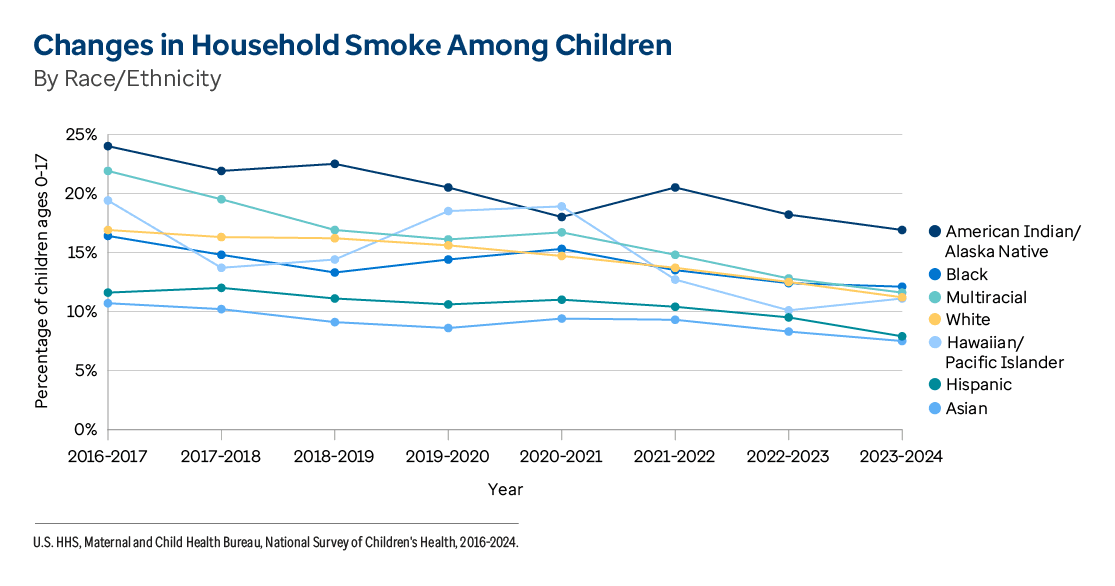
  • 24% among Hispanic (10.4% to 7.9%), 22% among multiracial (14.8% to 11.6%) and 18% among white (13.7% to 11.2%) children.
  • 23% among boys (13.0% to 10.0%) and 14% among girls (12.3% to 10.6%).
  • 21% among children with a caregiver who graduated from college (6.7% to 5.3%), and 15% among both children with a caregiver who graduated from high school (21.6% to 18.4%) and those who had a caregiver with some post-high school education (18.6% to 15.8%).
Graphic representation of Changes in Household Smoke Among Children By Race/Ethnicity information contained on this page. Download the full report PDF from the report Overview page for details.
During this time, the prevalence significantly decreased: 38% in Texas (12.9% to 8.0%), 32% in North Dakota (17.1% to 11.6%), 28% in California (8.0% to 5.8%) and 25% in Tennessee (17.9% to 13.4%).
Differences. The prevalence of household smoke significantly varied by geography, caregiver educational attainment, race/ethnicity and special health care needs status in 2023-2024. The percentage was:
  • 4.7 times higher in West Virginia (21.9%) than in Utah (4.7%).
  • 3.5 times higher among children with a caregiver who graduated from high school (18.4%) compared with children with a caregiver who graduated from college (5.3%).
  • 2.3 times higher among American Indian/Alaska Native (16.9%) compared with Asian (7.5%) children. 
  • 1.5 times higher among children with special health care needs (13.7%) than those without special health care needs (9.0%).
Note: The values for American Indian/Alaska Native (16.9%), Black (12.1%), multiracial (11.6%) and Hawaiian/Pacific Islander (11.2%) children may not differ significantly based on overlapping 95% confidence intervals. The same is true for Asian (7.5%), Hispanic (7.9%) and Hawaiian/Pacific Islander children.
America's Health Rankings, United Health Foundation Logo

Reports

Partner With Us

Explore the Data and Stay Tuned for New Insights

Want to be notified of our latest updates? Sign up now

America's Health Rankings, United Health Foundation Logo