Nutrition and Physical Activity
Regular exercise is a vital component of a healthy lifestyle. Engaging in regular physical activity offers numerous benefits for both physical and mental health, including
reduced risk of cardiovascular diseases, certain cancers, depression, sleep problems and anxiety.
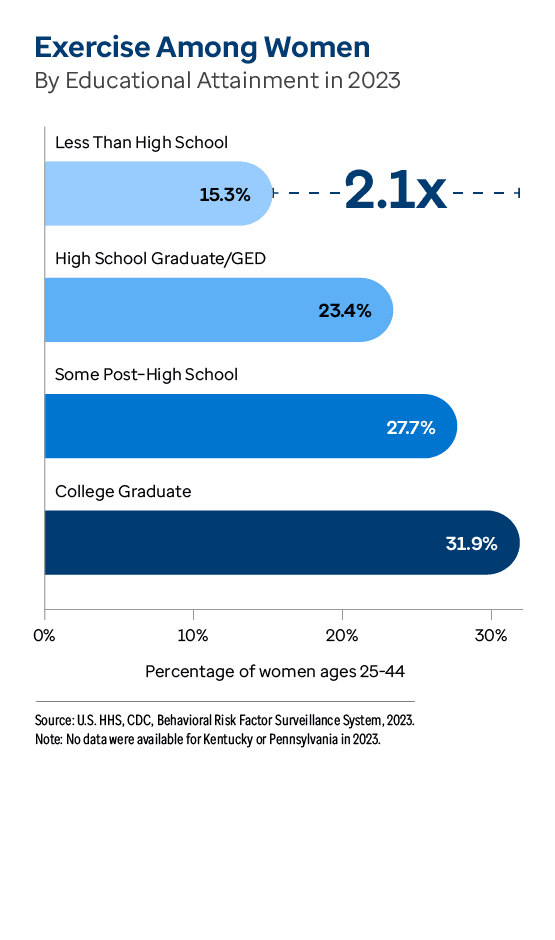
84 Differences. The prevalence of exercise among women varied significantly by educational attainment, disability status, household income, geography, race/ethnicity and veteran status. In 2023, the prevalence was:
Note: No data were available for Kentucky or Pennsylvania in 2023. The values for women who have difficulty with self-care (15.9%), women who have difficulty with mobility (19.3%), women with independent living difficulty (20.5%), women with difficulty hearing (21.9%) and women with difficulty seeing (22.3%) may not differ significantly based on overlapping 95% confidence intervals. The same is true for American Indian/Alaska Native (33.2%), multiracial (31.1%), other race (30.7%), white (29.8%), Asian (27.1%), Hawaiian/Pacific Islander (26.1%) and Black (24.6%) women; and Hispanic (24.0%), Black, Hawaiian/Pacific Islander, white and multiracial women.
Chlamydia is the most
commonly reported sexually transmitted infection in the United States.
86,87 The vast majority of reported chlamydia cases in the U.S. occur in
women, particularly women of reproductive age.
88 In 2023, more than
half of all reported chlamydia cases occurred in adolescents and young adults ages 15-24.
87 Changes over time. Nationally,
chlamydia incidence decreased 4% between 2022 and 2023, from 1,540.1 to 1,481.2 new cases per 100,000 females ages 15-44. In 2023, approximately 977,200 new cases of chlamydia were diagnosed among females ages 15-44, 32,300 fewer cases than in 2022.
Between 2022 and 2023, chlamydia incidence decreased 4% among
white women (659.0 to 633.4 cases per 100,000) and 4% (the national change) or more in 26 states and the District of Columbia, led by: 51% in
Maryland (1,555.9 to 766.5), 20% in
Tennessee (1,723.2 to 1,375.3) and 13% in
Montana (1,243.1 to 1,086.5). The incidence increased 4% or more in six states. The largest increases were: 26% in
Maine (248.5 to 312.9), 10% in
Hawaii (1,328.6 to 1,464.3) and 8% in
Delaware (1,771.6 to 1,916.4).
Differences. Chlamydia incidence varied by race/ethnicity and geography in 2023. The rate was:
- 12.5 times higher among Black (3,031.3 cases per 100,000) compared with Asian (242.8) women.
- 8.2 times higher in Louisiana (2,572.4) than in Maine (312.9).
Substantial social, economic and health costs are associated with teen pregnancy and child-rearing. Teenage mothers are significantly
more likely to drop out of high school and face unemployment.
89 The children of teen mothers also have a
higher risk of mental health issues, aggression and behavior problems, academic difficulties, continuous delinquent behavior and becoming
teen mothers themselves.
90,91 Changes over time. Nationally, the
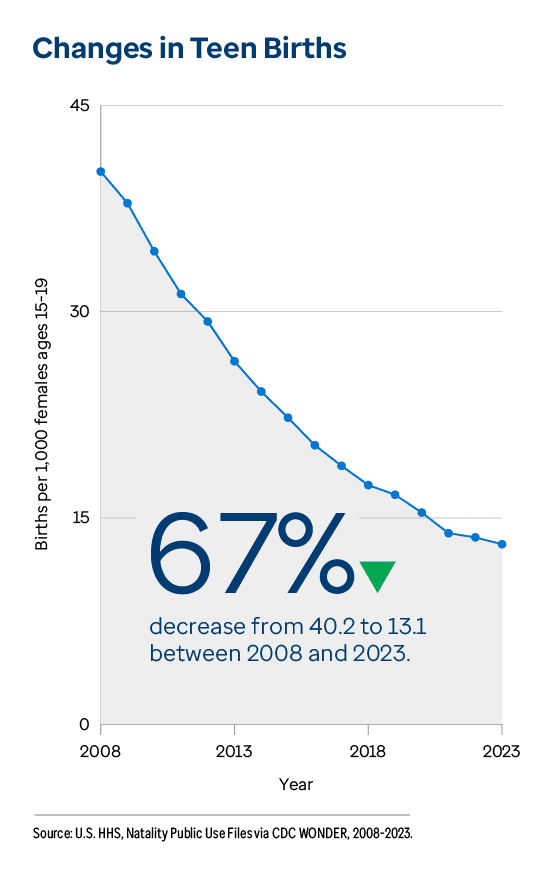
teen birth rate decreased 4% between 2022 and 2023, from 13.6 to 13.1 births per 1,000 females ages 15-19. In 2023, nearly 141,000 teenagers gave birth, 2,800 fewer than in 2022.
Between 2022 and 2023, the
teen birth rate decreased 8% among white teenagers (9.0 to 8.3 births per 1,000 females ages 15-19), 7% among
American Indian/Alaska Native teenagers (22.2 to 20.7), 6% among both
Asian teenagers (1.7 to 1.6) and
multiracial teenagers (13.5 to 12.7), and 5% among
Black teenagers (20.2 to 19.2).
During this time frame, the teen birth rate decreased 4% (the national change) or more in 29 states, led by: 21% in
Wyoming (16.0 to 12.6), 14% in
Maine (8.4 to 7.2) and 10% in
Rhode Island (8.3 to 7.5).
Differences. The teen birth rate varied by race/ethnicity and geography in 2023. The rate was:
- 13.0 times higher among Hispanic (20.8 births per 1,000 females ages 15-19) compared with Asian (1.6) teenagers.
- 5.4 times higher in Mississippi (24.9) than in New Hampshire (4.6).
Changes over time. Nationally, the percentage of mothers who reported
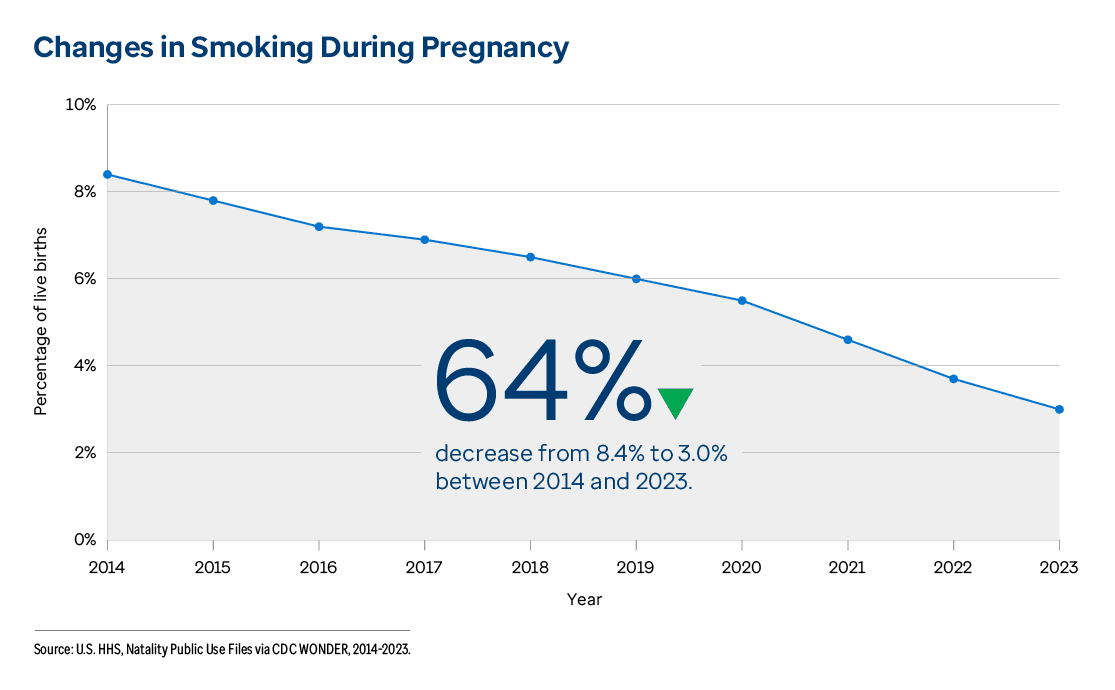
smoking cigarettes during pregnancy decreased 19%, from 3.7% to 3.0% of live births between 2022 and 2023. Over the long term, smoking during pregnancy has decreased 64% since 2014 (8.4%). In 2023, approximately 107,800 mothers smoked during pregnancy, 26,400 fewer mothers than in 2022.
Between 2022 and 2023, the prevalence of smoking during pregnancy decreased 19% or more (the national change) in 24 states, led by: 36% in
Rhode Island (2.5% to 1.6% of live births), 27% in
Mississippi (5.1% to 3.7%) and 26% in
South Carolina (4.3% to 3.2%).
Differences. Smoking during pregnancy was 20.5 times higher in
West Virginia (12.3%) than in
California (0.6%) in 2023.

 US Summary
 Alabama
 Alaska
 Arizona
 Arkansas
 California
 Colorado
 Connecticut
 Delaware
 District of Columbia
 Florida
 Georgia
 Hawaii
 Idaho
Idaho Illinois
 Indiana
 Iowa
Iowa Kansas
 Kentucky
 Louisiana
 Maine
Maine Maryland
 Massachusetts
 Michigan
 Minnesota
 Mississippi
 Missouri
 Montana
 Nebraska
 Nevada
 New Hampshire
 New Jersey
 New Mexico
 New York
 North Carolina
 North Dakota
 Ohio
Ohio Oklahoma
 Oregon
 Pennsylvania
 Rhode Island
 South Carolina
 South Dakota
 Tennessee
 Texas
Texas Utah
Utah Vermont
 Virginia
 Washington
 West Virginia
 Wisconsin
 Wyoming