Concentrated Disadvantage
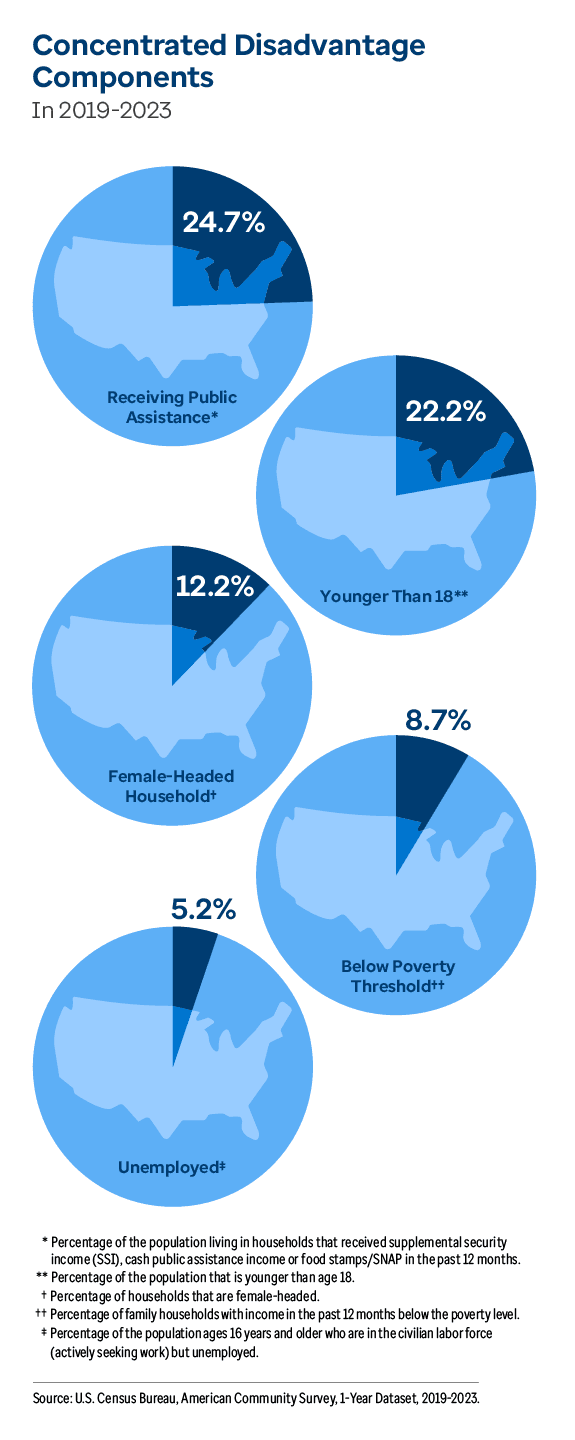
Concentrated disadvantage measures the percentage of households with children that are located in census tracts for which the averaged z-score of the following factors is above the 75th percentile: family households below the poverty line, female-headed households, individuals receiving public assistance, unemployed population age 16 and older and population younger than 18. It serves as an
indicator of community well-being and projected socioeconomic needs.
36 Studies have found that living in areas of higher community socioeconomic disadvantage is associated with
lack of access to healthy foods and recreational areas;
environmental hazards, including lead exposure, poor air quality and substandard housing; and
chronic conditions such as obesity, asthma, depression, anxiety and sexually transmitted infections.
36–38 Changes over time. Concentrated disadvantage increased 10% or more in 12 states and simultaneously decreased 10% or more in seven states between 2015-2019 and 2019-2023. The largest increases were: 54% in
North Dakota (4.8% to 7.4%), 43% in
Wyoming (5.1% to 7.3%) and 39% in
Hawaii (14.7% to 20.4%). The largest decreases were: 40% in
Idaho (12.8% to 7.7%), 39% in
Utah (10.8% to 6.6%) and 29% in
South Dakota (15.0% to 10.6%).
Differences. During 2019-2023, concentrated disadvantage was 15.0 times higher in
New Mexico (46.6%) than in
Vermont (3.1%).
Related Measure: Poverty Among WomenNationally, the percentage of women ages 18-44 living
below the poverty level decreased 2%, from 15.2% to 14.9% between 2022 and 2023. In 2023, more than 8.6 million women were living below the poverty level, a decrease of more than 100,000 women compared with 2022. Between 2022 and 2023, poverty among women significantly decreased 13% in
Missouri (16.1% to 14.0%).
Differences. In 2023, the prevalence of poverty among women significantly varied by geography and race/ethnicity. The prevalence was:
Note: The values for American Indian/Alaska Native (21.9%), Black (21.8%) and Hawaiian/Pacific Islander (18.2%%) women may not differ significantly based on overlapping 95% confidence intervals.
WIC Coverage Among Children
Changes over time. Nationally, the percentage of children ages 0-4
eligible for WIC who received benefits in an average month increased 5%, from 49.9% to 52.2% between 2021 and 2022. During this time, WIC coverage increased 5% or more in 27 states. The largest increases were: 19% in both
Delaware (46.8% to 55.6%) and
Arkansas (32.1% to 38.3%), 13% in
West Virginia (52.1% to 58.8%), and 12% in both
New York (52.0% to 58.1%) and
New Mexico (33.1% to 37.0%). The prevalence of WIC coverage also decreased 19% in the
District of Columbia (56.9% to 46.0%) and 5% in
New Hampshire (53.0% to 50.3%).
Differences. The prevalence of WIC coverage was 2.2 times higher in
Vermont (72.9%) than in
Louisiana (33.5%) in 2022.
Social Support and Engagement
Voter Participation Among Women
Voting is associated with
better individual and mental health, reduced community violence and lower unemployment rates.
41 Women gained the right to
vote a century ago, and since 1980 they have consistently voted at significantly
higher rates than men.
42,43 There is
evidence that women have different policy priorities than men, focusing on issues such as funding for public health.
44 During this time, voter participation among women significantly decreased 17% in
Arizona (76.5% to 63.3%) and 10% in
Texas (66.3% to 59.9%).
Differences. Voter participation among women was 1.4 times higher in
Minnesota (79.0%) than in
Arkansas (54.6%) in 2024.
Neighborhood Amenities Among Children
The health of individuals and communities is
closely tied to the environment in which they live.
45 Neighborhood amenities, such as recreational facilities, libraries, playgrounds and sidewalks, offer opportunities to socialize, play, exercise and enjoy one’s home.
46 There is evidence that safe neighborhoods with opportunities for and access to community engagement and healthy lifestyle habits
contribute positively to physical and mental health.
47 Changes over time. Nationally, the percentage of children ages 0-17 with access to
neighborhood amenities (including all of the following: a park or playground; a recreation center, community center or boys' and girls' club; a library or bookmobile; and sidewalks or walking paths) increased 6%, from 36.1% to 38.2% between 2021-2022 and 2023-2024. In 2023-2024, 26.5 million children had access to all neighborhood amenities, an increase of 1.4 million children compared with 2021-2022.
Between 2021-2022 and 2023-2024, the prevalence of neighborhood amenities significantly increased:
During this time frame, neighborhood amenities increased 24% in
North Dakota (33.6% to 41.6%) and 22% in
Indiana (26.0% to 31.8%).
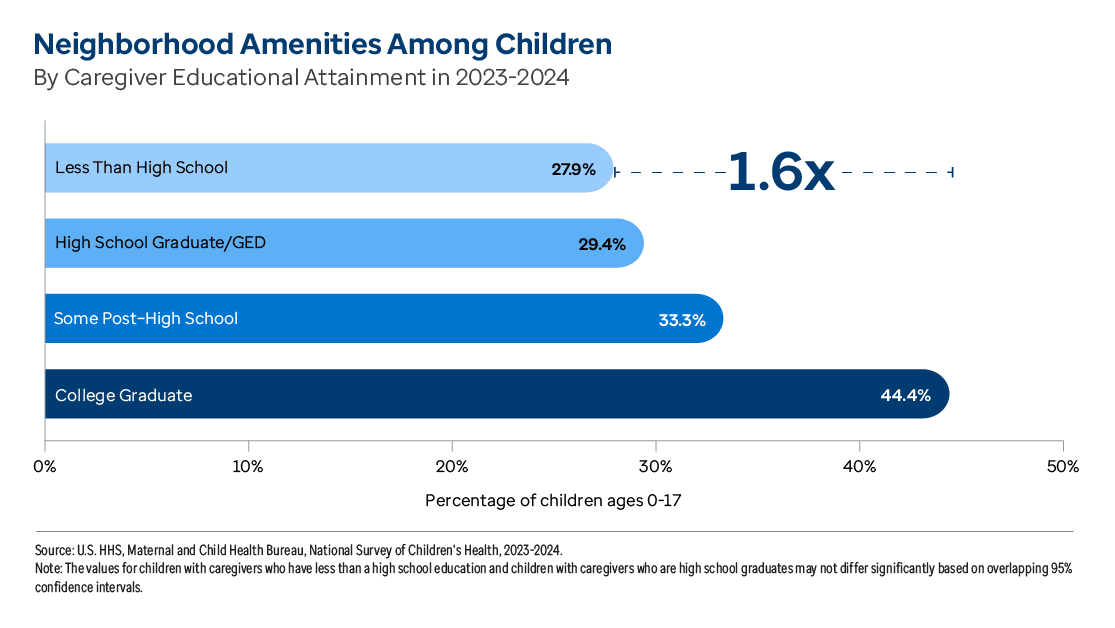
Differences. The prevalence of neighborhood amenities among children varied significantly by geography, race/ethnicity, caregiver educational attainment and special health care needs status in 2023-2024. The prevalence was:
Note: The values for Asian (51.1%) and Hawaiian/Pacific Islander (48.5%) children may not differ significantly based on overlapping 95% confidence intervals. The same is true for American Indian/Alaska Native (29.8%) and white (34.9%) children; and children with caregivers who had less than a high school education (27.9%) and children with a caregiver who graduated from high school (29.4%).
Reading, Singing or Storytelling Among Children
Reading aloud to children was described as the most important factor in developing literacy by the Commission on Reading’s 1985 landmark report
Becoming a Nation of Readers.
48 Research has shown that regularly reading aloud to children stimulates patterns of brain development that strengthen language, literacy and social-emotional skills at a critical age.
49 Other language-rich experiences that benefit brain development and future school success include
talking and singing to young children.
50 Changes over time. Nationally, the percentage of children ages 0-5 whose family members
read, sang or told stories to them every day during the past week increased 5%, from 57.1% to 59.7% between 2021-2022 and 2023-2024. In 2023-2024, nearly 12.9 million children had someone read, sing or tell stories to them every day, an increase of 157,800 children compared with 2021-2022.
Between 2021-2022 and 2023-2024, the prevalence of reading, singing or storytelling significantly increased 6% among
girls (58.4% to 62.0%). During this time frame, reading, singing or storytelling increased 20% in
Virginia (57.4% to 68.8%).
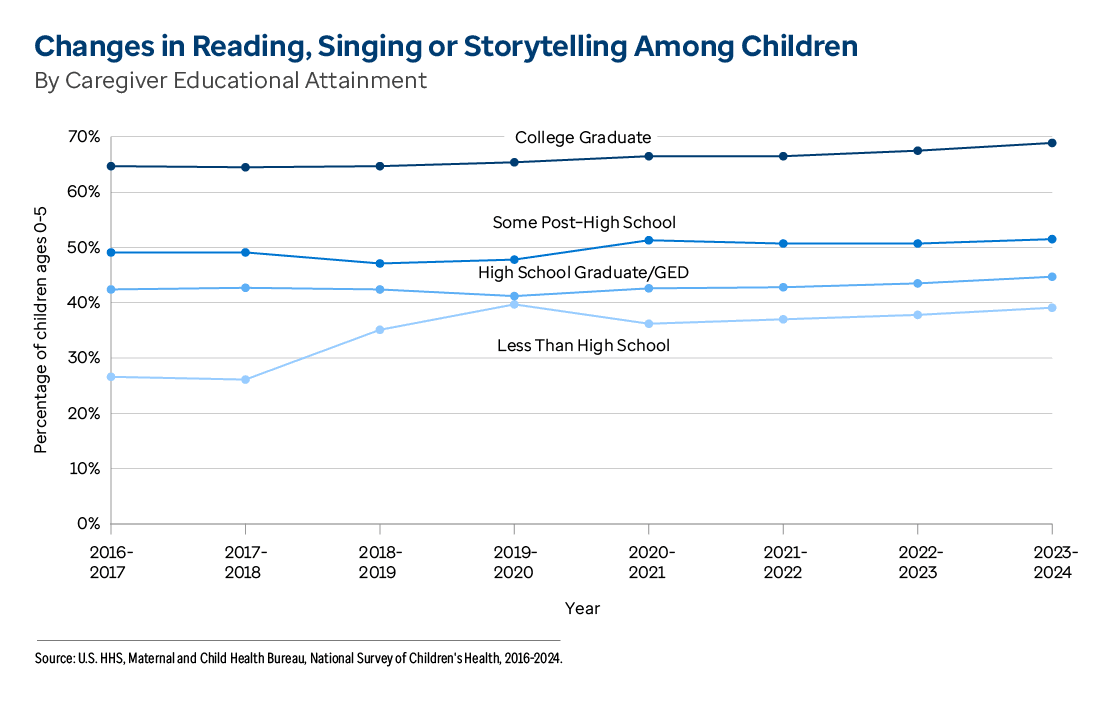
Differences. The prevalence of reading, singing or storytelling varied significantly by race/ethnicity, caregiver educational attainment, geography and gender in 2023-2024. The prevalence was:
Note: The values for white (67.6%) and multiracial (67.2%) children may not differ significantly based on overlapping 95% confidence intervals. The same is true for Hawaiian/Pacific Islander (34.8%), American Indian/Alaska Native (43.7%), Black (46.5%), Asian (49.1%) and Hispanic (50.8%) children.
Early Childhood Education
Evidence suggests that early childhood education, combined with higher educational attainment, contributes to improved health and promotes health equity.
51 Typically, children who attend early childhood education programs have reduced rates of teen births and teen crime, improved standardized test scores and increased high school graduation rates.
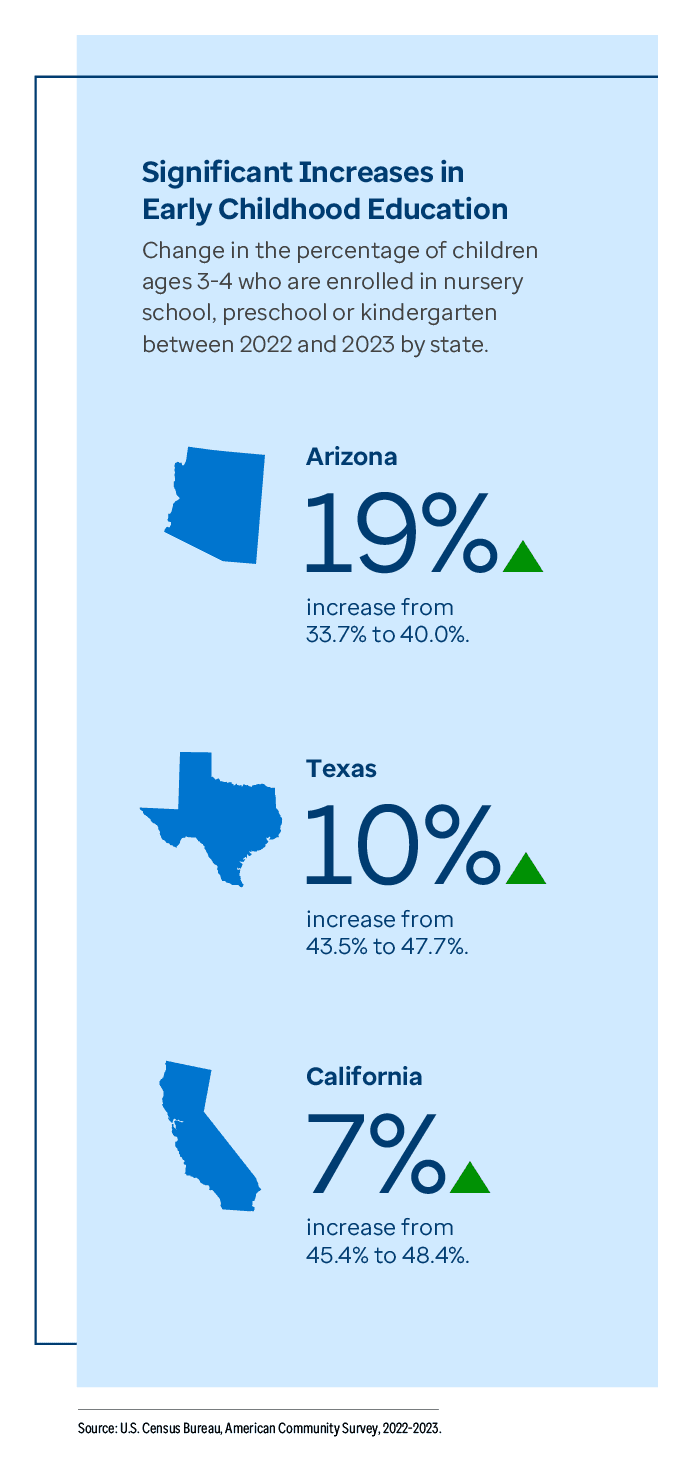
Changes over time. Nationally, the percentage of children ages 3-4 who were
enrolled in nursery school, preschool or kindergarten increased 4% from 46.7% to 48.5% between 2022 and 2023, returning to pre-pandemic levels. This means over 95,100 additional children ages 3 and 4 were enrolled in nursery school, preschool or kindergarten.
The rate of early childhood education enrollment increased in three states between 2022 and 2023: 19% in
Arizona (33.7% to 40.0%), 10% in
Texas (43.5% to 47.7%) and 7% in
California (45.4% to 48.4%).
Chronic School Absenteeism
Chronic absenteeism is defined as missing 10% or more of the school year, whether the absence is excused or unexcused.
52 Research has found that chronic absenteeism is
strongly associated with falling behind academically, becoming socially disengaged and dropping out of school.
53 Nationally, the percentage of public school students who missed 10% or more of their school days in an academic year was 27.8% in 2022-2023, representing approximately 13.4 million students.
Fourth Grade Reading Proficiency
Fourth grade reading proficiency is an important
indicator of adequate educational development.
54 By the time a child reaches fourth grade, they are expected to be able to read
to learn other academic subjects.
55 If a child is not proficient in reading by this age, it becomes harder for them to succeed academically.
During this time frame, fourth grade reading proficiency decreased by the national change (5%) or more in 27 states. The largest decreases were: 18% in
Nebraska (34.0% to 28.0%), 16% in
Arizona (31.4% to 26.4%) and 15% in
Florida (39.0% to 33.0%).
Over the same period, fourth grade reading proficiency increased 5% or more in 10 states and the District of Columbia, led by: 12% in the
District of Columbia (26.5% to 29.6%),
Nevada (26.9% to 30.0%) and
Louisiana (28.3% to 31.8%); and 10% in both
West Virginia (22.3% to 24.6%) and
Maryland (30.6% to 33.6%).
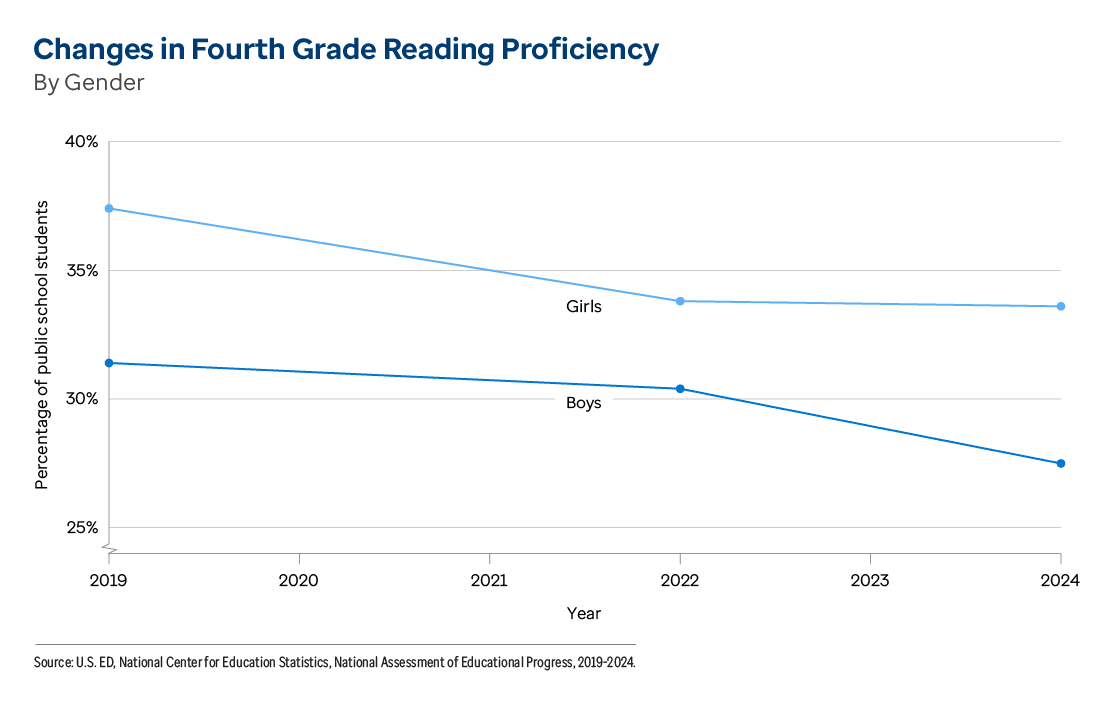
Differences. In 2024, fourth grade reading proficiency varied by race/ethnicity, geography and gender. The prevalence was:
- 3.4 times higher among Asian (52.3%) compared with American Indian/Alaska Native (15.3%) children.
- 2.0 times higher in Massachusetts (40.4%) than in New Mexico (20.3%).
- 1.2 times higher among girls (33.6%) than boys (27.5%).

 US Summary
 Alabama
 Alaska
 Arizona
 Arkansas
 California
 Colorado
 Connecticut
 Delaware
 District of Columbia
 Florida
 Georgia
 Hawaii
 Idaho
Idaho Illinois
 Indiana
 Iowa
Iowa Kansas
 Kentucky
 Louisiana
 Maine
Maine Maryland
 Massachusetts
 Michigan
 Minnesota
 Mississippi
 Missouri
 Montana
 Nebraska
 Nevada
 New Hampshire
 New Jersey
 New Mexico
 New York
 North Carolina
 North Dakota
 Ohio
Ohio Oklahoma
 Oregon
 Pennsylvania
 Rhode Island
 South Carolina
 South Dakota
 Tennessee
 Texas
Texas Utah
Utah Vermont
 Virginia
 Washington
 West Virginia
 Wisconsin
 Wyoming