The United Health Foundation® is proud to release the America’s Health Rankings 2025 Health of Women and Children Report, which provides a comprehensive look at the health of women of reproductive age and children nationwide and on a state-by-state basis.
In 2023, there were approximately 59.5 million
women of reproductive age (18-44) and 72.8 million
children younger than 18 in the United States. Together, these groups constitute a substantial share of the U.S. population, nearly 40%, whose health and well-being are essential to the strength and resilience of communities nationwide.
Women faced challenges across various health outcomes, including mortality, behavioral and physical health measures such as maternal mortality,
depression and
frequent physical distress. There were bright spots in children’s health outcomes, including decreases in
neonatal abstinence syndrome and overweight or obesity. These were offset in part by increases in child, infant and neonatal mortality. For the first time in the history of the
Health of Women and Children Report, infant mortality increased.
The report also examines differences across communities, spotlighting challenges faced by women living in rural areas, who experience higher rates of chronic conditions and risk factors than their metropolitan counterparts. These differences underscore the need for solutions tailored to the unique needs of rural communities.
The 2025 Health of Women and Children Report finds that:
- Child, infant and maternal mortality rates worsened, while the death rate among women of reproductive age continued to improve. This coincided with a plateau in drug deaths among women, which had been steadily increasing since 2014.
- The prevalence of depression and frequent mental distress among women continued to increase, as did diagnosed anxiety among children. However, the prevalence of children receiving needed treatment for attention-deficit/hyperactivity disorder (ADHD) improved.
- Some measures of women’s physical health worsened, such as frequent physical distress and high health status, while obesity or overweight among children improved. Rates of severe maternal morbidity and neonatal abstinence syndrome also improved.
- The poverty rate among women of reproductive age improved, as did the percentage of eligible children receiving USDA's Special Supplemental Nutrition Program for Women, Infants, and Children (WIC).
- Voter participation among women declined, while two measures of social support for children — neighborhood amenities and early childcare enrollment — improved.
- Fewer children were exposed to household smoke.
- More women avoided needed medical care due to cost, fewer women had a dedicated health care provider and fewer children had health insurance.
- The rate of preventive medical visits (well-visits) improved among women and children, but vaccination rates declined.
- Fewer than 1 in 3 women met federal exercise guidelines.
- Chlamydia incidence among women decreased, and the teen birth rate continued to improve.
- Rates of smoking during pregnancy continued to improve.
New in 2025
Users can
explore population data by metropolitan and nonmetropolitan (rural) areas for a variety of measures. For further insights into differences by metropolitan status, look for this icon throughout the Executive Brief and Comprehensive Report.
For details on demographic group definitions and limitations, data sources and methodology, please refer to the
Appendix.
America’s Health Rankings aims to inform and drive action to build healthier communities by offering credible, trusted data that can guide efforts to improve population health and health care. To achieve this, America’s Health Rankings collaborates with an advisory committee to determine the selection of a comprehensive set of measures. The 2025 Health of Women and Children Report is based on:
- One hundred and twenty-five measures. These include 82 ranking and 43 unweighted measures (not included in a state’s overall rank). For a complete list of measures, definitions and source details, see Measures Table - Women, Measures Table - Children and Data Source Descriptions.
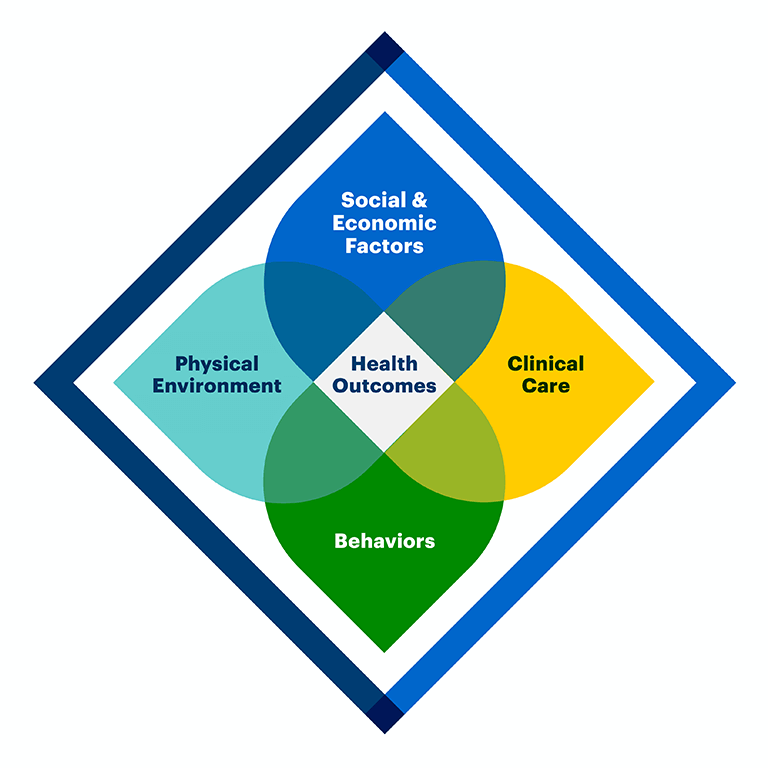
- Five categories of health. These comprise Health Outcomes and four categories of health determinants: Social and Economic Factors, Physical Environment, Behaviors and Clinical Care.
- Thirty-four sources. Data are from multiple sources, including the Centers for Disease Control and Prevention’s Behavioral Risk Factor Surveillance System, March of Dimes, the National Survey of Children’s Health and the U.S. Census Bureau’s American Community Survey.
The America’s Health Rankings Health of Women and Children Report aims to improve population health by:
- Presenting a holistic view of health. This report goes beyond measures of clinical care and health behaviors by considering social, economic and physical environment measures, reflecting the impact of social determinants of health.
- Providing a benchmark for states. Since 2016, the report has presented strengths, challenges and key findings for every state and the District of Columbia. Public health leaders can monitor health trends over time and compare their state’s health measures with those of other states and the nation. State Summaries are available on the America’s Health Rankings website as separate downloads.
- Highlighting differences. The report shows differences in health between states and among demographic groups at state and national levels where data are available, with groupings based on race/ethnicity, gender, age, education, income, metropolitan status, disability status, special health care needs status among children, sexual orientation and veteran status.
- Stimulating action. The report aims to drive change and improve health by drawing attention to trends and promoting data-driven discussions among individuals, community leaders, public health workers, policymakers and the media. States can incorporate population insights into their annual review of programs, and many organizations use the report as a reference when assigning goals for health improvement plans.
Model for Measuring America’s Health
America’s Health Rankings is built upon the World Health Organization’s definition of health: “Health is a state of complete physical, mental, and social well-being and not merely the absence of disease or infirmity.”
The model was developed under the guidance of the
America’s Health Rankings Advisory Council and Committees, with insights from other rankings and health models, particularly
County Health Rankings & Roadmaps and
Healthy People. The model serves as a framework across all
America’s Health Rankings reports for identifying and quantifying the drivers and outcomes that impact state and national population health.

 US Summary
 Alabama
 Alaska
 Arizona
 Arkansas
 California
 Colorado
 Connecticut
 Delaware
 District of Columbia
 Florida
 Georgia
 Hawaii
 Idaho
Idaho Illinois
 Indiana
 Iowa
Iowa Kansas
 Kentucky
 Louisiana
 Maine
Maine Maryland
 Massachusetts
 Michigan
 Minnesota
 Mississippi
 Missouri
 Montana
 Nebraska
 Nevada
 New Hampshire
 New Jersey
 New Mexico
 New York
 North Carolina
 North Dakota
 Ohio
Ohio Oklahoma
 Oregon
 Pennsylvania
 Rhode Island
 South Carolina
 South Dakota
 Tennessee
 Texas
Texas Utah
Utah Vermont
 Virginia
 Washington
 West Virginia
 Wisconsin
 Wyoming